Best iFetch Too Review: Space, Training and Buying Checks
An evidence-based look at the iFetch Too automatic ball launcher, with practical space checks, training expectations and the limits of a currently unavailable US listing.

iFetch Too Ball Launcher Medium/Large Dogs / 3 standard-size balls / DWH12741
Consider it for
Supervised fetch in a suitable clear area.
Check before buying
US listing unavailable at the dated check; supervision and training remain necessary.
Jump to a section
The direct answer: useful automation with a real owner workload
The iFetch Too is worth considering for a dog that already enjoys returning a standard-sized ball, in a household with a suitable clear play area and an owner willing to supervise and teach the routine. It is a poor match if your goal is entertainment while nobody is watching, or if your available space barely contains a thrown ball.
This review evaluates the documented design and buying considerations. We have not performed a hands-on test, measured launch accuracy or assessed long-term reliability. “Best” here identifies the buying question, not a claim that this machine beats every competitor. The useful decision is whether this particular kind of automation solves a problem in your home.
The verified US Amazon page showed the product as currently unavailable when checked on September 28, 2026. We cannot provide a restock date. Treat the product link as an identity and availability check; do not assume that an alternative appearing above it is the same machine.
Identify the Too model before comparing offers
The checked listing identifies ASIN B018HQTXB0, iFetch Too Automatic Dog Ball Launcher for Medium to Large Dogs, with three standard-size tennis balls. Its product details give item model number DWH12741 and manufacturer iFetch, LLC. The listing’s initial main image shows the white and blue launcher with a dog and blue ball; that verified image appears in the product module.
The original iFetch is a different product. In particular, ASIN B00PG3LWDK resolved to the small-dog launcher using mini balls when checked. A broad search for the brand can therefore lead to the wrong machine. Look for the word Too, the matching identifier and the intended ball size together.
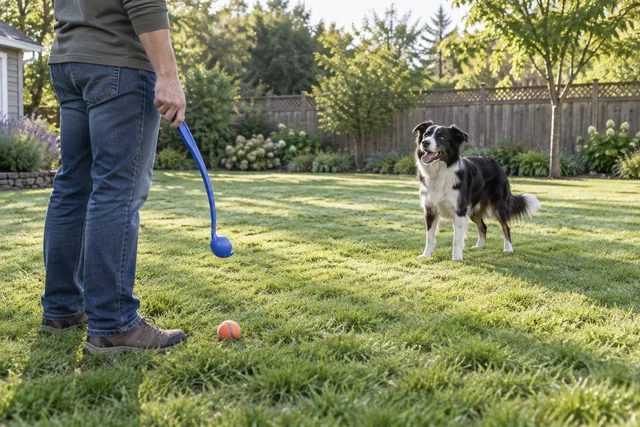
This article covers the iFetch Too family as one review. A different seller, bundle or listing title would not by itself justify a different assessment. The separate cover image is an illustrative backyard scene, not a photograph documenting use or testing of this product.
Product details and buying options

iFetch Too Ball Launcher
Medium/Large Dogs / 3 standard-size balls / DWH12741
Read customer reviews on Amazon ↗
- 10, 25 and 40-foot settings
- Built-in rechargeable battery
- Three approximately 2.5-inch balls listed
Consider for: Supervised fetch in a suitable clear area.
Before you choose: US listing unavailable at the dated check; supervision and training remain necessary.
Product information source · Reviewed 2026-09-28
Check current price, seller and options on Amazon.
Manufacturer product page, manual and US listing checked; this is not a hands-on trial. Affiliate link.
What the documented features actually offer
The manufacturer’s iFetch Too page specifies 10, 25 and 40-foot launch settings, a random-distance option, a built-in rechargeable battery and a carrying handle. It lists three approximately 2.5-inch balls and a charging plug in the package.
The value of those choices depends on your routine. A fixed setting lets you plan around one intended direction and range. Portability lets you choose where to set up rather than organising every game beside the same outlet. Neither feature determines whether the place you choose is appropriate for a running dog.
For someone who likes shared fetch but finds repeated throwing inconvenient, the machine may change the physical task. You still choose the location, manage the session and deal with returned balls. Think of the purchase as a different way to run a familiar game, with equipment preparation added to the job.
Evaluate the whole play area, not just the distance label
Measure the usable area before putting the launcher on a shopping list. An advertised throw distance describes a launch setting, not the complete space occupied by a moving dog. A ball can travel beyond its first landing point, while the dog needs room to approach, turn and return. We have not measured a universal clearance allowance for this machine.
Sketch the intended direction on paper and mark doors, furniture, planting beds, fence corners and places where another person might enter. Then consider the route back to you. A long but narrow strip of grass may offer a less workable game than its length suggests. A passage used by other household members is especially difficult to keep clear.
The owner’s manual calls for level placement, a clear ball path and nobody directly in front. It warns against aiming toward breakable objects and operating a wet machine or using it in rain. Those restrictions matter even when a retailer calls the product suitable for outdoor use.
A sensible buying decision starts with a real location that meets the instructions. Do not buy first and hope to create the space later. If the only possible route crosses a busy doorway or ends at glass, choose a different activity for that area.
Ball compatibility and dog suitability are separate questions
The manufacturer’s FAQ describes the Too as the standard-ball option, generally aimed at medium to large dogs. It gives the supplied ball diameter as 2.5 inches. Its broader compatibility guidance does not establish that every ball which fits the opening is suitable for every dog.
Check the actual ball and your dog’s established play habits before treating breed size as an answer. A dog that retrieves a ball and releases it presents a different situation from one that settles down to dismantle it. If ball choice is uncertain, resolve that question with an appropriate professional rather than using the machine’s opening as a safety test.
Budget for replacing worn play items as well as purchasing the launcher. Keep compatible balls organised separately from unrelated toys so that someone joining the game does not make an accidental substitution. A box labelled for this machine can be more useful than a mixed basket beside the door.
Our related ball reviews discuss their own products; a link to one is not a compatibility endorsement for this launcher. Matching approximate diameter alone does not prove identical weight, surface behaviour or suitability. We have not tested third-party balls in the iFetch Too.
Expect to teach the routine
The iFetch training guidance recommends gradual introduction and rewarding manageable progress, including calm interest in the unfamiliar equipment. It acknowledges that learning varies. That is a more useful starting point than expecting a dog to understand the funnel immediately after unboxing.
Before buying, ask what your dog already does with a returned ball. Does the dog bring it near you, release it willingly and remain comfortable around unfamiliar objects? These observations help identify the work ahead. They are not a pass-or-fail temperament test, and success in ordinary fetch does not guarantee interest in a machine.
Separate your expectations into observable goals: comfortable presence near the equipment, returning the ball, releasing it where intended and waiting in an appropriate position. If you cannot describe which part is difficult, it becomes tempting to repeat the whole sequence and hope. A qualified reward-based trainer can help when progress is unclear.
Do not place a purchasing deadline on the dog’s learning. A return window is a commercial arrangement, not a training schedule. Consider whether you would still want the product if you remained the person loading each ball. If the answer is no, the buying risk is greater than an attractive demonstration video suggests.
Supervision remains part of every session
The manual requires supervision, warns against hands or a pet’s body inside an active or standby machine, and says to switch it off when rest is needed. It also explains that indicator lights can go dark while the machine remains in standby. Darkness at the controls should not be treated as proof that the launcher is off.
In a shared household, decide who is responsible before the game starts. An owner reading nearby and another person assuming they are watching can create a gap in attention. A clear handover is better: one person manages the equipment and ends the session before walking away.
Do not use enthusiasm as a reason to keep a game going indefinitely. We cannot prescribe an exercise duration for your dog from a product listing. If your dog has an exercise restriction or you are uncertain about suitability, discuss the proposed activity with your veterinarian before making it part of the routine.
Ownership includes storage, charging and troubleshooting
A launcher occupies more of a routine than the few seconds when a ball leaves it. Decide where it will live between games, where the supplied charger will be kept and who will notice that a ball needs replacement. If storage requires balancing it on a crowded shelf, reconsider that plan before delivery.
The manual says to store the machine indoors in a dry location after play. It also warns that wet or dirty balls can affect launches. Its cleaning section contains conflicting directions about power and the mechanism; we would ask the manufacturer for clarification rather than reproduce a powered internal-cleaning procedure here.
That unresolved care detail is a real limitation of the available documentation. This review does not provide dismantling, wheel-cleaning or repair instructions. Save the supplied guide and identify the exact unit if you need support. Do not assume that advice for the smaller original iFetch applies to the Too.
We have not verified runtime under a repeatable test, sound level, charging performance over time or repair-part availability for an individual shipment. These gaps matter more to a buyer planning frequent use than to someone exploring occasional supervised play. Ask specific questions about the intended workload instead of relying on a general durability adjective.
When a simpler fetch option makes more sense
If you enjoy choosing each throw and moving around with your dog, a machine may add little to the game. It introduces an object to position, charge and store, while the main pleasure of the activity may already be the interaction. Keep the existing routine if there is no clear problem to solve.
A manual launcher is a different decision because a person initiates every throw. Our Chuckit Classic 26M review covers one such design. This comparison is about the kind of interaction, not a claim that either product is universally safer, easier or more durable.
For a household short on clear space, buying a shorter-distance setting does not automatically fix the layout. You may get more value from a different supervised activity that already fits the room. Avoid choosing a large piece of equipment solely because it looks like a technological upgrade.
Questions to resolve before an order
Confirm the actual seller, condition, included charger and balls, and the identifiers on the offer. The checked listing was unavailable, so a later offer needs a fresh review. A used unit and a new boxed unit should not be evaluated as though their condition and included accessories were necessarily identical.
Read the return terms attached to the specific offer, including any restrictions after use. Keep the receipt and packaging while checking that the delivered item matches the order. Manufacturer-site return terms should not be assumed to govern a purchase made through another seller.
Finally, write down the reason you want automation. “Less repetitive throwing during shared play” is a concrete objective. “My dog will entertain itself whenever bored” relies on several assumptions this review cannot support. A clear objective makes it easier to judge whether the product is worth its cost to you.
Frequently asked questions
Is this the small iFetch? No. This review identifies the Too model and ASIN B018HQTXB0. Check the exact page rather than buying by brand name alone.
Does it replace supervision? No. Plan for an owner-managed game and read the complete supplied instructions before use.
Can every dog learn to reload it? We cannot promise that. Consider the purchase acceptable only if the likely training effort, including the possibility of continued owner loading, fits your expectations.
Is the Amazon listing available now? It showed unavailable at our dated check. Recheck the current offer; this article does not predict replenishment.
What is the final verdict? Consider the iFetch Too when the space, ball choice and shared-play routine already make sense. Postpone buying when you still need the machine itself to solve those underlying questions.