
How to Check Dog Travel Paperwork for a U.S. Road Trip
Match your route and entry dates to official requirements, coordinate with your vet, and verify the right documents before driving with your dog.
Jump to a section
Direct answer: check the route before collecting forms
To check dog travel paperwork for a U.S. road trip, write down your route and entry dates, open the receiving states’ official animal-entry instructions, and confirm which requirements apply to your dog and purpose of travel. Share those findings with your veterinarian early. Then match each required document to its issuer, timing, accepted format and recipient before departure.
The useful result is a verified requirements list, not simply a thick folder. A vaccination record, a certificate of veterinary inspection and a hotel confirmation answer different questions. Having one does not establish that the others are unnecessary. This guide provides an administrative checking workflow for owners driving with their own dogs; it does not certify eligibility, prescribe care or cover international border crossings, air travel or commercial animal transport.
Step 1: describe the actual journey
Create a brief itinerary with the starting location, states entered, overnight stops, arrival dates and return route. Include a possible alternate route if it is already part of your plan. A round trip can involve different entry dates in each direction, so the outbound destination alone is an incomplete description.
Record who accompanies the dog and whether ownership remains unchanged. Do not choose a category such as adoption, sale or rescue transport merely because a form is easier to find. A trip to visit relatives with your existing family dog and a journey to collect a newly adopted dog may fall under different instructions.
Give the itinerary a version date. If a stop moves or the route changes, update that version before asking someone to check it. Otherwise, a veterinarian may be planning around Tuesday’s arrival while your latest reservation shows Friday. Keep uncertain stops marked as tentative rather than presenting them as confirmed.
For states you only drive through, look for transit instructions and ask the relevant authority when the wording is unclear. Do not assume that a short visit, a quick fuel stop or remaining inside a vehicle automatically creates an exemption. The question to resolve is how the official rule applies to your described movement.
Step 2: start with the correct government source
The USDA APHIS interstate pet-travel page explains that receiving states and territories set domestic movement requirements for pets traveling with their owners. It provides a destination selector and directs unresolved questions to the receiving state’s animal health official. APHIS also advises contacting your veterinarian as soon as travel details are known.
Use that route to reach the state’s animal-health or agriculture website. Read the page for dogs or small animals, not an unrelated livestock chart. Save the full page address and the date you checked it. Search results can help locate a page, but their short excerpts may omit the qualification immediately above a rule.
Keep government entry requirements separate from private business policies. A hotel employee can explain that property’s document request; their answer does not establish state entry eligibility. Likewise, a state page does not confirm that a boarding facility has accepted your reservation or its required records.
If the official link is broken, return to the agency’s main website and use its published contact channel. Avoid treating a travel blog, an old forum answer or a search summary as the missing authority. Put the unresolved item on your list until you have a usable official source.
Step 3: read conditions and alerts together
Read the whole applicable section, including headings, exceptions and current alerts. Look for distinctions involving origin, recent travel, age, ownership changes or the kind of movement. These details are reasons to seek clarification, not an invitation to select whichever paragraph is least demanding.
For example, Washington’s small-animal import page, when checked for this guide, displayed an emergency-rule section addressing New World Screwworm alongside a separate section for animals outside affected areas. This illustrates why reading only a familiar exemption further down a page can miss relevant conditions. Consult the current alert and authority for your itinerary; this example is not a determination about your dog’s entry.
Write a short applicability question when two sections seem inconsistent. Include the route, dates and the exact section titles. Asking which section governs those facts is more useful than asking whether dogs generally need papers. Save the answer with its source and date, and flag any facts that the answer assumes.
Do not translate an animal-health alert into a home treatment plan. If the instructions raise examination, vaccination, testing or treatment questions, take them to your veterinarian. The document-checking task is to identify the requirement and responsible professional, not to improvise a medical substitute.
Step 4: distinguish possession from submission
A rule may concern having a document, obtaining it from a specified professional, carrying it during travel or sending it to a named recipient. Those are separate actions. Read the verb and recipient carefully before deciding what is complete.
The California CDFA dog-CVI submission page provides a useful example. It distinguishes dogs entering for a change of ownership from dogs traveling or moving with their existing owners, and says the latter do not need a CVI submitted to CDFA under that submission instruction. That statement concerns submission to the agency; it should not be expanded into a claim that every dog has no other entry requirements.
In your notes, create separate entries for document required, document carried and document submitted whenever the official instructions distinguish them. If someone else handles submission, identify who does it and how completion will be confirmed. A copy in your email inbox alone does not demonstrate delivery to another recipient.
Avoid forwarding records speculatively to every address on an agency website. First establish whether submission is required for your circumstances and what channel the authority specifies. This keeps your task focused and avoids exposing personal information through an unnecessary transmission.
Step 5: build a requirement-to-evidence checklist
Use one row or note per requirement. Include the state or organization, applicable trip segment, official source, question resolved, required evidence, responsible person, deadline and current status. The status can be unknown, awaiting clarification, appointment arranged, document received or checked. These labels make unfinished work visible.
For a hypothetical item requiring a veterinary document, your note might read: destination entry on the planned date; current official instructions saved; clinic asked to confirm issuing requirements; appointment pending. That is an honest working record. Do not mark it complete merely because a clinic visit appears in your calendar.
Record exact timing language from the relevant instructions in your private checklist, then ask the issuer to confirm how it applies to the trip. Distinguish examination date, issue date, submission deadline and entry date. Do not apply a commonly repeated ten-day or thirty-day window to every state or document.
Use a separate unresolved-questions column. For example: whether an electronic copy is accepted, whether a changed return date affects the document, or whether a specific transit condition applies. Assign each question to the authority or issuer that can answer it. A checklist is useful because it exposes these gaps before the car is packed.
Step 6: coordinate with the issuing clinic
Send the clinic your current itinerary and links to the official instructions through its agreed channel. Explain the purpose of the trip and ask whether it can issue the required paperwork, what existing records it needs and when an appointment should occur. Let the clinic confirm professional requirements rather than assuming every routine appointment provides travel certification.
If records are held elsewhere, arrange their transfer early enough for the clinic to review them. Our guide to transferring dog records covers that separate task. A clinic receiving historical records is still different from a professional completing a current travel document.
Ask what you should expect to receive after the appointment and whether the clinic handles any required transmission. Note the expected delivery method and whom to contact if the document has not arrived. Do not request backdating or edit a professional’s signed record yourself to fit a changed itinerary.
If the timing cannot be met, discuss the available options with the clinic and relevant authority before relying on the trip plan. Record the actual outcome, even if it means a document remains unavailable. The purpose of checking early is to discover a practical problem while there is still time to address it.
Step 7: verify the finished documents
When a document arrives, compare the dog’s identifying details and the listed travel information against the itinerary and clinic records. Check for missing pages, unreadable scans, an incorrect owner contact or a date that differs from what you discussed. Ask the issuer to correct errors; keep the corrected version clearly identifiable.
Review the evidence against each checklist item rather than checking only that a file exists. A receipt for an appointment and the document produced at that appointment are not interchangeable. If a requested certificate is absent, contact the clinic through the established channel instead of assuming the receipt will serve the same purpose.
Confirm the accepted format with the relevant recipient where instructions are unclear. Keep accessible copies in the form actually requested. A phone screenshot may cut off a signature, attachment or document number; inspect the whole saved file before departure. Retain originals when instructed and protect them from moisture or accidental loss.
Store the travel set privately and give access only to the people who need it. The driver should know where it is, but a public sharing link is unnecessary. This is a limited set for the journey, not a reason to publish the dog’s entire medical history or household identification documents.
Step 8: recheck changes before leaving
Reopen the official pages near departure and review any new alerts against the latest itinerary. A saved page proves what you read earlier, not that the instructions can never change. If the route, entry date or purpose changes, revisit the affected checklist rows and seek clarification where needed.
Make the final handoff concrete: which documents are ready, which person carries them and which unresolved item still needs an answer. Test that the intended files open on the device you will use, and keep the required physical copies accessible. Avoid burying essential paperwork underneath luggage that cannot easily be reached.
The benefit of this method is traceability: each task connects a specific trip fact with a source and evidence. Its limitation is equally clear. A tidy checklist does not grant entry, replace official interpretation or establish that a dog is medically fit to travel. Keep those decisions with the responsible authority and veterinarian.
Frequently asked questions
Does every U.S. road trip require the same health certificate? Do not assume a nationwide form or time window. Check the receiving states’ instructions for your circumstances and confirm the issuing process with your veterinarian.
Is a rabies tag the same as a vaccination certificate? Treat them as different items. If instructions request a certificate or record, verify the specified evidence rather than substituting a tag without confirmation.
What if I am only passing through a state? Look for applicable transit wording and ask the state animal health authority if it is unclear. Describe your route and stops accurately.
Can a hotel approve all my paperwork? It can explain its own requirements. Keep government entry checks and the hotel’s document requests as separate checklist items.
Can I reuse documents from a previous trip? Check their identity, scope and timing against the new itinerary. Prior use alone does not establish current acceptance.
Sources and related reading
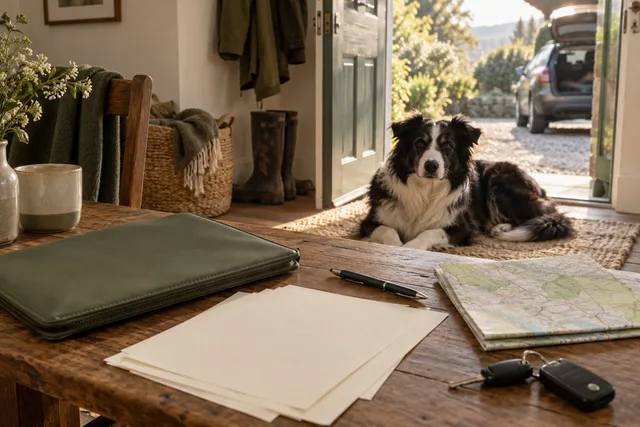
Official sources checked October 11, 2026: USDA APHIS interstate pet travel, Washington small-animal import instructions and California CDFA dog-CVI submission guidance, linked in the relevant sections. State examples illustrate how to read conditions; they are not an exhaustive entry checklist. The organization workflow is editorial guidance, and the cover is an illustrative scene.
For separate preparation tasks, see packing for an overnight stay, transferring veterinary records and organizing adoption paperwork.