Best for an Open Food Cup? SodaPup Honey Pot Review
Assess the Large yellow Honey Pot as an open food cup, with verified US identity, material wording conflicts, cleaning claims and clear performance limits.
SodaPup Honey Pot Large / Yellow reference / SPT-HP1-700
Consider it for
A specific supervised open-cup food-toy routine.
Check before buying
No verified duration or wear results; material and detail specifications conflict.
Jump to a section
Direct answer: an open cup, with important listing questions
The SodaPup Honey Pot is worth considering if you specifically want an open-top food toy rather than a narrow-neck dispenser or a moving dry-food puzzle. Its buying case rests on the accessible cup shape and the manufacturer’s stated cleaning options. It is a weaker choice if you need a guaranteed occupation time, a toy to leave unattended or fully reconciled retailer specifications.
This review concerns the Honey Pot family, using the yellow Large US listing, model SPT-HP1-700 and ASIN B0CVQDP91Z, as the purchasing reference. We have not handled, filled, washed or chew-tested it. The assessment separates published information, visible design and our buying judgment; no star rating, current price or owner anecdote is used as evidence of performance.
Product details

SodaPup Honey Pot
Large / Yellow reference / SPT-HP1-700
Read customer reviews on Amazon ↗
- Open-top cup format
- Published Large body: 3.25in tall and diameter
- Maker specifies top-rack dishwasher care
Consider for: A specific supervised open-cup food-toy routine.
Before you choose: No verified duration or wear results; material and detail specifications conflict.
Product information source · Reviewed 2026-10-21
Check current price, seller and options on Amazon.
US identity and initial MAIN directly checked; no hands-on testing. Affiliate link.
What the specific listing establishes
The US Amazon page identifies SodaPup, the Honey Pot name, model SPT-HP1-700 and ASIN B0CVQDP91Z. Its feature text describes the Large as 3.25 inches tall and 3.25 inches in diameter. The initial main image shows a single yellow pot with an open top, raised honey-like decoration and a bee motif. That is the actual listing image used in the product module.
We did not use a search-result image as proof of the product. Nor did we select an independent size or color control: none was present in the inspected page layout. The Large description and yellow photograph are the evidence for this reference item. If the linked page later presents a different selection, compare its identifying details before ordering.
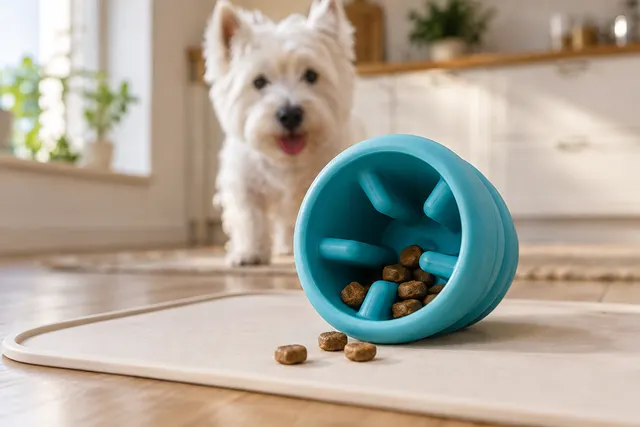
The cover above is a separate illustrative home scene. It does not show the Honey Pot, establish its scale beside a dog or demonstrate a successful feeding session. Keeping the product photograph and the general scene separate makes it easier to see what each image can actually tell you.
The strongest feature is access from above
The visible open top changes the buying question. Instead of asking whether food can pass through a small dispensing hole, ask whether you want your dog working from an exposed cavity. You can see into the opening and approach it from above. That is a design observation, not a measurement of how easily a particular dog will reach the contents.
An open cup also leaves the food less enclosed than a narrow-opening toy. We would not choose it on the assumption that it meters out individual pieces or contains loose contents when tipped. Those outcomes depend on the actual setup, and we have not tested them. If predictable dry-food dispensing is your main goal, start with that requirement rather than the attractive pot shape.
This distinction matters when comparing toys that are all described as enrichment products. A shared marketing category does not mean a shared activity. The Honey Pot’s appeal is the cup format itself; it does not need an unsupported claim about a dog’s emotions or behavior to explain why someone might prefer that format.
Material wording needs a careful reading
The manufacturer’s Honey Pot page describes PUP-X synthetic rubber. Amazon’s feature text also identifies PUP-X as synthetic, while the listing title says natural rubber. Those statements are inconsistent. We use the more specific PUP-X description and keep the title conflict visible rather than presenting natural rubber as a settled fact.
This is especially relevant if material composition is a deciding factor for you. A title keyword is not enough to resolve a formulation question. If you require a particular material, obtain clarification for the item you would receive before buying. We have not performed material analysis or obtained a separate composition certificate.
Do not read a food-safe or durability claim as proof that a dog can consume the toy. A product’s intended use and the condition of the actual item still matter. The material label helps identify the product; it does not supply a personalized assurance about chewing, swallowing or suitability for an individual dog.
Dimensions and weight are not fully reconciled
The manufacturer’s Large description and Amazon feature text agree on the nominal 3.25-inch height and diameter. However, Amazon’s product-details block displays 10 by 8 by 6 inches and 6.1 ounces. A separate manufacturer family page lists the Large weight as 6.4 ounces. We have not reconciled these entries.
It would be convenient to call the larger dimensions packaging measurements, but the inspected detail block does not establish that explanation. We therefore do not relabel them. Use the clearly identified Large body dimensions as the published reference, and seek clarification if an exact measurement or weight affects your purchase.
The size name also does not establish mouth fit. Large is a product variant, not an assessment of your dog. Before buying, consider how you will judge the toy in person and what you will do if its size or condition is unsuitable. Choosing a different color does not resolve a dimensional uncertainty.
Capacity is useful, but not a feeding instruction
SodaPup gives the Large a stated capacity of 7 ounces. Treat that as a product specification, not a recommended portion or a nutritional calculation. It does not establish how much of a particular food your dog should receive, or how that amount fits an existing feeding plan.
For a purchasing comparison, capacity can help you decide whether the physical format seems relevant. It cannot substitute for the dimensions, the opening shape or your own requirements. A cup that sounds ample on paper may still be the wrong activity if your goal is a rolling dispenser, and a smaller amount of food does not necessarily make a toy easier to use.
We do not provide fillings, recipes or freezing-time prescriptions here. A manufacturer’s list of possible ingredients is not evidence that every listed food suits every dog. Keep any dietary restrictions and professional care instructions separate from the product’s marketing. Buy the container for a defined task, not for an implied meal plan.
Cleaning is a real part of the buying decision
SodaPup describes the Honey Pot as freezer safe and top-rack dishwasher safe. Amazon’s feature text also specifies the top rack. Those are published care claims, not results from our own wash-cycle testing. Follow the instructions supplied with the actual item and resolve any difference before using a method you are unsure about.
The open top appears to offer access for visual inspection of the cavity. That may make the format attractive if you dislike working through a narrow neck. It does not establish that every residue will rinse away, that a particular brush will reach every surface or that a single dishwasher cycle will always finish the job.
Consider the whole routine: where the used toy will wait, how you will clean it, how you will inspect it and when it will be ready again. If that routine is inconvenient, the product may see little use regardless of its shape. Do not purchase extra units simply to avoid deciding whether the maintenance fits your household.
Durability language does not answer the supervision question
The brand markets PUP-X for demanding chewing, but we have no measured wear results for this Honey Pot. We cannot tell you how many sessions it will last, how its rim will respond to a particular dog or whether it will remain intact under a specific chewing style. A replacement promise, where applicable, would not establish those outcomes either.
The manufacturer family page advises supervision and removing damaged toys. Plan around observing the actual use and condition, rather than treating a strong material description as permission to leave the dog alone with it. Inspect what you receive and keep the supplied instructions available.
The retailer also makes broad claims about stress, barking and calming. This review does not validate those claims or recommend the pot as treatment for a behavior problem. If that is the problem you are trying to solve, a toy purchase should not replace appropriate professional guidance. Our recommendation is about a physical format and a manageable routine.
How it compares with other food-toy formats
The West Paw Toppl is already covered separately on this site. It is another open-food-toy option, so the Honey Pot should not be treated as a completely new activity merely because it has a different theme. Compare the specific opening, body, care instructions and unresolved listing questions instead of assuming that owning both is necessary.
The KONG Wobbler review concerns an active dispensing game. That is a different starting task from choosing an open cup. If you want a dog to move a dispenser around a suitable space, evaluate that format directly; if you want an accessible filling cavity, compare open formats. We have not conducted a side-by-side performance test.
The West Paw Tux offers another cavity-based design discussed in its own review. These links help narrow the format question. They are not a ranking by durability, cleaning speed or engagement time. There is no measured basis here for declaring one toy the universal winner.
Who should consider it, and who should wait
Consider the Honey Pot if you can name the specific job you want an open cup to perform, accept the published care requirements and can supervise its use. The yellow pot styling may be a pleasant extra, but the practical reason to choose it should survive a change of color. This review covers the family rather than recommending separate purchases for decorative variants.
Wait if material composition is critical and the natural-versus-synthetic title conflict remains unresolved for you. Also wait if the conflicting detail dimensions affect storage, handling or another precise requirement. Those are reasonable purchasing limits, not problems to explain away in order to recommend the product.
Finally, reconsider if your central requirement is a promised number of minutes, unattended occupation or a guaranteed change in behavior. We cannot support those outcomes. An honest buying decision can end with keeping a suitable product you already own rather than adding another food toy with overlapping uses.
Before ordering the reference item
Compare the product identity in the offer with the reference above, especially if a marketplace page combines several sizes or colors. Read the offer’s own return conditions before deciding whether unresolved specifications are acceptable. A familiar photograph alone does not confirm every detail of the item being sold.
On receipt, compare the label and supplied care information with the description you relied on. Keep the packaging information long enough to ask a precise question if something differs. Do not begin by assuming that a discrepancy is harmless or that an unverified substitute shares the same instructions. This is a purchasing check, not an instruction to buy now; the uncertainties described in this review remain part of the decision.
Frequently asked questions
Is this a natural-rubber Honey Pot? The title uses that phrase, but the manufacturer and Amazon feature text identify PUP-X synthetic rubber. The conflict is disclosed rather than resolved by assumption.
Which item does the product button reference? The inspected US listing is B0CVQDP91Z, model SPT-HP1-700, with Large dimensions in its feature text and a yellow initial main photograph.
Is it dishwasher safe? Both inspected product sources specify top-rack care. We have not tested a dishwasher cycle; read the instructions supplied with your item.
Does capacity tell me a portion size? No. Container capacity is not dietary advice.
Is it better than a Toppl? No comparative test supports that claim. Compare the physical format and your actual requirements before deciding.
Verdict and evidence limits
The Honey Pot has a clear reason to be considered: an open cup format with published freezer and top-rack cleaning compatibility. The recommendation is conditional because the listing contains unresolved material, dimension and weight wording, and because no hands-on results establish wear or duration.
Choose it for a specific, supervised food-toy routine after resolving the details that matter to you. Do not buy it for a guaranteed behavioral result or because the honey theme suggests a required filling. The manufacturer’s pages and the inspected US listing support the identity and stated features; the comparisons and buying judgments above are editorial inferences from those features.