How to Plan a Grand Canyon South Rim Visit With Your Dog
Build an above-rim day visit around pet rules, a shuttle-free return and verified service status rather than assumed kennel or lodging availability.
Jump to a section
Direct answer: build a day plan that does not depend on a pet shuttle ride
Plan a Grand Canyon South Rim visit with your dog around permitted above-rim areas and a return route your group can complete without boarding a park shuttle. Keep a responsible person with the dog throughout the outing. Do not add a below-rim hike, indoor stop or overnight stay unless the dog’s care and the actual service arrangements are independently resolved.
Current service notices make that distinction especially important. When this guide was reviewed, the kennel operator reported a closure related to Stage 4 water restrictions, and the Yavapai operator displayed a notice that in-park lodging was closed to overnight guests. A normal pet-friendly description is not confirmation that the service is operating for your dates.
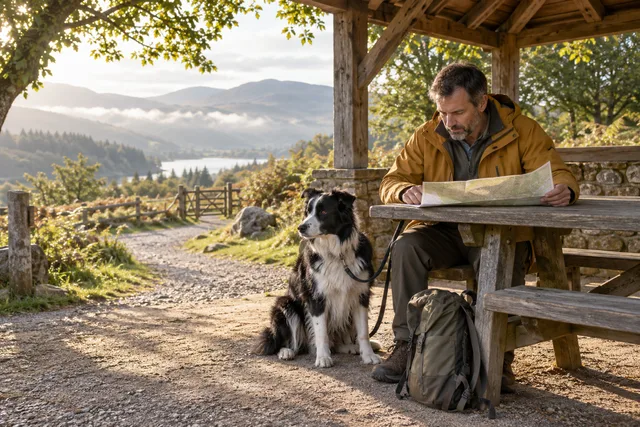
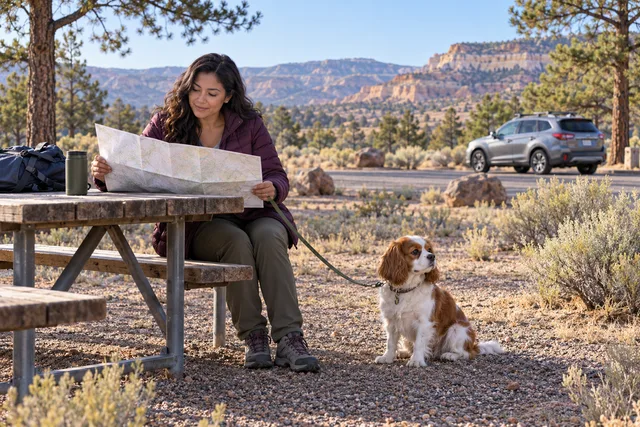
This guide is for an ordinary pet visiting the South Rim. It does not assess a dog’s exercise readiness, supply medical or heat-treatment advice, or promise current access. The independent scene cover is illustrative rather than a photograph of an NPS location or today’s conditions.
First separate the canyon rim from trails descending into it
The park’s official pet page allows leashed pets on South Rim trails above the rim and in developed areas, while excluding ordinary pets from inner-canyon trails. It requires a leash no longer than six feet, waste collection and keeping pets attended. Service-animal access is a separate policy; it should not be used as a workaround for an ordinary pet itinerary.
On your map, mark the above-rim activity you intend to use and identify any junction with a descending trail. A viewpoint near a trailhead does not turn the trail below it into an extension of the pet-permitted walk. The same place name may appear in several different descriptions, so read the actual route rather than relying on the destination label.
Resolve dog care before planning a below-rim activity. If your group cannot provide a workable arrangement, choose a different activity.
A shuttle stop is not a return plan for the dog
The current South Rim shuttle page repeats that pets are not allowed on park shuttle buses. The existence of a bus route beside a walking route therefore does not provide an ordinary pet with a ride back. A carrier, a small dog or an empty-looking bus is not an exception established by the published pet rule.
When reading a suggested human itinerary, look for the moment it switches from walking to riding. That is where an otherwise attractive plan may stop working for your group. Do not copy only the outbound walking distance while leaving the return to an assumed bus connection.
For an out-and-back plan, record the return on foot as part of the outing from the beginning. A turnaround point is a decision about the whole group and conditions, not a challenge to reach the next named overlook. This guide gives no universal distance or time target for a dog.
Nor does it verify private tours, commercial transfers or an informal ride as a substitute. If a different transport arrangement is essential, confirm its actual pet policy and availability separately before relying on it.
Choose a small Rim Trail segment instead of treating thirteen miles as a goal
NPS’s Rim Trail map and guide describes roughly thirteen miles between South Kaibab Trailhead and Hermits Rest, with most of the trail paved. It also identifies narrower dirt sections farther west and warns that winter surfaces can be icy. That overview is useful for understanding variety along the route, not a recommendation to cover the full distance.
Use a current park map to select a limited segment with a clear start and return. Note how you will reach that start without a pet shuttle trip, and keep the car or other confirmed base identifiable in your notes. The full trail’s name can conceal a much larger undertaking than the short section your party wants.
Do not assume that a paved description means every approach, slope or adjacent viewpoint suits each person and dog. If accessibility is important, obtain current segment-specific information from NPS. This guide does not certify a barrier-free route or substitute for the actual conditions at a path entrance.
Keep the plan flexible enough to shorten it. A brief visit at a permitted area can be the complete outing rather than the first stage of an itinerary that has to grow.
Check operating restrictions before using a familiar park itinerary
The park’s alerts and conditions hub links road, weather and service information. The separate operations update showed Stage 4 water restrictions when reviewed, including Trailer Village closure and dry camping at Mather Campground. Those notices demonstrate why normal descriptions of facilities cannot establish current service.
Make this check before committing to a plan and again near departure. Save the relevant current information so your group can distinguish a real service confirmation from a general tourism page. If two pages appear inconsistent, resolve the practical question with the responsible operator rather than choosing whichever statement makes the trip easier.
Keep South Rim information separate from North Rim notices. They concern different access routes and services, and a closure or opening on one side does not establish the status of the other. This article does not propose a rim-to-rim alternative or transfer the South Rim pet permission to another district.
An available map remains useful during disruption, but it is not evidence that every facility printed on it is operating. Treat it as route information that must be read alongside current notices.
Do not rely on the kennel while its operator reports it closed
NPS’s kennel information page describes a facility near Maswik Lodge for dogs and cats, with proof of current vaccinations and reservations recommended. That page’s update date is November 2022. Its ordinary service description does not establish present-day availability.
The actual Xanterra services page stated that the kennel was closed because of Stage 4 water restrictions when checked for this guide. Do not plan to drop off a dog for a canyon hike on the strength of the older NPS hours or a past travel account. Confirm an actual reopening and accepted reservation before making boarding central to a future trip.
If service later resumes, clarify the required records, acceptance conditions and drop-off and collection arrangements directly with the operator. A list of vaccination paperwork is an administrative requirement, not a recommendation to change the dog’s medical care without its veterinarian.
Until a workable care arrangement exists, remove activities that require leaving the dog behind. A closure is a reason to change the itinerary, not to leave the animal in a parked vehicle or tied outside while the group continues.
A pet-friendly room category does not establish an available overnight stay
The Yavapai pet-room page describes designated pet-friendly rooms. However, its operator’s operational updates and page alert said that park lodging was closed to overnight guests under the water restrictions when reviewed. This guide does not treat the standard room description as a current accommodation offer.
For a future stay, verify both that lodging is operating and that the actual reservation is for an accepted pet arrangement. Confirm the pet terms for your dog and travel dates rather than assuming any room at a familiar property will do. A reservation for a person does not automatically answer every question about the accompanying animal.
An operator notice may mention lodging in a gateway community, but that does not establish a particular outside property’s pet policy or vacancy. This guide verifies no substitute hotel and makes no booking or price promise. Check the specific accommodation if an overnight trip depends on it.
A day visit still needs a workable journey and supervision throughout.
Plan human indoor stops without leaving the dog unattended
The pet page says not to leave pets tied or unattended outside or in a vehicle. Build that requirement into ordinary parts of the day, including information gathering, shopping and other indoor errands. Do not treat a short queue or quick purchase as a reason to improvise supervision after arrival.
If your group can split responsibilities, agree on the arrangement before reaching the stop. Identify who stays with the dog, where they may wait and how the group will reconnect. That practical handover matters more than assuming that someone will be able to manage the animal while everyone else goes inside.
If you are traveling alone, choose activities and services that you can actually use with the dog-care constraint intact. This guide does not verify ordinary-pet access to every building, patio, restroom approach or visitor program. Ask about the specific place rather than generalizing from an outdoor path.
Keep the day’s priority clear. An optional shopping or museum stop should not force an unresolved situation for the dog. A shorter itinerary with a workable supervision plan is preferable to a list of attractions whose requirements cannot be met.
Prepare for the conditions without turning gear into a guarantee
NPS highlights heat, elevation and hot pavement as considerations for pets. The practical planning question is whether the actual conditions and the dog’s needs suit the outing, not whether one item in a shopping bag makes the visit appropriate. Discuss individual concerns with the dog’s veterinarian when needed.
Arrange suitable water and ordinary travel supplies for the whole trip, without assuming a particular tap, shop or other service will supply everything on arrival. Water restrictions make the current service check especially relevant. This article prescribes no drinking quantity, temperature threshold, supplement or exercise allowance.
Check the condition and fit of equipment already in use before departure. A new boot or harness should not be selected solely because the destination sounds demanding, and this guide does not claim that protective equipment prevents heat injury or makes a questionable surface suitable.
If conditions or the dog’s response change, retain the ability to stop the activity. The plan should not depend on completing a route simply because you traveled a long way or saved a particular viewpoint to a wish list.
Keep viewpoints, wildlife and other visitors in the same plan
At a busy scenic area, think about the space occupied by the whole group, including the leash. Choose a place to pause without blocking the route or allowing the dog to approach people or animals unexpectedly. Follow signs and on-site directions rather than treating the edge of a photograph as a suggested position.
Do not seek a dramatic dog portrait by moving beyond a permitted barrier or into a questionable location. The visit can be documented from the space your party can use appropriately. An attractive image on social media does not establish permission, stability or a safe route to its camera position.
Keep wildlife encounters observational and avoid attempts to lure an animal closer. If a dog is becoming difficult to manage around activity, change the situation rather than trying to finish the photo or reach the next attraction. This guide does not provide a behavior-training procedure for encounters at the park.
For a broader method of checking a route’s permission and current notices, see our dog-friendly trail-rules guide. The South Rim’s specific transport and operating-service constraints remain the focus here.
Write a final plan that survives a changed service
Before leaving, put the start location, chosen above-rim segment, return arrangement and supervision responsibilities together on one page. Add the source and date of any essential service confirmation. That makes it easier to see whether the day is workable without relying on a shuttle ride, kennel opening or room availability that has not been established.
Identify which optional stop will be dropped first if the outing needs to be shorter. The answer should not require changing the pet rules or finding an unverified last-minute sitter. A simple fallback is valuable only when your group can actually carry it out.
Review the return arrangement with everyone traveling, especially anyone using an itinerary that assumes a bus ride.
FAQ: a South Rim visit with an ordinary pet
Can a small dog ride in a carrier on the park shuttle? No carrier exception is established by the published ordinary-pet rule.
Does an above-rim walk permit a short descent? Do not extend pet permission to an inner-canyon trail.
Is the kennel available as a guaranteed fallback? No. The operator reported it closed when reviewed; verify future service directly.
Does a pet-room page confirm lodging is open? No. Read current operational notices and obtain an actual accepted reservation.
Is this a real-time conditions report? No. Recheck the linked official notices for the day of travel and change the plan when needed.