How to Plan a Dog-Friendly Visit to Great Smoky Mountains
Choose between the Smokies’ two pet-permitted trails, check closures and parking tags, and build an itinerary that respects pet-access boundaries.
Jump to a section
Direct answer: build the visit around the two permitted trails
To plan a dog-friendly visit to Great Smoky Mountains National Park, start with the Gatlinburg Trail or the Oconaluftee River Trail rather than a general list of popular hikes. Confirm current access, choose the entrance that fits your travel plans, arrange parking correctly and keep a pet-appropriate alternative outside the day’s restricted activities. Bringing a dog substantially narrows the park itinerary.
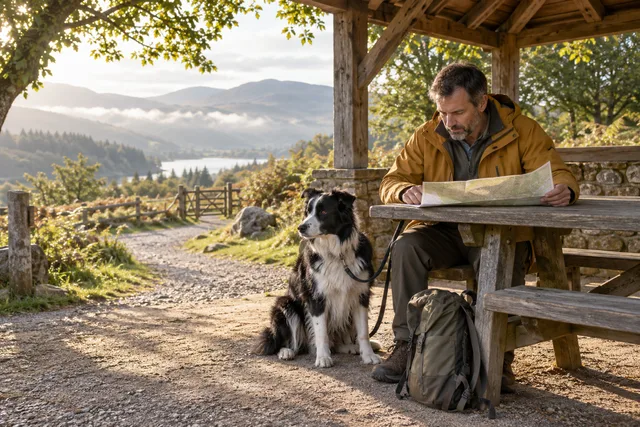
This guide covers planning for an ordinary pet dog. It does not assess an individual dog’s ability, book accommodation or guarantee that a trail, road or parking space will be available. The independent cover is a generic preparation scene, not a photograph documenting conditions at either trailhead. Recheck official information for your actual date before leaving.
1. Understand exactly where an ordinary pet may go
The park’s official pet page permits pets in frontcountry campgrounds, picnic areas and along roads, and names only two pet-permitted trails: Gatlinburg and Oconaluftee River. It requires a leash no longer than six feet, cleanup after the pet and no unattended pets in vehicles or RVs. Use that limited access pattern as the foundation of the trip.
Do not begin with a favorite waterfall, summit or backcountry route and assume a leash solves the access question. A trail can be popular, short or near a visitor center while still being unavailable to ordinary pets. Read the pet policy before investing time in detailed route planning.
Keep the dog with a responsible person throughout any change in plans. A building visit or another activity that excludes pets needs an appropriate arrangement, not an assumption that the dog can wait alone in the car. If that arrangement is unavailable, remove the activity from the shared itinerary.
Service-animal access follows a different framework. Apply the published pet restrictions to an ordinary pet itinerary.
2. Choose one trail area before planning the rest of the day
The two permitted trails begin in different visitor-center areas: Gatlinburg Trail near Sugarlands and Oconaluftee River Trail near Oconaluftee and Cherokee. Choose a base that fits the rest of your trip rather than assuming the two walks belong in one compact neighborhood outing.
Write down the chosen trail, the intended starting point and how you will return to your vehicle or lodging. A named destination is more useful than a note saying walk somewhere in the park. It also makes a closure check more precise because you know which access road, parking area and path matter.
One area can be enough for a visit. Trying to fit both permitted trails into the same day adds travel and uncertainty without creating any extra pet access on the intervening trails. If your main purpose is a manageable walk together, a simpler plan may better serve it.
Separate your group’s must-do activities from its optional ones. If most of the must-do list excludes pets, reconsider bringing the dog for that portion of the trip. The existence of two allowed trails does not make every Smokies holiday a good fit for a dog.
3. Gatlinburg Trail: plan the approach as well as the woods
The NPS Gatlinburg Trail description gives an approximately four-mile round trip between Sugarlands Visitor Center and River Road in Gatlinburg. Near Sugarlands, the route includes sidewalk and roadside before becoming a wider dirt path beyond the maintenance area. It notes uneven surfaces and some steeper sections and does not describe the trail as ADA accessible.
Those details matter when a photograph has led you to imagine an uninterrupted forest stroll. Review the actual start and approach before deciding the walk fits your party. A route name and a pleasant woodland image cannot establish that every segment is suitable for your dog or the people accompanying you.
Record the round-trip nature of the published distance. Do not mistake it for the distance in each direction, and do not turn it into a compulsory target. Choose an appropriate outing length for the actual group and conditions, with enough flexibility to shorten it when needed.
The NPS page also lists alternate hikes. That list is not blanket permission to take a pet onto those alternatives. Cross-check any proposed substitute against the park’s pet policy. Staying within the allowed route is more important than completing an itinerary copied from a general hiking page.
4. Oconaluftee River Trail: account for its surface and wildlife setting
The NPS Oconaluftee River Trail page describes an approximately three-mile round trip from Oconaluftee Visitor Center toward Cherokee. It calls the route relatively flat, wide and graveled, while noting occasional roots, rocks and larger gravel. It also identifies the area as elk habitat and directs visitors to stay fifty yards from elk and wildlife.
Treat a relatively flat description as useful context, not a promise of a uniformly smooth surface or an individual accessibility assessment. Read the detailed page and consider the actual party’s needs. A dog comfortable on one type of path may still need a different plan in a busy wildlife setting.
Do not make an elk encounter a scheduled attraction for the dog. Wildlife presence can change what is appropriate at the moment. If an animal is near the route, keep distance and follow current ranger directions rather than trying to preserve the planned photograph or walk length.
The trail being near a visitor center or museum does not extend pet permission into every adjacent facility or attraction. Keep the walking route and any separate building visit as distinct decisions. If one person needs to go inside, plan how another responsible adult will remain with the dog in a permitted place.
5. Check closures with the actual route names in hand
Use the park’s Current Conditions page to reach current road, facility and trail alerts. It explains that these places can have warnings or closures and that weather can differ with elevation. This article does not certify a route as open on the day you read it.
Make the check specific. Look for the chosen trail, its visitor-center access and roads needed to reach it. A broad statement that the park is open does not establish that every part of your planned visit is available. Conversely, a closure elsewhere should not be casually interpreted as closing every permitted pet area.
Save the relevant official links and a map before traveling, and review changes close to departure. A screenshot records what you saw at one time; it cannot update itself. Include the time of your check in your notes so that another person does not mistake an older status for a fresh confirmation.
Have a stopping rule for uncertainty. If you cannot confirm the needed access, choose an alternative whose rules you can establish or postpone that part of the outing. A closure is not a reason to move onto a different park trail with the dog simply because it appears nearby on a map.
6. Plan the parking tag separately from the walk
The park’s Fees and Passes page says a parking tag is generally required for vehicles parked longer than fifteen minutes, with listed exemptions and special dates explained there. A physical tag must be displayed; a digital image is not a substitute. The tag must match the vehicle’s plate, and an America the Beautiful entrance pass does not replace it.
Check the rules for your visit date and vehicle before setting out. This guide does not purchase a tag, claim an exemption or guarantee a current fee. If buying ahead through an official route, follow its actual printing and display instructions rather than assuming park staff will complete that step for you.
A parking tag does not reserve a space. Keep the parking requirement and space availability as two separate questions in your plan. If a lot is full, use a lawful, permitted alternative or change the itinerary; possessing the tag does not authorize improvised roadside parking.
The dog-care arrangement matters during this errand too. Do not rely on leaving the dog unattended while someone handles the tag or asks a question inside. Arrange responsibilities beforehand so the practical steps of arrival do not create an avoidable gap in supervision.
7. Build an itinerary with clear handoffs and an exit option
Create a simple sequence: arrive at the chosen area, complete the parking steps, check posted information, take the suitable permitted walk and return to a place where the entire party is welcome. Keep optional detours outside that core sequence until their pet rules are confirmed.
Assign responsibilities if traveling with others. One person can handle navigation or a brief information stop while another remains with the dog in a permitted location. Agree on where to meet again and avoid assuming someone else has taken over the leash. This is especially useful when a group splits between pet-permitted and pet-excluding activities.
Allow the visit to end early. If the area is too crowded, access changes or the dog is not coping well, a shorter visit can be the appropriate result. The time spent traveling or obtaining a parking tag does not create a duty to complete the advertised trail distance.
For overnight plans, confirm the exact accommodation or campground arrangement separately. A business described generally as pet-friendly can still have specific conditions. No lodging, boarding, shuttle or restaurant policy has been verified by this guide, and no park pet rule automatically establishes a private property’s permission.
8. Prepare supplies around the permitted activity
Bring the dog’s familiar essentials for the planned outing, including suitable leash equipment, cleanup supplies and its established water arrangement. This guide does not prescribe a universal amount of water, an exercise duration or preventive treatment. Plan those needs for the individual dog and actual conditions, seeking veterinary guidance where relevant.
Keep the leash setup capable of meeting the park’s stated limit. A long retractable lead does not become appropriate simply because you intend to shorten it when someone approaches. Check the working arrangement before arriving so that crowd management and compliance do not depend on a last-minute adjustment.
Organize the human supplies too: official information, navigation, parking documents where required and a way to carry out what you brought. The best pack list supports the limited shared activity; it should not encourage a more ambitious route merely because you brought extra equipment.
Avoid using a new destination as the first trial of unfamiliar gear or an entirely new routine. A more familiar setup can make it easier to distinguish a planning problem from an equipment problem. If something essential is missing or unsuitable, revise the outing rather than hoping the trail will provide a solution.
9. Keep a permitted alternative instead of an improvised shortcut
Your backup can be a shorter suitable visit in an allowed area, a separately verified activity outside the park or returning to your lodging under its actual rules. It does not need to reproduce the original walk. The point is to retain a workable option without crossing a pet-access boundary.
When considering nearby public land, check that land manager’s own rules. Similar scenery or proximity to the Smokies does not establish identical leash, trail or seasonal restrictions. This guide does not verify an unrestricted regional alternative and should not be read as permission to take a dog anywhere outside the park boundary.
After the visit, save a brief note about the route actually used and what you would change. Keep observations separate from official rules and label them with the date. A full lot or a difficult surface on your visit is useful personal context, but it should not become a permanent claim about every future visitor’s experience.
FAQ: visiting the Smokies with a pet dog
Can a leashed dog join any short hike? No. The park names only Gatlinburg Trail and Oconaluftee River Trail as pet-permitted trails. Short distance alone does not establish access.
Does the parking tag reserve a trailhead space? No. It addresses the parking requirement, not availability. Follow designated parking rules and keep a lawful backup.
Can the dog wait in the car during a different activity? The park’s pet page says not to leave pets unattended in vehicles or RVs. Build the itinerary around responsible supervision.
Are both permitted trails guaranteed to be open? No. Recheck current alerts and posted instructions for the date and area you will visit.
Must we complete a full round trip? No distance in this guide is an individual exercise prescription. Choose a suitable plan and change it when conditions or your dog’s needs require.