How to Plan a Washington State Ferry Trip with a Dog
Plan a WSF crossing around current pet areas, boarding logistics, accessible supplies, crew instructions and a separately checked return journey.
Jump to a section
Direct answer: plan the crossing around permitted spaces
To plan a Washington State Ferry trip with a dog, identify the route and boarding method, read Washington State Ferries’ current pet policy, and work out where you and your dog can wait and travel together. Check the return journey separately. Build a plan that still works if you cannot use your first-choice passenger area.
This guide concerns ordinary pet dogs on Washington State Ferries, abbreviated WSF. It does not describe every ferry in Washington or set rules for another operator. It also does not assess whether a particular dog is medically fit for travel. The workflow below helps you organize a crossing; current operator instructions, signs and crew directions remain essential on the day.
1. Identify the operator before reading pet advice
Write the operator name beside the departure and arrival terminals. A map showing water transport does not establish who runs the boat or what pet rules apply. Private passenger ferries, sightseeing services and another state’s routes can have different requirements even when their photographs look similar.
Use the official WSF website for a WSF crossing. Keep a direct link to the operator’s pet page rather than relying on an undated travel blog or a short search summary. Record when you checked it. If your itinerary combines a ferry with a bus, accommodation or another vessel, treat each as a separate permission question. Approval for one segment does not answer whether a dog can accompany you on the next.
2. Record the two directions as separate journeys
Make two short entries: outward terminal to destination, then return terminal to homeward destination. Add the travel date and whether you plan to board on foot or with a vehicle. Those basic facts make it easier to ask a precise question and avoid comparing a timetable for the wrong direction.
Do not copy an old departure time into a new trip simply because you used the route before. Check the current schedule and any route-specific booking instructions through the operator. This article provides no timetable, fare, check-in interval or reservation guarantee. Keeping those changing details in your trip note, with their source, is more useful than treating an example time in a general guide as a current sailing.
3. Read the current WSF pet-area restrictions
The checked WSF pet policy permits leashed dogs in most passenger areas, with exclusions. It identifies indoor food-service areas, seats and tables, and roughly half the indoor cabin at the galley end as places where pets cannot remain. Follow the signs identifying the applicable areas.
The page distinguishes passing through the restricted cabin area while boarding or leaving from lingering there. It also calls for control and cleanup, and says crew may direct an owner to move a pet outdoors or back to a vehicle. This is a summary checked during preparation, not a guarantee of a particular indoor place. Read the current page again before travel, especially if indoor access is important to your plan.
4. Turn the policy into a place-to-stay plan
Ask yourself where your group could reasonably remain during the crossing. For a large dog, plan around floor space rather than passenger seating. The checked policy allows a small dog on an owner’s lap or in a carrier, while keeping pets off seats and tables. Do not turn an available chair into an assumed place for a dog bed or carrier.
Your planning note can simply say “use a signed pet-permitted area and ask crew if unclear.” It should not promise a particular bench, room or quiet corner. If your plan depends entirely on a space you cannot confirm, resolve that dependency before booking other activities around the trip. A policy allowing pets in many areas is different from a reserved place for your household.
5. Decide how supplies will stay accessible
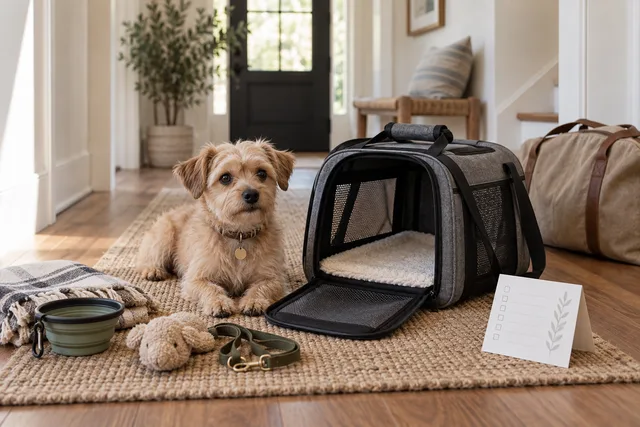
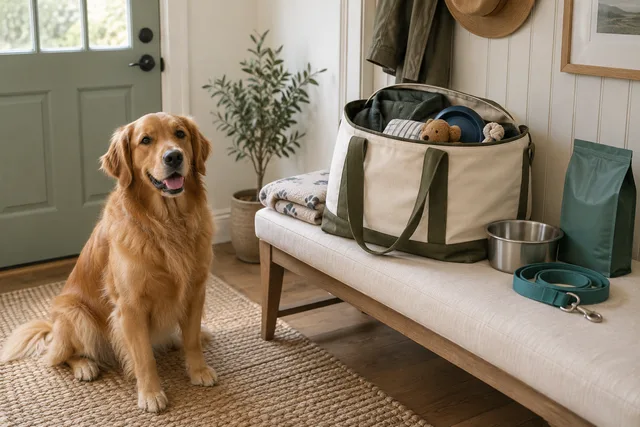
Separate what you need during the crossing from luggage you will not want to unpack while boarding. Keep familiar walking equipment, cleanup materials and any routine supplies you intend to use in one manageable bag. Choose what your own trip requires; this is a planning suggestion, not a ferry-mandated product list.
Try carrying the bag alongside your usual leash or carrier before departure. The question is whether you can move without repeatedly putting belongings down or changing hands awkwardly. You do not need to buy a special ferry accessory to answer it. If traveling with another adult, agree who handles the dog and who manages tickets and luggage. An explicit division of tasks is easier to follow than both people reaching for the same item at a boarding point.
6. Check boarding logistics for your chosen method
Walking aboard and driving aboard create different practical sequences. As a foot passenger, think through reaching the terminal, waiting, presenting any required ticket and moving with your dog and bag. As a driver, plan how you will manage supplies and dog equipment without needing to rearrange everything during vehicle loading.
Ask the operator about any route or vessel question that affects your plan. Do not infer vehicle-deck access, permission to remain in a vehicle, or an unloading procedure from a pet-policy sentence. Those operational details need their own current instructions. WSF’s safety guidance emphasizes following staff directions. Build your plan to accommodate those directions rather than a fixed sequence copied from someone else’s crossing.
7. Make the terminal wait part of the itinerary
The ferry ride is only one part of the time away from your normal routine. Include travel to the terminal, the waiting period, the crossing and the onward journey in your note. This makes missing information visible without pretending that every queue or boarding interval is predictable.
Identify what you would do if you need to wait longer than expected. Where would you obtain current information, and what decision would you make if the revised trip no longer suits your dog or group? Avoid building an itinerary with no room to reconsider. This guide supplies no universal maximum waiting time, weather threshold or exercise prescription. Those depend on the individual circumstances and any relevant veterinary advice, not a generic ferry checklist.
8. Recheck alerts instead of relying on a saved plan
Use WSF’s official travel information for the route shortly before you leave. A screenshot of yesterday’s plan can help you remember what you intended, but it cannot tell you that today’s service is unchanged. Check the date and route on any alert before applying it to your journey.
Our suggested note has a small update field: “last checked,” “change found,” and “action.” For example, you might record that you are allowing more time or postponing an onward booking while you clarify a service change. These are planning examples, not reports of a current disruption. If the information is unclear, keep the uncertainty visible. Do not write “confirmed” merely because a timetable page opened successfully.
9. Plan for a change of area on board
Keep the items you would need to move together rather than spreading them across several places. If a crew member directs you elsewhere, ask where you should go and follow that instruction. The aim is an orderly move, not a debate about an older photograph or a traveler’s description of a previous crossing.
If you already know that a possible move would make the journey impractical, address that before departure. For example, do not assume that indoor access can never change simply because your intended area is normally permitted. Think through what you can actually manage with the dog, carrier if used, and luggage. A workable alternative is more valuable than a detailed plan that only succeeds when every preferred space is available.
10. Understand the limits on changing your mind after boarding
WSF’s safety page states that, once loading begins, leaving the vessel requires the captain’s permission. A passenger who needs to leave should explain the situation to a crew member. Do not treat boarding as a casual inspection during which you can independently step off whenever you decide not to travel.
Make the important suitability decisions before you join that process. If you have an unresolved question about your dog, your group or the permitted areas, seek clarification at the terminal before boarding. This is not a reason to rush a decision under queue pressure. A delayed or abandoned outing can be inconvenient, but an itinerary should leave you able to stop before you enter a process with different movement instructions.
11. Keep the destination and return plan realistic
Check what happens immediately after arrival. A dog being permitted on the ferry does not establish access to a destination building, café, trail or hotel. Separate the transport decision from the activity you intend to do afterward. Our trail-rule guide covers that different permission task when a walk is part of your destination plan.
Leave a clear return option in your notes and check its current conditions. If you change the outbound plan, review any assumptions you made about getting back. Do not assume that an alternative terminal or another operator has the same pet policy. A useful day plan includes the return journey even when the outbound crossing is the part you are most excited about.
12. Use a short trip note with unresolved items
A workable note can fit into seven lines: operator; outward route and date; return route and date; boarding method; pet-policy link and check date; supplies and responsibilities; unresolved questions. Store tickets or booking details separately where you can find them without searching a long conversation history.
For a fictional example, a household might have its route and walking equipment ready but still need to clarify where its dog can remain on the expected vessel. Mark that question unresolved. Do not convert it into “probably fine” to finish the checklist. When the operator supplies an answer, add the source and date, then review whether the rest of the itinerary still works. The note supports decisions; completing every box is not the goal by itself.
If several people are traveling, share the practical plan before leaving home. Everyone should know which terminal you mean, which person is handling the dog and where current journey information is stored. Agree how you will communicate a change without asking the person holding the leash to search through messages while moving. This is particularly useful when one person is managing the vehicle and another is carrying supplies.
After the trip, keep only observations that may help your next plan: what you carried, what you did not use, and which question needed clarification. Label those notes with the date. A personal experience can improve your organization, but it should not become a claim that the same boarding sequence, vessel or permitted area will always be available. Start the next crossing with a fresh policy and journey check.
Frequently asked questions
Can a pet dog sit on a passenger seat? The checked WSF page prohibits pets on seats and tables. Plan using the current permitted arrangements rather than interpreting an empty seat as permission.
Does this guide apply to every Washington ferry? No. Identify the operator. A different company or service may have different rules, reservations and vessel arrangements.
Does a carrier remove every pet-area restriction? Do not assume it does. Read the current WSF policy and ask about any arrangement that is unclear before boarding.
Can I leave immediately if I change my mind on board? WSF says permission is required to disembark after loading begins. Explain the circumstances to crew rather than independently leaving.
Are service animals covered by this ordinary-pet plan? WSF provides a separate service-animal section and accessibility contact. Use that official guidance for related questions; this article does not determine eligibility or legal status.
Sources and related reading
The linked WSF pet page and safety page provide the operator-specific rules summarized here. They were read directly during preparation. The trip-note format, task division and examples are practical planning suggestions. No timetable, price, vessel assignment or guaranteed indoor location is supplied.
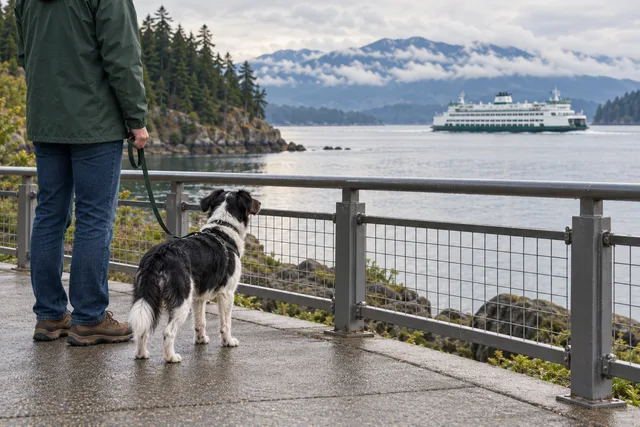
For supporting tasks, see preparing a carrier for a day trip and packing for an overnight stay. Neither replaces ferry instructions. The cover is an illustrative waterfront scene, not a photograph identifying a specific terminal or demonstrating WSF access.