
How to Prepare for a Dog Daycare Evaluation
Confirm the daycare assessment format, prepare accurate intake information and arrival equipment, and discuss the evaluator’s observations before booking.
Jump to a section
Direct answer: prepare for an assessment, then review the result
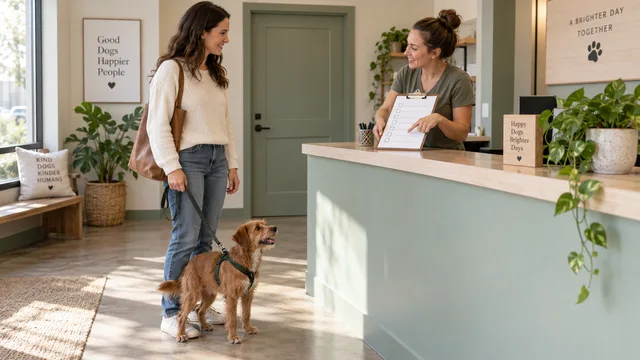
Prepare for a dog daycare evaluation by confirming the exact location’s appointment process, submitting the information it requests, and asking what the evaluator will observe. Bring the required arrival equipment and documents, stay reachable, and collect a clear explanation of the outcome before booking regular attendance. The goal is an accurate assessment of fit for that facility’s environment.
An evaluation is not a competition your dog needs to win. It is a chance for the operator to see how the dog responds to its handling, rest arrangements and proposed activities. This guide covers the evaluation appointment and its follow-up conversation. It does not diagnose behavior, prescribe training or establish that group daycare is suitable for every dog.
1. Confirm what your appointment actually includes
Ask whether the booking is a brief introduction, an assessment followed by a trial visit, or a longer first day. Operators use different names, and those names do not tell you how long responsibility will remain with staff. Get the start time, expected collection time and any requirement for you to wait nearby.
Dogtopia’s Denton location describes a Meet & Greet taking roughly twenty to thirty minutes and including several observations. Camp Bow Wow describes its first-day process as an interview. These examples show why you should ask your selected location about its own format rather than copy another company’s timing into your schedule.
Confirm the appointment rather than assuming that submitting an online request completes the booking. Save the location’s name and confirmation together. If you have more than one dog, ask whether each dog has a separate assessment and whether the appointments can happen together. Do not infer that one household booking automatically includes every dog.
2. Separate eligibility paperwork from medical decisions
Read the location’s current admission requirements and identify which records must arrive before the appointment. Ask about the accepted submission route and whether staff have confirmed receipt. An uploaded file and an approved record are different stages; a missing attachment should be resolved before you travel.
The operators checked for this guide publish vaccination-related entry conditions, and some locations also state age or reproductive-status requirements. Those are operator policies, not a medical plan written for your dog. Ask your veterinarian about individual medical questions and ask the facility about the paperwork it needs. Keep those two conversations connected without treating them as interchangeable.
If a requirement cannot be met or you do not understand its wording, explain that before booking. Do not change a record, omit a relevant detail or assume that a familiar brand name means every location applies identical conditions. Use the particular location’s current instructions and obtain clarification where the published information is incomplete.
3. Give observations that help staff understand your dog
Provide the background the intake form requests, including previous daycare experience and situations that affect handling. Use specific observations rather than broad labels. A description of what happened, when it happened and what the person did afterward is more useful than calling the dog good, difficult or friendly without context.
For example, an owner might report that a dog moved away when an unfamiliar person reached for the harness during a recent visit. That sentence describes an event without diagnosing its cause. The evaluator can ask follow-up questions and decide how the information matters to the facility’s process.
Be candid about relevant incidents and uncertainty. If you do not know how the dog behaves during a particular situation, say so. An evaluation based on accurate information is more useful than an apparently reassuring history assembled from guesses. Keep health instructions identifiable as directions from the dog’s clinician rather than blending them into your own interpretation of behavior.
4. Ask about the stages of the evaluation
Before arrival, ask what staff will assess and in what general sequence. You do not need a promise that the appointment will follow a rigid script. You do need enough information to understand whether it includes staff handling, a rest space, contact with other dogs or another element you should discuss beforehand.
Dogtopia Denton’s public description includes responses to staff interaction, comfort in a crate and reactions in a controlled open-play setting. That is an example of an operator’s process, not a universal daycare assessment standard. Another facility may use different arrangements or offer a different style of care.
Ask how staff decide when to pause or end an assessment and how they will communicate that decision. If something in the proposed process does not fit your dog’s known needs, raise it before drop-off. The appointment should provide information about a realistic care arrangement, not require you to hide a concern until after it has become relevant.
5. Clarify who stays and who can collect the dog
Find out whether you remain in the lobby, take a tour, leave for a specified period or return at an agreed time. The answer affects transport and your ability to respond if the visit ends sooner than expected. Keep enough flexibility in your schedule to collect the dog when the facility asks.
Give a contact number you can actually answer during the appointment. If another person may collect the dog, ask how the facility records that authorization and whether identification is required. Confirm the process beforehand rather than sending someone unfamiliar with the booking to reception at the last moment.
Decide how updates will arrive. A telephone call, a text and a conversation at collection are different channels. If the operator uses cameras, ask what they show and when access is available, but do not treat a camera view as a complete report of the assessment. The evaluator’s direct explanation still matters.
6. Follow the location’s arrival equipment instructions
Confirm what the dog should wear on arrival and what equipment staff will use during the assessment. Camp Bow Wow’s published first-day checklist calls for a quick-release collar with a readable ID tag and a leash for arrival and departure. Dogtopia Denton also asks owners to enter its lobby with the dog secured on a leash or slip lead with a collar or harness.
These examples belong to the named operators. Check your appointment’s instructions instead of combining them into a rule for every facility. If the requested equipment differs from what you normally use, resolve the practical question with staff before arrival. Do not improvise a change that makes handling uncertain.
Keep the dog secured while waiting for the handover instructions. A reception area is a transition space, and other dogs or visitors may arrive while you are discussing paperwork. Allow the staff member to explain the next step rather than assuming that entering the building is the point at which you release the dog.
7. Pack only what the appointment requires
Make a short list based on the location’s instructions: documents still needed, required identification, arrival equipment and any items the operator has specifically accepted. Ask what happens to equipment you hand over and which belongings should return with the dog. A labeled item list makes collection easier.
Do not assume that toys, blankets or food belong in every evaluation visit. Camp Bow Wow’s checked first-day guidance asks Day Camp visitors to leave personal toys and blankets at home. Other appointments may have different arrangements. The useful step is to verify acceptance, not to bring a larger bag just in case.
If the booking overlaps a meal or requires medication handling, confirm the facility’s process and keep existing veterinary directions intact. This guide does not recommend changing feeding times, medication or a medical routine to influence an assessment. Ask the relevant clinician and operator to resolve any conflict before the visit goes ahead.
8. Keep preparation focused on accurate information
Avoid making the day before the evaluation into a test of your own. You do not need to stage unfamiliar encounters to produce a story for the intake form. Use your existing observations, the requested documents and a clear appointment plan. Leave questions visible rather than filling them with assumptions.
Tell staff about changes since you completed the form. A new concern, a different pickup person or an updated instruction can affect the visit even when the original registration is complete. A dated correction is easier to follow than several conflicting messages sent through different channels.
If you are unsure whether the appointment should proceed because of a new health or behavior concern, contact the appropriate professional and the facility before arrival. Rescheduling may be the practical result. An evaluation is meant to inform the care decision; keeping the original date is not more important than giving staff a truthful picture of current circumstances.
9. Ask for an outcome tied to observed situations
At collection, ask the evaluator what happened during the stages you discussed. Request concrete observations: which interactions were attempted, how the dog responded and whether staff changed the plan. Distinguish an observation from an interpretation or a recommendation so that you can understand the basis for the next step.
For example, a report that the dog remained apart from others during a brief introduction is different from a claim about how it will behave during every future visit. Ask what the operator concluded for its own environment and whether any uncertainty remains. Do not turn a single appointment into a universal temperament certificate.
Clarify the practical outcome. Is regular attendance offered, is another meeting proposed, or is this particular service unsuitable? Ask what conditions accompany any offer and whether they apply to a specific group or schedule. Keep a short dated note of the explanation so that another household member does not have to reconstruct it from a general impression.
10. Decide the next booking from the actual proposal
If the facility offers attendance, ask what the first regular visit would involve and whether it differs from the assessment. Confirm the duration, rest arrangements, communication and collection window for that booking. Acceptance for one process does not tell you every detail of the service you may purchase next.
If the operator declines or requests more information, ask which aspect of the proposed environment led to that outcome. You can use that explanation when considering an alternative care format or discussing an issue with an appropriate professional. There is no need to frame the result as failure or seek another facility while withholding the same relevant history.
Avoid buying a package merely to make the evaluation feel complete. Read the applicable booking, cancellation and payment terms before committing. The valuable result is a clear care decision based on the operator’s observations and your dog’s needs, whether the next step is attendance, further discussion or choosing another arrangement.
Frequently asked questions
Is an evaluation the same as a full trial day? Not necessarily. Confirm the location’s format, how long the dog stays and whether the booking includes activities beyond the assessment.
Should I try to make my dog pass? Focus on honest information and the operator’s preparation instructions. The appointment should establish fit for its care environment rather than reward a particular presentation.
Do all branches of a chain use the same requirements? Do not rely on that assumption. Verify the selected location’s current process and documents before attending.
Can I bring a favorite toy? Ask first. Some operators exclude personal toys from Day Camp; bringing one does not mean it will be admitted or used during an assessment.
Does acceptance prove that future visits will always go well? It describes the operator’s decision from the information and observations available. Ask how it reviews fit as circumstances change.
What should I take away from collection? The evaluator’s observations, the practical outcome, any unresolved question and the conditions of a proposed next booking.
Sources and related reading
Checked October 13, 2026: Dogtopia Denton new pet parent and Meet & Greet information and Camp Bow Wow first-day checklist. Examples describe those operators’ published processes. No universal assessment standard or guaranteed outcome is claimed.
For other care decisions, read how to compare boarding facilities, how to prepare a sitter handover sheet and how to transfer veterinary records. Each solves a separate task from preparing for an evaluation appointment.