How to Compare Dog Gate Extension Kits Before Buying
Match gate and extension model numbers, check approved combinations and avoid confusing panel dimensions with the installed opening range.
Jump to a section
Start with the gate model, not the gap
Choose a dog-gate extension by matching the exact gate model to a manufacturer-approved part and configuration, then confirming that the resulting installation range covers your opening. A matching color, similar bar spacing or convenient panel width is not enough. The connector, height, mounting arrangement and permitted number of sections also matter.
This guide is for comparing extension kits before purchase. It does not replace the installation manual or certify an arrangement as safe. It is especially useful when you already own a gate and want to move it to a wider opening, or when a listing offers several extensions that look nearly identical.
Separate the decision into three questions: is the part compatible, is the combination permitted, and does that combination fit this location? Answer them in that order. Buying a panel first and trying to make the gate accept it reverses the process.
Collect an identification record
Find the model information on the gate, packaging, receipt or instruction booklet. Record the complete model number, including letters or suffixes, and photograph the identification label if available. Also note which extensions and mounting components are already present. A used gate may have arrived with parts that were not originally supplied together.
Do not identify a gate solely from an online photograph. Manufacturers can sell several similar-looking versions under related names, and sellers may shorten those names. An older order title may also omit information that appears on the physical label.
If the label is missing, collect clear photographs of the whole gate, latch, connection points and existing hardware for the manufacturer. Ask for identification before ordering a replacement or extension. An uncertain model is a reason to pause the purchase, not a reason to select whichever panel appears closest.
Find the matching manual and parts page
Use the manufacturer’s support site to locate instructions for the exact model. Check whether a revision or production version is specified. Keep a copy with your measurements so you are not repeatedly switching between a retailer listing, an unrelated manual and a remembered width range.
Read the extension section as well as the installation warnings. A product page may identify a compatible part while the manual explains where it belongs in the assembly and which combinations are allowed. Both questions need answers.
If a retailer’s compatibility statement conflicts with the manufacturer’s documentation, resolve that disagreement before buying. Save the relevant links and ask a focused question about your model and proposed arrangement. A general statement that an extension fits many gates is less useful than a documented answer naming the gate you own.
Use a real compatibility example carefully
For example, Carlson’s Platinum 12-inch extension page identifies extension model 0914 EP and limits compatibility to gate models 0932 and 0937. It lists a height of 30 inches. That is a specific model relationship, not permission to attach any 12-inch Carlson panel to any Carlson gate.
Use the example as a way to read a parts page: locate the extension identifier, compatible gate identifiers and physical dimensions separately. Do not transfer this compatibility statement to another color, height or product family without checking its own page.
The manufacturer’s parts directory also separates several gate families. That organization is a useful reminder to start in the correct family before comparing widths. This article does not recommend that particular extension for your home or provide a shopping link to an unverified substitute.
Keep opening measurements separate from panel dimensions
Write down your actual opening measurements rather than one rounded number. Include the relevant mounting positions, changes caused by trim and the intended location of the gate. If you have not done this yet, use our doorway measurement guide before comparing parts.
On the same page, create a separate space for the manufacturer’s installed-width ranges. A panel dimension and an opening range describe different things. One tells you about a component; the other tells you about an approved assembly in an opening.
For an illustrative example, suppose your notes show different widths near the floor and higher up. Do not average them into a convenient middle number. The installation instructions must address the actual mounting geometry. An extension that makes one measurement look right does not automatically resolve uneven or unsuitable contact surfaces.
Avoid the simple subtraction trap
It is tempting to subtract the advertised gate width from the opening and buy a panel equal to the difference. That arithmetic may not represent the installed system. The advertised number might describe a maximum range, a frame dimension or a package that already includes an extension.
Instead, locate the table or instructions showing the permitted arrangement for your opening. Identify the base gate, each extension and any adjustment range specified by the manufacturer. Keep all measurements in one unit while comparing them, and check conversions rather than mixing rounded inches and centimeters.
If the documentation does not show a combination covering your measurements, ask the manufacturer. Do not stretch an adjustment beyond its stated range or assume another small panel will solve the problem. The absence of an approved configuration can mean that a different gate is the appropriate purchase.
Check quantity and placement together
A compatible extension is not necessarily approved in every quantity or on either side of the gate. Compare the entire proposed assembly with the model’s instructions, including the placement of different-sized sections. Do not build a combination by adding together individually compatible parts without checking the combination itself.
Regalo’s official FAQ gives extension-count conditions for its pressure-mounted gates and notes that additional extensions are not available for every gate. Those brand-specific statements illustrate why a universal extension-count rule would be misleading. Follow the current instructions for your exact product rather than importing a limit from another brand.
Make a simple written sequence, such as wall, approved extension, gate, wall, using the arrangement actually specified for your model. If a second section is allowed, record its specified position. This gives you a concrete configuration to check before ordering.
An extension does not change the mounting category
A wider assembly still has to be appropriate for its location. Do not treat an extension as a way to convert a pressure-mounted gate into a different kind of barrier or make an unsuitable location acceptable.
The linked Regalo FAQ explicitly warns against pressure mounting at the top of stairs. Check location restrictions in your own gate’s manual, especially around a change in floor level. If the intended position is not allowed, choose a suitable system instead of trying to compensate with extra panels or improvised fasteners.
Also consider who relies on the barrier. A product intended for pets should not be assumed to meet a child’s safety needs. Shared households need equipment appropriate to the actual use. This guide cannot establish child-safety suitability, stair suitability or compliance from a product photograph.
Inspect what the kit actually includes
Read the package contents before comparing cost. Determine whether the listing is for a panel alone, a panel with connectors or another type of replacement part. Do not assume every pictured component is included, especially when a photograph shows the extension attached to a complete gate.
Compare those contents with the parts list in your manual and with what you already own. Record any missing manufacturer-specified components. If their availability is uncertain, resolve that first; a cheap panel is not a complete solution when the necessary installation parts cannot be obtained.
For secondhand equipment, inspect identification and condition before treating existing hardware as usable. Unknown pieces should not be accepted merely because they slide into an opening. Keep unfamiliar parts separate while checking them so they are not accidentally incorporated into the final assembly.
Compare total cost after compatibility passes
Only compare prices among options that have passed the model, configuration and location checks. Include shipping, required components and the seller’s applicable return conditions. Note whether a listing represents one panel or a set, and whether the selected option changes what is supplied.
Then compare the complete extension solution with a gate designed for the opening. This is not an automatic argument for replacing equipment. It is a way to avoid spending on several parts when the existing gate still would not meet the household’s needs.
Keep the decision grounded in the job. If the gate is damaged, unidentified or unsuitable for the dog, widening it does not address those issues. If it is suitable and an approved extension solves the width problem, the smaller purchase may be all you need.
Ask support a question they can answer
A useful support request includes the gate model, label photograph, opening measurements, intended location and the exact extension identifier you are considering. Explain which components you already have and show the proposed arrangement. This is more actionable than asking whether a panel will fit a wide doorway.
For example: “My gate label shows model X. The opening measures A at one mounting position and B at the other. I have the original parts listed here. Is extension Y approved for this arrangement, and which manual section should I follow?” Replace every placeholder with your own information.
Keep the answer with the manual and order record. If support cannot confirm compatibility, do not interpret silence or an ambiguous response as approval. Choose a documented alternative or continue investigating before placing the order.
Verify the delivered parts before installation
When the package arrives, compare the model and contents with your order and the compatibility information you saved. Check for visible damage and missing components before beginning assembly. Keep the packaging until you have confirmed that the correct item was supplied.
Follow the complete manufacturer installation sequence, including any required mounting hardware, adjustments and checks. Do not substitute this article for those steps or use an online photograph as an installation diagram. If the latch, frame or connections do not behave as the instructions describe, stop and resolve the issue.
After installation, use the checks specified by the manufacturer before relying on the gate. Do not use the dog as a strength test. Recheck according to the instructions and after any event that might have moved or damaged the assembly. A successful purchase still depends on correct installation and continued suitability.
Frequently asked questions
Are gate extensions universal?
No universal compatibility should be assumed. Match the exact gate and extension identifiers and verify the permitted configuration with the manufacturer.
Can I mix brands if the connectors look similar?
Appearance is not sufficient evidence. Do not mix parts without explicit documentation approving that particular combination.
Does a wider panel make the walk-through opening wider?
Do not assume it does. Check the gate’s passage dimensions separately from the total installation width. An extension may change the overall span without changing the door opening.
What if my opening is just outside the listed range?
Do not round it into range or improvise a filler. Ask about an approved configuration or select a system intended for the actual measurements.
Can I copy another owner’s arrangement?
Use it only as a prompt for questions. Their gate version, hardware, surfaces and location may differ, and a photograph does not verify installation.
Keep a short comparison record
Before ordering, your notes should identify the gate, extension, approved combination, opening measurements, required components and supporting manual or manufacturer response. Add the final purchase option so a later color or size change does not quietly replace the part you verified.
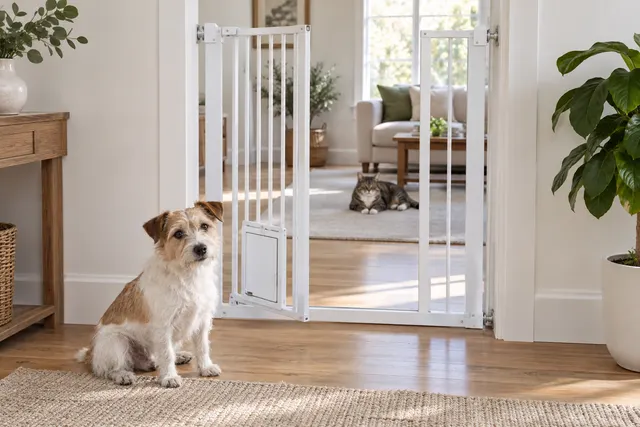
Sources checked September 18, 2026: Carlson’s linked extension and parts pages and Regalo’s official FAQ. The cover is an illustrative planning scene, not a photograph of a certified installation or a specific kit. For related decisions, browse doors, gates and ramps and our Carlson gate buying assessment.