Best for Compact Food Packing? Kurgo Kibble Carrier Review
Assess the Kurgo Kibble Carrier for short-trip food packing, including usable capacity, cleaning, pocket limitations and when original packaging is simpler.
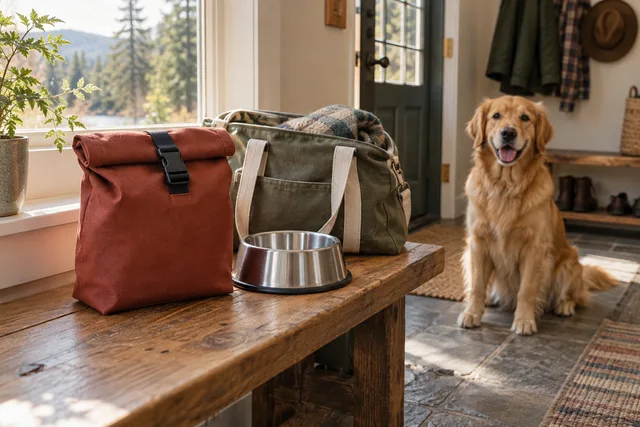
Kurgo Kibble Carrier Chili Red / K01671
Consider it for
Measured dry-food packing for short trips.
Check before buying
Bowl sold separately; not a verified waterproof or chew-resistant container.
Jump to a section
Direct answer: useful when a rigid container wastes luggage space
The Kurgo Kibble Carrier is a sensible candidate for someone who wants a flexible bag for a measured quantity of dry dog food and is willing to clean and dry it between trips. Its appeal is packing convenience. It is less compelling if your existing food packaging already travels neatly, if you need a chew-resistant container, or if you expect a travel bag to provide refrigeration or a verified waterproof seal.
This review evaluates the Chili Red selection, US Amazon ASIN B014V5OUXM and model K01671. It is a source-based buying assessment, not a physical test. We have not measured leakage, odor retention, abrasion resistance or real-world capacity. The cover is an illustrative travel scene; the product module uses the selected listing’s first image. Other colors belong to this same review rather than receiving separate articles.
What the verified specification actually tells you
Kurgo lists a roll-and-buckle closure, ripstop construction, a food-safe PEVA lining and heat-sealed seams. Its advertised maximum is five pounds, described as roughly twenty cups of average kibble. There is a zippered side compartment and a bottom opening intended for a separately purchased Collaps-A-Bowl. The manufacturer specifies hand washing and air drying. These are manufacturer specifications, not findings from our own testing.
The selected Amazon page identifies Chili Red and K01671 and shows buying options rather than one assured offer. Check the selected option and seller before ordering. A product-family page can display several colors without making their availability identical. We do not reproduce a price, delivery promise, star rating or stock guarantee here.
Capacity: plan meals first, then check the bag
Treat the advertised volume as a starting point for a packing trial. Cups measure volume; pounds measure weight. The relationship changes with the food. A statement about average kibble therefore cannot tell you exactly how many meals your own food will occupy. Nor should a bag’s capacity determine what you feed. Use your dog’s established feeding plan and the food’s directions, with veterinary advice where appropriate.
For a simple packing example, imagine that your existing routine uses two cups a day and the itinerary contains three full feeding days. That itinerary needs six cups before any contingency portion. If you elect to pack one additional day, the total becomes eight cups. This is an arithmetic illustration, not a feeding recommendation. Substitute your own measured daily quantity and the actual meals away from home.
Count departure and return meals explicitly. A Friday evening departure after dinner followed by a Sunday return before dinner is different from leaving Friday morning. Writing the meals on the itinerary can prevent both unnecessary bulk and a missing final portion. Include food for any planned delay separately in the calculation so it does not quietly disappear into a vague estimate.
Then test the complete load at home. Include any inner packaging you intend to retain, close the top normally and place the bag in the luggage space it will actually use. A load that fits an open bag but prevents proper closure is not a successful fit. We cannot supply a measured usable volume or a required number of folds for your particular load.
The real comparison is with what you already own
Start by packing the same measured quantity in your current arrangement. If the original food bag fits securely inside an existing tote, a dedicated carrier may add little. If a bulky household container forces everything else into a second bag, a flexible format could be worth considering. The important comparison is the complete packed system, including the bowl, measuring utensil and any labels.
A rigid container offers a defined shape, which some people find easier to stack. A flexible bag can occupy a less regular space, which may suit a crowded overnight tote. Neither observation proves that this particular product is superior. Think about the place it must fit: a narrow cupboard at a rental cabin, a car luggage area or a shelf at a sitter’s home.
Do not compare only the empty products. A bag that looks exceptionally compact when empty still has to accommodate food. Likewise, a container that appears inconvenient on a kitchen counter may fit your car neatly. A useful purchase solves a specific packing problem you can describe before ordering, rather than adding another item to an already adequate setup.
Original packaging and travel convenience are different priorities
The FDA recommends keeping dry pet food in its original bag, with its top folded closed, in a cool, dry location. A lined travel carrier does not cancel that guidance. Consider whether a suitably sized original package will fit inside your travel arrangement. If it does not, a smaller original package may be simpler than buying a carrier solely to decant food.
Keep the product identity and lot information available during a trip. A photograph of the label can help with recordkeeping, but it is not a substitute for suitable storage conditions. For the broader home-storage routine, see our linked original-bag guide. This review focuses on whether the carrier’s format suits a trip; it does not establish a shelf life for transferred kibble.
The FDA also advises securing the food so a pet cannot eat the whole supply. A buckle and fabric shell should not be treated as a verified barrier against a determined dog. Choose an inaccessible storage location at the destination. A convenient handle or attractive bag is not a reason to leave meals on the floor beside the dog’s bed.
Try the serving routine before departure
Picture the first meal after arrival. Where will you put the bag while opening it? Where will the bowl sit? Can you reach the measuring utensil without unloading clothes or toiletries? These questions reveal whether the carrier belongs near the top of the luggage or in a separate, accessible compartment. The best location is one that also keeps it away from cleaning products and wet equipment.
Practice with your usual measuring method rather than estimating a portion from the shape of a pour. If food goes into a bowl easily at home, repeat the exercise using the surface and lighting you expect while traveling. This is a personal usability check, not a claim that the product pours accurately or without spills. Individual hands, bowls and packing arrangements differ.
At a sitter’s home, make the handoff unambiguous. Label whose food it is, identify the agreed meal quantities and explain where the contingency portion belongs. If two dogs eat different diets, separate and label their supplies rather than relying on bag color alone. Written instructions should come from the owner’s established care plan, not from a travel-product review.
Pocket fit matters more than pocket count
Before choosing an accessory around the carrier, decide whether you already have a bowl you like. An advertised bowl pocket does not verify compatibility with every folded bowl, lid or utensil. Measure your own accessory and check the pocket when the carrier is loaded. A fit that depends on forcing the accessory into place is a reason to use a separate compartment.
Keep expectations modest for the side pocket as well. Your practical question is whether it accommodates the small items you actually need while remaining easy to close and reach. We have not measured its dimensions or tested a phone, measuring cup or particular treat container inside it. Product photographs can illustrate arrangement without establishing usable space.
Wet accessories require their own plan. Do not assume an exterior pocket will dry a recently washed bowl before it is packed against other belongings. Dry the accessory or carry it separately in a suitable arrangement until you can clean and dry everything properly. The carrier is most useful when its organization reduces steps, not when each pocket acquires a new unresolved storage problem.
Cleaning is part of the buying decision
Follow the supplied care label and Kurgo’s hand-wash, air-dry instructions. Do not substitute machine washing, a tumble dryer or a dishwasher based on another retailer’s generalized bag-care advice. Before your first trip, find a place where the emptied carrier can remain open while drying. If you travel on consecutive days, account for that turnaround in your packing plan.
After cleaning, inspect the interior and seams before refilling. If you cannot establish that the bag is clean, fully dry and undamaged, use another suitable storage arrangement. This is a practical inspection step, not a validated sanitation procedure. Ask the manufacturer about compatible cleaning products rather than guessing a chemical concentration or assuming the liner tolerates every household cleaner.
The FDA advises washing bowls and measuring utensils with soap and hot water after use and using a separate clean utensil rather than the food bowl to scoop. That guidance concerns feeding equipment; it does not authorize hot-water treatment beyond the bag’s own care instructions. Keeping those instructions separate avoids damaging a carrier while trying to clean a different item.
Limits worth deciding on before you buy
We found no verified submersion rating or measured leak test for this assessment. River-bag styling should not be translated into permission to immerse the carrier. If a trip requires water protection, choose equipment with a documented rating for the intended conditions. A dry-food packing accessory is also not a cooler for perishable meals or a substitute for required refrigeration.
We have not established bear resistance, rodent resistance or chew resistance. Follow the food-storage rules of the campsite or accommodation, including any required lockers or approved containers. For a car journey, choose suitable storage conditions and do not assume the passenger cabin or luggage area remains cool while parked. The right storage environment matters independently of the product’s appearance.
Finally, consider the inconvenience you are accepting. A dedicated carrier means another item to empty, inspect, wash and dry. That may be a reasonable trade for someone who travels frequently. For an occasional overnight visit, a smaller original package and existing luggage may be easier. Buying less is a valid outcome when the new item does not solve an actual problem.
Frequently asked questions
Is the bowl included? No. Kurgo describes the compatible bowl as a separate purchase. Check the selected offer before assuming any pictured accessory is supplied.
How many days does it hold? There is no universal number. Calculate your established daily food quantity, count the actual meals and test the complete load. Do not convert the advertised weight into days without considering your own food and routine.
Should I buy a second color for another dog? Only if a separate carrier solves your organization needs. Color does not create a different product type, and labels are still useful when another person handles the meals.
Does the lining prove food stays fresh longer? No independent preservation test is supplied in this review. Follow the food manufacturer’s storage directions and avoid treating travel convenience as a shelf-life claim.
Who should skip it? Someone needing a rated protective container, chilled-food storage, or no additional cleaning may be better served by another arrangement. Someone whose original package already packs neatly may not need a new product.
Sources and final verdict
The Kurgo product page supplies the construction, capacity and care specifications. The selected US Amazon listing confirms model K01671, Chili Red and the product image. FDA guidance linked above informs the limited food-handling discussion. These sources were checked on September 20, 2026; seller offers and supplied instructions can change.
Choose the Kibble Carrier if its flexible format resolves a demonstrated packing problem and its cleaning routine fits your schedule. Decide against it if you need protection or preservation capabilities that this review cannot verify. A successful choice is one that makes the actual meals on your itinerary simpler to manage.
Check the Kurgo Kibble Carrier

Kurgo Kibble Carrier
Chili Red / K01671
Read customer reviews on Amazon ↗
- Flexible roll-top packing
- Food-safe PEVA lining
- Separate bowl and accessory pockets
Consider for: Measured dry-food packing for short trips.
Before you choose: Bowl sold separately; not a verified waterproof or chew-resistant container.
Product information source · Reviewed 2026-09-20
Check current price, seller and options on Amazon.
Check the selected color and seller offer. Test your actual food load before departure. Affiliate link.