How to Store Dry Dog Food in Its Original Bag
Build a practical bag-in-bin routine with a readable lot record, an opening date, enough lid clearance and a clear handoff between bags.
Jump to a section
The short answer: keep the bag, then organize around it
Keep dry dog food in its original packaging, close that packaging after serving, and use a suitable outer container if you want additional containment. Build the storage space around the whole bag rather than buying a bin first and discovering that the bag cannot fit. Keep the product identity readable and make the opening date easy to find.
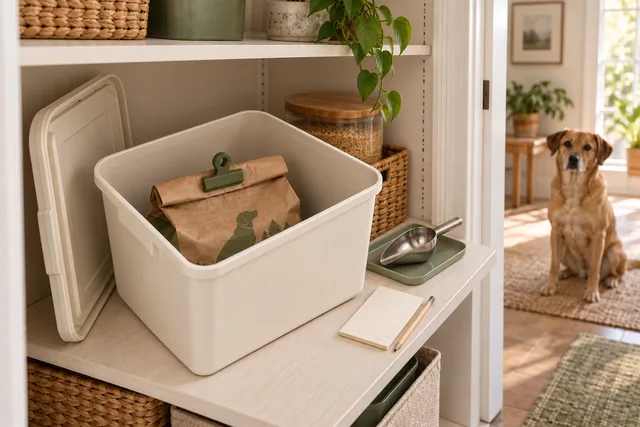
This guide concerns ordinary dry kibble stored at home. It does not establish storage rules for raw, refrigerated, rehydrated or homemade food, and it does not change your dog’s feeding plan. The practical examples below concern space and record keeping, not a tested extension of shelf life. The cover depicts an illustrative arrangement rather than a specific container recommendation.
1. Start with the safety rules and the actual label
FDA recommends retaining original packaging, placing the whole bag inside an outer bin when one is used, and storing dry food somewhere dry and below 80°F, approximately 27°C. It also advises washing and drying the container between bags, cleaning serving utensils after use, and keeping food inaccessible to pets. Retain the product name, manufacturer, UPC, lot and best-by information. If illness appears associated with the food, stop feeding it and contact your veterinarian. These are storage and handling precautions, not a guarantee against contamination. Read FDA’s storage guidance.
Read your own package before organizing anything. Look for storage instructions, the printed date, a customer-service contact and any directions that apply after opening. Put unanswered questions in a note. A container’s advertising cannot settle a question about the food inside it, and a general article cannot replace instructions for a particular formula.
2. Measure the package and the space together
Take three measurements of the bag you actually buy: its standing height, widest filled width and front-to-back depth. Soft packaging changes shape, so record these as practical fit observations rather than exact engineering dimensions. If you are measuring an almost empty bag, it will not represent the space occupied by a fresh full one.
Next, measure the proposed storage location. Include the shelf opening, depth behind any door, and the space needed above the bin to open its lid. Check whether a hinged lid will hit another shelf. A bin that fits when closed can still be awkward every morning if you must drag it into the room to reach the food.
For example, a hypothetical shelf opening measuring 18 inches high cannot accommodate a 17-inch container if its lid needs another 4 inches to swing upward. Those are invented dimensions to demonstrate the check, not specifications for a product. Compare the opening action, not only the listed container height, before buying or rearranging shelves.
3. Choose access that works with a full bag
An outer bin should allow you to insert and remove the whole package without tearing it against a narrow rim. A large advertised capacity does not establish that fit: pounds describe food weight, while the opening and interior shape determine whether your particular bag passes through. Ask for internal dimensions when a listing gives only exterior measurements.
Try the serving motion with an empty bin first. Can you reach the bag opening without lifting the container? Can you close the bag without trapping its folded edge under the outer lid? If another household member feeds the dog, have that person try the same motion. Comfortable access matters more than how neatly a container photographs.
Choose a location you can inspect and clean without moving a heavy appliance. Avoid balancing a full bin on an unstable stool or storing it where you must reach overhead to lift it down. These are practical layout choices: match the load and handling task to the person doing it, and use a stable surface appropriate for the container.
4. Make one useful record for each opened bag
Photograph the front of the package and the area containing its identifying codes before folding the top. Check that the pictures are sharp enough to read. A wide photograph of the entire bag may make tiny printing illegible. Keep the original package as well; the photograph is a convenient backup, not an excuse to discard its information.
Our suggested record has five fields: dog or household, exact food name, date opened, printed best-by date, and a reference to the lot-code photograph. Add the manufacturer’s after-opening instructions once you have checked them. Label the opening date as “opened” so nobody mistakes your handwriting for a manufacturer-printed expiry date.
Use one format consistently, such as September 20, 2026, rather than a numeric date that another reader could interpret differently. Name the image folder with that opening date and food name. When the next bag starts, create a new entry instead of editing the old photograph’s filename and losing the previous batch history.
5. Separate a purchase estimate from a freshness limit
You can estimate how long a bag will last without deciding how long it is safe to keep. Divide the bag’s weight by the amount your household already uses each day, using matching units. For an illustrative calculation, 6,000 grams divided by 200 grams per day equals 30 days. This is inventory arithmetic, not a feeding recommendation or a validated storage duration.
Use the feeding amount established for your own dog; do not adopt the example’s quantity. If the amount changes, update the estimate. When two dogs eat the same food, add their actual daily amounts before dividing. When they eat different foods, calculate each package separately instead of treating all household kibble as one shared supply.
Compare that estimate with the specific manufacturer’s instructions before choosing a bag size. Purina’s general storage page describes two to three months for properly stored opened dry food, while another Purina guide recommends four to six weeks for maximum freshness. Those different formulations should not be turned into a universal deadline. Ask about your exact product if its label is unclear. Purina storage guide; Purina dry-versus-wet guide.
6. Keep the daily sequence easy to repeat
Put the record where the feeder can read it without opening a phone or moving the bag. Store a clean serving utensil in an obvious separate place. A small tray can distinguish the utensil ready for use from one waiting to be washed. The aim is to remove a decision from the feeding routine, not to add decorative accessories.
Purina advises expelling extra air from the dry-food bag, securing it with a clip, and using an airtight outer bin for additional protection. It also warns against pouring new food over leftovers in a storage container. Follow your package’s closure design if it has one, rather than assuming every bag needs the same folding method. See the manufacturer’s explanation.
After serving, check the bag closure and outer lid as two separate actions. Do not leave a clip sitting on top of the bin as a reminder to finish later. A written sequence such as “serve, close bag, close bin, clean utensil” can help a sitter follow the same process without guessing what normally happens in your kitchen.
7. Give bag changes their own short routine
Plan the changeover before a fresh delivery arrives. Keep the unopened replacement distinguishable from the active bag, and avoid putting both in a single unlabeled enclosure. If you need to rearrange supplies, move the record with the corresponding package. A tidy cupboard is not useful if its labels no longer describe the contents.
At changeover, remove the finished package, handle the container according to its cleaning instructions, and allow time for complete drying before reuse. Check removable seals and lids against that container’s care guide; do not assume they are dishwasher-safe. Keep an appropriate temporary location available so a wet bin does not create pressure to rush the process.
Start the new record before serving from the replacement. Retire the old visible card to your household file so only the active bag’s details appear at the feeding station. Keeping an archive is an organizational choice; this guide does not prescribe a mandatory retention period. Follow any manufacturer or recall instructions relevant to a particular batch.
8. Troubleshoot the arrangement before adding equipment
If the lid will not close, check whether the folded bag is occupying the hinge space. Do not force the latch and assume it has sealed. Try another suitable location or a differently shaped bin. If the package must be crushed into the container, the arrangement probably does not support the routine you intended.
If the record keeps disappearing, attach a reusable card holder to the outside rather than writing on a loose scrap. If several people feed the dog, place the same instructions at the station instead of maintaining competing notes. If the dog can reach the supply, reconsider access to the storage area rather than relying on a lid that has already proved easy to open.
If the package or contents seem abnormal, keep the identity information available while seeking product-specific advice. Do not use a pleasant smell, a new bin or an unexpired printed date as proof that questionable food is acceptable. Describe the observation, when you noticed it and the batch involved, rather than trying to diagnose the cause yourself.
9. Make a clear handoff for another feeder
Leave a short note naming which bag is active and which package is unopened reserve stock. Include the location of your existing feeding instructions without copying a quantity from this article. If your household has two dogs with different foods, use their names on the outer containers and keep the full formula names on the records; color alone is easy to confuse.
Ask a temporary caregiver to show you where they would find the batch photograph and the manufacturer contact. This checks whether the system is understandable without requiring them to memorize it. If they cannot distinguish the opening date from the printed date, rewrite the labels before leaving. For an unexpected change, such as a damaged package or a missing closure, explain whom to contact rather than leaving them to improvise a replacement storage method.
Frequently asked questions
Do I need a new storage bin? Not automatically. First check whether your current arrangement meets the package directions, permits a reliable closure and prevents access. If an existing suitable container holds the whole bag comfortably, replacing it solely for appearance may solve no practical problem.
Can I write the lot code on the lid? You can make a working reference, but a lid may be swapped between containers. Keep the package and a readable photograph too. When using several bins, give each a distinct name and match that name to its active record.
Does a bigger bag always save money? Compare the amount you realistically use, the product’s instructions and the space available. A lower price per pound does not automatically make a bag practical for your household. This guide does not calculate current prices or recommend changing food to suit a container.
What if I already discarded the original bag? Record what you know and contact the manufacturer with any remaining product details. An order receipt may identify the formula but should not be assumed to identify the manufacturing lot. Do not invent a batch number from a purchase date.
A final setup check
Before calling the station finished, have another person identify the active food, opening date and package details, then open and close the arrangement. Watch for a shelf that blocks the lid, a record hidden behind the bin or a scoop with no clear home. Fix the specific obstacle rather than adding another general checklist.
For the serving equipment, continue with our stainless-steel bowl cleaning guide. For a short stay away from home, see the overnight dog-supply packing guide. Keep the home record available to whoever takes over feeding, so the routine travels with clear information.