Best for Targeted Fabric Hair Removal? Uproot Cleaner Pro Review
Evaluate the Uproot Cleaner Pro Original by its matched UPC, manual edge, fabric limits and official handling guidance, without transferring newer-version claims.

Uproot Cleaner Pro Original Blue / 1 Pack / UPC195893874583
Consider it for
A defined compatible non-knitted fabric task.
Check before buying
Surface compatibility needs checking; no damage-free or speed guarantee.
Jump to a section
Direct answer: consider the original scraper only after checking the fabric
The Uproot Cleaner Pro Original is worth considering for a defined pet-hair removal job on a suitable non-knitted fabric. Its appeal is a compact manual edge rather than sticky refills or a powered mechanism. The important buying limit is surface compatibility: a claim that a tool removes hair does not establish that every upholstered item in your home can tolerate it.
This review uses the blue single-tool US listing, ASIN B09LNX88YK and UPC 195893874583, matched to the manufacturer’s Original product page. It does not transfer the newer Pro’s improved-edge claims to this reference. We have not scraped a carpet, tested upholstery damage, timed a cleanup or compared collected hair. The recommendation is conditional on the task and the surface, with the evidence limits stated openly.
Product details

Uproot Cleaner Pro Original
Blue / 1 Pack / UPC195893874583
Read customer reviews on Amazon ↗
- Compact manually drawn edge
- Original UPC matches maker page
- No sticky rolls or batteries for operation
Consider for: A defined compatible non-knitted fabric task.
Before you choose: Surface compatibility needs checking; no damage-free or speed guarantee.
Product information source · Reviewed 2026-10-22
Check current price, seller and options on Amazon.
OriginalUPC195893874583 matches US listing; no hands-on testing. Affiliate link.
The identity check that separates Original from the newer Pro
The manufacturer’s Original page gives UPC 195893874583 and describes PP and zinc construction. The inspected Amazon single-tool listing has the same UPC, identifies Uproot Lint LLC as manufacturer and uses Uproot Clean as its model and part-number wording. The UPC provides the useful match; we do not invent a more specific numeric model.
The manufacturer’s other current Pro page advertises a new cleaning edge under UPC 198715527278. That is not the identifier matched here. A shopper searching only the familiar product name could overlook this difference. Keep the version identity with your comparison rather than combining features from whichever page has the strongest language.
Before ordering, compare the offer name, item count and identifier with the reference rather than using the product name alone. Save the description you relied on so an unexpected substitution can be described accurately. On receipt, check the supplied identity and instructions before beginning a cleaning job. A familiar handle color does not resolve a different identifier or a changed edge. If the version matters to your decision and you cannot confirm it, postpone the purchase. Original and revised Pro, color choices and pack quantities belong in this single family assessment. Buying two copies does not create a new cleaning mechanism. If the offer changes, check its identifying details before assuming it is the same reference tool or that every published specification transfers.
What the product image actually shows
The module uses the initial main image from the verified US product page. It shows a turquoise-blue handle attached to a metal frame with a yellow cleaning edge, plus a cat, dog and a pile of hair in the composition. This is the listing’s product image, not our photograph of an actual cleanup result.
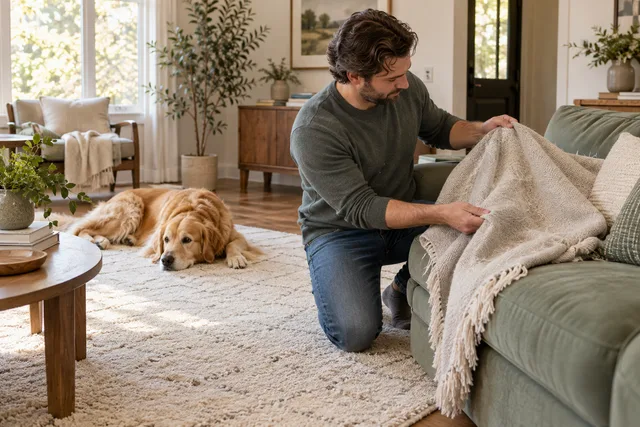
The separate household cover is illustrative. It does not show the Uproot tool, certify compatibility with the pictured sofa or claim a before-and-after outcome. A clean-looking room is not evidence of how much hair a scraper removed. Neither image establishes the force required in your hand or the response of a particular textile.
Use the product image to understand the general form, then use the written identity and limitations to assess the purchase. Do not choose a lookalike on appearance alone. Several tools can share a frame-and-handle silhouette without sharing the same manufacturer, edge or instructions.
The manual edge is the reason to consider it
A manual scraper offers a different interaction from rolling a sticky sheet over a surface. You control the path and the area being worked, then deal with the collected material. The Uproot listing describes drawing the tool across the affected area and removing the gathered hair. That is the proposed workflow, not a measured collection rate.
This format may be attractive when you want a small hand tool for a particular reachable patch. It is less attractive if your main need is to cover a large area without repeated hand movements. We have not measured head pressure, fatigue or the number of passes, so the compact shape should not be read as a promise of effortless work.
The key question is whether a controlled scraping task fills a gap in your routine. If a suitable method already handles your problem, the existence of another reusable tool is not a reason to replace it. Define the surface and the remaining hair problem before evaluating the mechanism.
Non-knitted is a restriction, not a blanket safety approval
The manufacturer describes the Original for non-knitted fabric. That excludes treating a knitted throw or sweater as automatically suitable. It also does not prove that every other construction, finish or upholstery assembly can tolerate the edge. Read the item’s own care information and resolve uncertainty before proceeding.
For a cautious purchasing decision, identify the exact surface rather than writing only couch or rug. Those names can describe many materials. If you cannot determine what the surface is or what its care directions allow, the scraper may be the wrong purchase for that task. Do not let a general product category replace the missing information.
Where use is appropriate under the relevant instructions, start with a gentle check in an inconspicuous area and inspect the response before considering a broader area. That is a precaution, not a guarantee that later use cannot cause damage. Stop if the surface responds poorly; more pressure is not a way to resolve uncertain compatibility.
Official angle guidance has a limited purpose
The brand’s Pro and Max instruction page describes a 45-degree angle for hard fabrics such as carpets and car mats. For delicate fabrics it describes 90 degrees and gentle first swipes. It gives directional strokes rather than a promise that pressing harder improves the result.
These instructions help explain the intended handling distinction. They do not override the non-knitted restriction or the care limits of your own item. A change of angle cannot be assumed to make an unsuitable material suitable. If the instructions with your particular tool differ, clarify the difference before relying on a general webpage.
We do not give a universal pressure setting or number of strokes. No test here establishes those values, and a visual angle does not quantify force. Treat technique as something to understand before buying, especially if you want a tool that requires little judgment about the material underneath it.
Assess a small area instead of judging by the hair pile alone
A pile of collected material can look persuasive, but it is not the whole assessment. Consider whether the surface remains acceptable, whether the task is manageable and whether the method addresses the specific problem you identified. This review supplies no measured standard for how much material should be collected.
If you assess the tool yourself, keep the observation narrow: the item, the area, the method used and what you noticed. Do not assume that a result on one mat establishes compatibility with a different piece of upholstery. Avoid turning a single satisfactory patch into a claim about an entire house.
The tool is marketed for hair removal, not as proof of hygiene, allergen removal or disinfection. A visually improved surface does not establish those outcomes. Choose any separate cleaning process according to the item’s care instructions and the job you actually need done; do not infer it from the scraper’s appearance.
The collection step still takes work
The listing presents the Pro as reusable without sticky rolls, batteries or vacuum bags for its own operation. That identifies consumables the tool does not require; it does not establish zero maintenance, zero waste or a measured environmental advantage. Collected hair still has to be managed.
Think about the complete task before purchasing. Where will you put the removed material, how will you keep it from spreading again, and where will the tool be stored? These ordinary questions can matter more than the dramatic appearance of a demonstration. A device that lifts hair but does not fit your cleanup sequence may be inconvenient in practice.
We have not verified a dishwasher method or a specific cleaning chemical for the Original. Follow the supplied care information and ask about an unclear maintenance step. Metal and plastic construction alone do not establish compatibility with every wash method, soak or temperature.
Keep this household review separate from grooming
The inspected Amazon copy says the products can also be used directly on pets. This review does not recommend that use. The evidence assessed here concerns a manual household hair-removal tool and fabric instructions; it does not establish a body-grooming method or individualized skin and coat suitability.
If your aim is removing loose hair from your dog’s coat, identify a product and instructions intended for that grooming task. A photograph of a dog beside a household tool is not enough to establish a safe handling technique on the animal. Do not substitute fabric scraping directions for grooming directions.
This distinction also keeps the buying decision clearer. Hair already lodged in a carpet and hair still on a dog’s coat are different tasks. Solving one does not automatically solve the other, even when a product page places both in the same marketing paragraph.
Compare the scraper with the ChomChom format
Our ChomChom Original Roller review covers a different manual format. The Uproot reference uses a drawn edge; a roller presents a different handling and collection arrangement. That distinction can help you decide what kind of interaction suits your task, but it is not a performance ranking.
No side-by-side test here establishes that the Uproot lifts more hair, works faster, protects fabric better or replaces a vacuum. Claims of superiority would require evidence we do not have. Start with surface compatibility and the exact cleaning task before comparing convenience.
If the attraction is merely that both products are reusable, the comparison is not specific enough yet. Consider whether the tool you already have leaves a defined problem that the scraper’s format could address. Buying another device without identifying that gap may just add storage and another set of instructions.
Who should consider the Original, and who should wait
Consider it if you have identified a suitable non-knitted surface, want a compact manual edge and can follow a controlled handling process. The matched Original UPC makes the purchasing reference clear. It is a conditional option for an identified job, not a recommendation to scrape every pet-accessible surface.
Wait if you cannot identify the fabric, if its care directions conflict with scraping or if you need an assurance against damage. Also wait if you are buying specifically for the newer cleaning edge: this reference is the Original and should not be sold to you in the review as the revised version.
The purchase is also less compelling if your main requirement is an effortless whole-room solution or a guaranteed amount of time saved. We have not established those outcomes. A reasonable decision can be to keep your current compatible method and leave the uncertain surface alone.
Frequently asked questions
Which Pro does the button reference? The blue single-tool US listing B09LNX88YK, matched to the Original by UPC 195893874583.
Does the newer Pro page describe the same exact version? Its UPC differs and it advertises a revised edge. We do not combine those specifications here.
Can it be used on every sofa? No such guarantee is supported. Check the exact fabric and care requirements; a broad furniture label does not settle compatibility.
Is it better than a vacuum or roller? No comparative performance test was performed for this review.
Does reusable mean maintenance free? No. Collected material, storage and the tool’s care still need attention.
Verdict and sources
The Uproot Cleaner Pro Original has a straightforward buying case: a manual edge for a defined, compatible fabric task, with a verified US product identity. Its main limit is the judgment required around the surface. Version confusion and broad no-damage language should not obscure that decision.
The linked Original manufacturer page supports the matched UPC and stated construction; the official instruction page supplies the angle guidance. The inspected US listing supplies the ASIN, reference image and model wording. Our workflow and comparison judgments are editorial inferences, not measured results. No customer ratings, current price, personal test or removal guarantee underpins the recommendation.