Best Reusable Roller for Sofa Fur? ChomChom Original Review
A researched look at the ChomChom Original: fabric touch-ups, the collecting chamber, manual effort and the care limitations to check.
ChomChom Original Roller White Classic / Original / 2323445
Consider it for
Routine surface-fur touch-ups on supported fabric upholstery.
Check before buying
Loose fabric needs support; no cleaning-performance or lifespan testing claimed.
Jump to a section
Quick answer: a shortlist option for fabric touch-ups
The ChomChom Original Roller is worth considering when your main job is removing visible pet hair from accessible fabric surfaces and you prefer a reusable manual tool. Its appeal is a collecting chamber instead of disposable adhesive sheets. The tradeoff is the work you still do: positioning the fabric, making repeated short strokes and emptying the chamber. It is not an automatic room-cleaning system.
Our conditional recommendation is strongest for a clearly defined area, such as a frequently used section of a sofa. We would reconsider the purchase if your priority is whole-room floor cleaning, narrow crevices or a promise that one tool works on every textile. This is a researched assessment, not a hands-on test. We have not measured pickup rates, effort, fabric wear or service life.
The exact Original Roller reviewed here
The verified US Amazon listing is B00BAGTNAQ, White Classic, Original size, model 2323445. It identifies one roller and GTIN 00856957004000. These details anchor the product being discussed; they do not imply that white performs differently from another finish. We treat equivalent colors and identifiers within this roller family as one review.
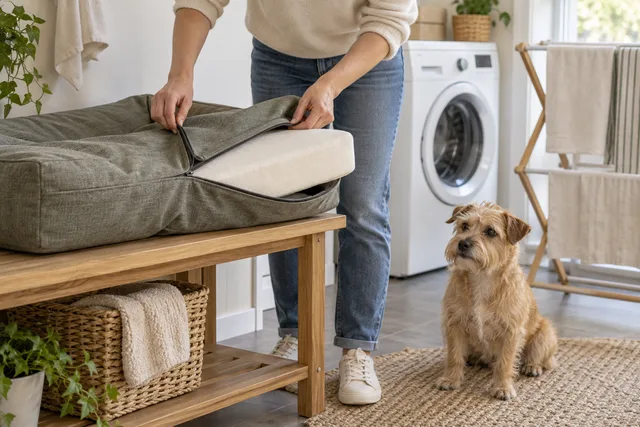
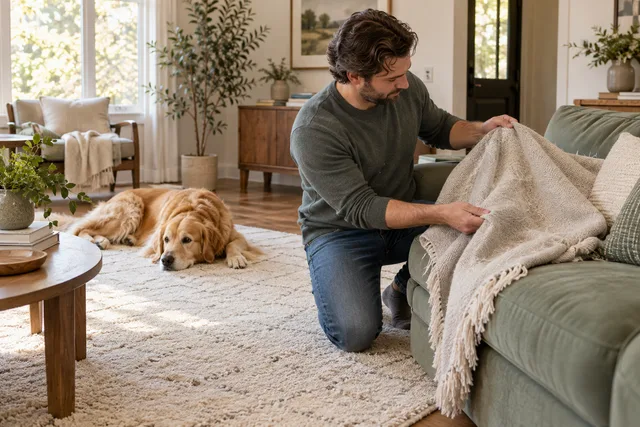
The product panel uses the selected listing’s verified first image, a composite showing the white tool and its collection chamber. Promotional words printed within that retailer image are the brand’s claims, not results of our testing. The separate article cover is an illustrative home scene and should not be used to judge the exact shape or dimensions of the roller.
Check the selected offer before ordering. A roller, a detailer and a roller bundle with another implement are different package descriptions, even when the brand name is prominent in all of them. Decide whether you want the original tool by itself before comparing an offer that includes additional equipment. We have not evaluated those other implements here.
What the collection mechanism asks you to do
The US product listing directs short back-and-forth strokes, followed by opening the catch and removing collected hair. It describes a reusable design without adhesive refills. Think about that alternating movement when assessing the format; a long, one-direction sweep is not the same motion as the supplied directions.
The practical benefit is having a place for collected hair within the tool. The practical responsibility is emptying it. Plan the job as a complete sequence rather than judging only the movement across a cushion. If reaching a bin, opening a catch or removing the collected material feels inconvenient, that matters to the purchase just as much as the absence of replacement sheets.
A promotional image of a full chamber cannot establish how many strokes your sofa will require. The amount of visible hair, the textile and the area being worked on all differ between homes. Treat photographs as illustrations of the design, not a controlled comparison against your vacuum or another roller.
Evaluate the surface before the hair
Start with the material you want to clean. Read its care information and consider seams, raised stitching, loose threads and decorative elements. Broad product wording about furniture does not certify every upholstery construction. If the furniture maker restricts rubbing or brushing, resolve that conflict before trying a new tool on the visible seating area.
A supported cushion panel and a loose hanging throw present different handling problems. On the first, the surface stays comparatively steady while you move your hand. On the second, you may spend time holding the fabric in place. That distinction is an editorial way to assess the job, not a measured performance ranking of textiles.
Chewy’s White Roller page includes a retailer Q&A explaining that loose fabric needs support. Use that as a reason to consider the setup, not permission to pull a delicate material tightly. The textile’s own care requirements still matter. We did not verify a fabric-by-fabric compatibility table for this product.
Look at access as well as material. Can the working head reach the intended area without catching piping or hardware? A flat photograph of a car seat may hide the deep joins and shaped edges that make the task awkward. Do not assume the tool will reach every place simply because the general surface category appears in the listing.
Three household jobs, with different tradeoffs
A favorite sofa seat: this is a focused job with a clear boundary. Consider whether the cushion remains stable and whether you can reach its edges comfortably. If only a small visible area needs attention between your normal cleaning sessions, the manual format may be convenient. That is a use-case judgment, not a promise about speed or the number of passes.
A removable throw: the preparation may matter more than the size of the tool. You need an appropriate supporting surface and a way to keep the fabric from bunching. Decide whether that setup is simpler than your current fabric-approved hair-removal method. The roller does not change the throw’s laundering instructions or deal with every kind of soil.
A textile car seat: separate the broad sitting surface from seams, buckle openings and other recesses. One implement may be convenient for a panel while another method remains necessary elsewhere. Compare the complete task rather than expecting one purchase to replace every attachment or cleaning step.
These examples describe choices to consider before buying. They are not reports of trials in our home or vehicle. If your main problem falls outside accessible fabric areas, keep that mismatch visible rather than trying to stretch the recommendation to justify a new tool.
Compare formats without inventing a winner
With an adhesive-sheet roller, keeping replacement sheets available is part of ownership. With this reusable format, the relevant questions shift toward emptying and care. That difference can matter to someone who dislikes running out of supplies, but it does not by itself establish better pickup, lower lifetime cost or a smaller environmental footprint.
A vacuum introduces a different set of questions: the attachments you already own, the surfaces they are approved for, where they are stored and how much of the overall cleaning job they cover. If your existing setup is convenient and effective for your needs, another manual tool should have a specific role before it earns storage space.
Do not turn the comparison into a contest over the largest pile of hair. A tool used on a different area or at a different time has not been given an equivalent task. For your own decision, consider whether the proposed purchase removes an inconvenience in the routine rather than whether its advertising looks more dramatic.
We do not assign savings, a payback period or a performance score because we have not established those figures. Reusable describes the intended format. It does not establish indefinite durability, zero waste or a guarantee that no component will ever need replacement.
A sensible first-use check
When the order arrives, compare the item and package description with the selected offer. Read the supplied directions before using it, including any restrictions that were not visible online. Keep the purchase record until you have confirmed the correct product arrived. A matching color alone is not a complete identity check.
If the textile’s guidance permits the method, start with a small, inconspicuous area. Use the normal movement described in the product instructions; do not begin with a pressure test or repeated aggressive rubbing. Stop if you see snagging, an altered surface or a mechanical problem. An unclear result is a reason to reassess, not automatically to push harder.
Inspect what happened to both the fabric and the tool. Did the material remain stable? Was the handle comfortable for that position? Could you open and empty the chamber without spilling hair back onto the surface? Those observations address whether the format suits you, without claiming a scientific comparison.
Keep any trial within the seller’s current conditions. This review does not promise that a used item can be returned. If return eligibility matters to your decision, check it before testing rather than assuming that a policy quoted elsewhere applies to your purchase.
Care guidance and its evidence limits
The exact White Roller page on Chewy includes an older retailer answer advising against washing the brush directly under water and describing cleaning with a soft damp towel. That is retailer guidance, not a manufacturer manual independently verified for this review. Follow the instructions supplied with your unit and clarify any conflict before choosing a cleaning method.
Emptying dry hair and cleaning the roller are separate jobs. A chamber that no longer contains a visible clump is not evidence that the tool has been washed or disinfected. We have not verified a dishwasher cycle, soaking method, disinfectant recipe or universal detergent compatibility, and we do not prescribe one.
Choose storage that keeps the working surface protected and the tool out of chewing reach. If the catch or housing becomes damaged, set it aside while checking the appropriate next step. Do not force a stuck mechanism merely because some hair remains inside it.
The missing manufacturer care document remains a limitation of the evidence. We have not filled that gap with instructions from similarly named websites whose relationship to the brand was not established. Readers who need an exact chemical-cleaning protocol should resolve that question before relying on this tool for that routine.
What this purchase will not establish
This is a surface-cleaning purchase, not a grooming plan. Chewy’s product Q&A advises against direct use on the animal. If the task is coat care, our HandsOn grooming gloves assessment discusses a different equipment category. Its methods should not be transferred to this roller.
Removing visible hair also does not establish removal of allergens, microorganisms or every particle in a fabric. We make no health or sanitation claim for the roller. Keep the ordinary care requirements of the surface separate from the narrower question of whether visible fur has been collected.
For bedding that needs laundering, follow the actual cover label. Our removable dog bed cover guide addresses that separate job. A surface tool may have a place in preparation when permitted, but it cannot turn an unsuitable wash setting into an appropriate one.
Frequently asked questions
Does it need adhesive refills? The verified listing describes a reusable roller without adhesive sheets. You still need to empty and maintain the equipment. That feature is a supply difference, not proof of a lower total ownership cost.
Is another color a separate recommendation? No. We cover the Original Roller family together. Confirm the actual package and selected variant, especially when comparing a single tool with a bundle containing other implements.
Will it work on loose clothing? Do not infer that from a sofa example. Consider the garment’s care requirements and whether it can be supported appropriately. The retailer’s loose-fabric caution is useful context, not a guarantee of compatibility with delicate garments.
Can it replace a vacuum? We have not established that. Identify the particular fabric area you want it to serve and retain suitable methods for the rest of the job. A tool can be useful without replacing an entire cleaning routine.
What should I check if the exact size matters? Ask for current measurements of the selected product and compare them with the space you need to reach. We do not infer a working-head dimension from the photograph or copy a size from another bundle.
Sources and final buying decision
The linked US Amazon listing establishes the reviewed identity and basic operation; the exact White Roller page on Chewy supplies separately attributed retailer guidance. Neither source is a substitute for comparative testing. Our household examples and decision questions are editorial analysis, not customer testimonials.
Shortlist the ChomChom Original when a refill-free manual tool has a clear role on suitable, accessible fabric. Reconsider it when that role depends on universal textile compatibility, a verified cleaning protocol that you do not yet have, or replacing equipment that already handles the wider task.
Product details

ChomChom Original Roller
White Classic / Original / 2323445
Read customer reviews on Amazon ↗
- Manual back-and-forth operation on supported fabric
- Collecting chamber opens for emptying
- No disposable adhesive sheets required
Consider for: Routine surface-fur touch-ups on supported fabric upholstery.
Before you choose: Loose fabric needs support; no cleaning-performance or lifespan testing claimed.
Product information source · Reviewed 2026-09-24
Check current price, seller and options on Amazon.
US Amazon listing identifies B00BAGTNAQ, White Classic, Original size and model 2323445. Affiliate link.