Best for Pantry Storage? Vittles Vault Pawprint Outback Review
Assess the Vittles Vault Pawprint Outback 25-pound offer by its verified UPC, screw-lid format, original-bag fit and unresolved dimensions.
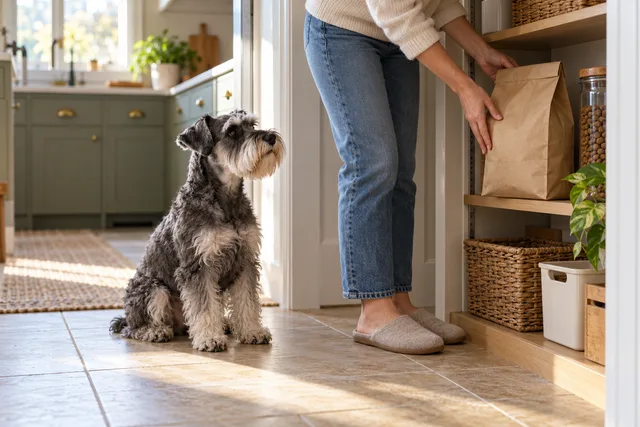
Vittles Vault Pawprint Outback 25 Pounds + scoop / UPC 029695342196
Consider it for
A pantry with confirmed bag fit and lid clearance.
Check before buying
Published height and capacity details conflict; no tested seal or pest guarantee.
Jump to a section
Direct answer: a useful candidate when the bag and space actually fit
The Vittles Vault Pawprint Outback is worth considering when you want a rigid, screw-lid outer container for dry dog food. The buying decision depends on usable space, lid access and the size of the original food bag. A nominal 25-pound label is not a guarantee that your particular unopened or rolled bag will fit inside.
This review uses the US 25 Pounds listing with scoop, ASIN B0GZSLP7B6 and UPC 029695342196. We matched that UPC to Petmate’s item 34219 under model code 15-4328. We have not filled the container, tested the seal, measured its dimensions or challenged it with insects. The recommendation concerns its documented format and your storage routine, with important specification conflicts left visible.
Product details

Vittles Vault Pawprint Outback
25 Pounds + scoop / UPC 029695342196
Read customer reviews on Amazon ↗
- Rigid container with threaded lid
- Scoop included in inspected offer
- Manufacturer grid matches the listing UPC
Consider for: A pantry with confirmed bag fit and lid clearance.
Before you choose: Published height and capacity details conflict; no tested seal or pest guarantee.
Product information source · Reviewed 2026-10-22
Check current price, seller and options on Amazon.
ASIN and UPC directly inspected; Petmate grid item34219 / modelcode15-4328. No hands-on test. Affiliate link.
Which Vittles Vault this review covers
The Petmate manufacturer grid connects item 34219, UPC 029695342196 and a 25-pound scoop-included description to model code 15-4328. It also lists older item 4328 with UPC 769397143287 under that code. This supplies an identity bridge without pretending that the two UPCs are identical.
The inspected Amazon page selected 25 Pounds and displayed the matching newer UPC. Its initial main image showed a gray pawprint container, a scoop and a 25-pound label. That supports the reference offer; it does not establish the dimensions, sealing performance or contents of every other seller’s shipment.
This is one review of the Pawprint Outback family. A different size, pack or identifier does not create a separate recommendation. Before ordering, compare the selected size, included components and identifier with your intended purchase. A familiar name on a search tile is a starting point, not enough information to settle those details.
The specification conflicts matter for a tight pantry
The official Pawprint Outback page contains inconsistent 25-pound dimensions: the written details give 12 by 12 by 18 inches, while a product graphic describes a 13.75-inch height. We cannot determine which applies to the inspected offer. Do not use either as a verified cabinet-fit measurement.
The Amazon page has another conflict: its title and selected option say 25 pounds, while a feature paragraph says 50 pounds. We use the selected 25-pound identity and disclose that mismatch rather than combining the larger capacity with the smaller offer. No measured capacity claim follows from this review.
If your shelf has little spare clearance, that uncertainty is a practical reason to postpone this purchase. Ask for the dimensions of the actual item being supplied before committing to a constrained space. Consider both the closed container and room to remove the lid, reach the bag and return the scoop. A footprint alone does not answer the access question.
Why the screw-lid format may suit your routine
The format offers a defined opening and a separate lid rather than a flexible bag closure. For someone who wants an outer shell around the original bag, that is a sensible mechanism to compare. The manufacturer describes a threaded lid with gaskets; this is a design description, not our confirmation of airtight performance.
Think through the actual sequence at your feeding spot: retrieve the container if necessary, open the lid, access the food bag, close the bag, then secure the outer lid. If that sequence feels awkward in the available location, a product’s sealing language will not make the location more convenient. Choose around the actions you will repeat.
The same reasoning applies to shared households. A container should be easy to identify and put back correctly without someone having to guess which food belongs inside. Decide where the current bag information and instructions will remain accessible. The aim is a clear routine, not simply replacing visible packaging with a tidier object.
Keep the original bag in the purchasing calculation
The FDA’s storage guidance favors putting the entire dry-food bag into an outer container. It also calls for retaining identification information and washing and drying the container between bags. Those points are why original-bag fit belongs in this buying decision.
A bag’s shape is a separate problem from the weight printed on it. To plan your purchase, note its width, depth and the space needed for its folded closure. Then seek usable opening and internal-space information for the actual container. External dimensions cannot prove that the opening will admit a bulky bag.
Do not buy a larger food quantity just to match a bin’s advertised capacity. The container should serve the food you already intend to store. If it cannot accommodate that bag as planned, consider another size or format without treating a second purchase as inevitable. This review supplies no feeding quantity, food-selection or nutrition recommendation.
Choose the location before choosing the size
A useful exercise is to outline the proposed storage area and simulate opening a lid at that height. Check what sits above, beside and in front of it. A bin that fits on an empty floor may become inconvenient when a door swings across it or another household item occupies the approach.
Also consider whether you expect to move the filled container. We have not tested its loaded handling, grip comfort or stability. Do not infer comfortable lifting from the empty product photograph. A location that avoids repeated movement may be more suitable for your circumstances, but the right arrangement depends on the person and room.
Our preference is to resolve access and dimensions before comparing capacity labels. For an open pantry corner, the outstanding height conflict may be less decisive; for a fitted pullout shelf, it can determine the entire purchase. This is a conditional choice based on available space, not a universal best-container ranking.
A seal claim does not settle every storage question
An airtight marketing description should not be converted into a promise of indefinite freshness, insect exclusion under every condition or protection from a determined dog. We have not independently verified those outcomes. Nor does the presence of a gasket establish that a lid has been closed correctly after every use.
Treat the container as one part of the storage arrangement. Follow the food’s own instructions and dates. A rigid outer shell does not authorize extending a best-by date, mixing an old remainder with a new bag or ignoring damage. If your main requirement is a certified resistance standard, this review does not establish one.
Similarly, do not infer that the bin is a safe unattended barrier simply because it has a screw lid. Decide where access should be controlled separately from whether you like its closure mechanism. Product descriptions about pests and freshness are claims to assess, not substitutes for understanding your household’s specific access problem.
Maintenance is part of the ownership cost
Before purchasing, consider whether you have a workable place to empty, clean and fully dry an object of this form. We have not tested cleaning time or access to its corners. A container that seems convenient while full may require more space when you are handling the empty bag and preparing for the next one.
The maker recommends regular washing and drying. Neither that statement nor a plastic material description establishes dishwasher compatibility for the exact supplied container. Use the supplied instructions to determine the permitted method. Do not assume that a lid, seal and body can all be treated identically because they arrive together.
Plan storage for the included scoop as well. Inclusion is a convenience feature, not evidence that the scoop measures the amount your dog should receive. We have not calibrated it. Keep the distinction between a tool for moving food and the method you use to determine a quantity; the container review cannot supply that decision.
Who should consider it, and who should wait
Consider this family if you want a rigid outer shell with a screw-top opening, can confirm the actual dimensions, and have room to access the original bag without reorganizing the pantry each time. The matching manufacturer item and UPC make the inspected offer more identifiable than a generic product-name match.
Wait if cabinet clearance is critical and the seller cannot resolve the height discrepancy. Also wait if your decision depends on a proven pest test, guaranteed airtightness or measured bag capacity. None of those results was produced for this review. A missing result should remain missing rather than becoming an optimistic estimate.
If your current storage already meets your needs, there is no reason here to replace it simply for a cleaner-looking shelf. The case for buying is a specific unmet requirement: perhaps a rigid outer container or a different opening arrangement. Define that requirement before deciding whether this particular format answers it.
Compare the task, not just the container label
For a pantry purchase, compare usable bag space, opening access, closure handling and care instructions. For a travel purchase, your questions may instead concern what you can carry and how it packs with other belongings. Those are different jobs; a useful home bin does not automatically become a convenient trip container.
Our existing Kurgo Kibble Carrier review addresses that travel format separately. It is not a head-to-head performance test against this bin. Read the relevant review only if that task matches your need, and avoid buying both as a default solution to an undefined storage problem.
For the wider routine, our original-bag storage guide explains the handling task independently of a specific product. This review adds an identifiable purchasing reference, a closure-format assessment and unresolved specification limits. A named bin is optional; the choice should follow a specific storage need.
Check the delivered item before assigning it a permanent space
Keep the offer identity available when the item arrives. Compare the label and included components with the selected purchase, then inspect the body, opening and lid before placing food inside. This is an inspection step you can plan, not a claim that we examined a delivered sample. Report an unexplained mismatch through the seller’s normal process rather than assuming it is simply a renamed version.
Try the intended empty bag arrangement and the opening sequence before committing the pantry layout. Notice whether your hand can reach the bag closure and whether the lid has a safe place to rest while open. A convenient closed position can conceal an inconvenient working position. Do not rely on a photograph of another household’s setup to decide yours.
If the fit is wrong, pause and reassess the container choice. Compressing the bag into an awkward arrangement or moving other essentials out of reach can undermine the reason for buying a storage aid. A return or another format may be more appropriate than adapting your whole routine around an unresolved measurement.
Frequently asked questions
Does the 25-pound offer have a verified model identity? Its Amazon UPC matches Petmate item 34219 under model code 15-4328. The older 4328 item has a different UPC.
Will my 25-pound food bag fit? That has not been established. Bag dimensions, opening clearance and usable internal space still need checking.
Which published height should I use? Neither conflicting value is a measurement verified here. Resolve the actual supplied item’s dimensions for a tight space.
Is the included scoop a feeding prescription? No. We have not calibrated it or established an appropriate serving amount.
Was this container tested for pests or airtightness? No. The review distinguishes the maker’s design claims from tested results.
Should I buy separate colors or sizes for a better result? There is no such recommendation. Choose only the format and capacity your defined task requires.
Verdict and evidence limits
The Pawprint Outback has a reasonable buying case as an identifiable rigid outer container with a screw lid and included scoop. The decision becomes weaker when exact cabinet clearance or guaranteed bag capacity is essential. Resolving those questions matters more than choosing the largest number on a listing.
The linked manufacturer product page supports the design and care descriptions; its grid connects the offer’s UPC to an item and model code. The FDA link supports the limited storage precautions cited. Fit judgments and workflow questions are editorial analysis. No personal testing, customer feedback, star score or current-price claim underpins this recommendation.