How to Prepare for Your First AKC Rally Novice Course
Learn Rally Novice signs, rehearse transitions and use the handler walkthrough to prepare for a new AKC course.
Jump to a section
Direct answer: learn the signs, then rehearse the route
To prepare for your first AKC Rally Novice trial, learn the official Novice signs, practice moving between them with your dog on leash, and develop a repeatable way to study a new course. At the event, use the handler walkthrough to connect the posted map with the actual ring. Knowing an individual exercise and remembering where it belongs are different skills; prepare both.
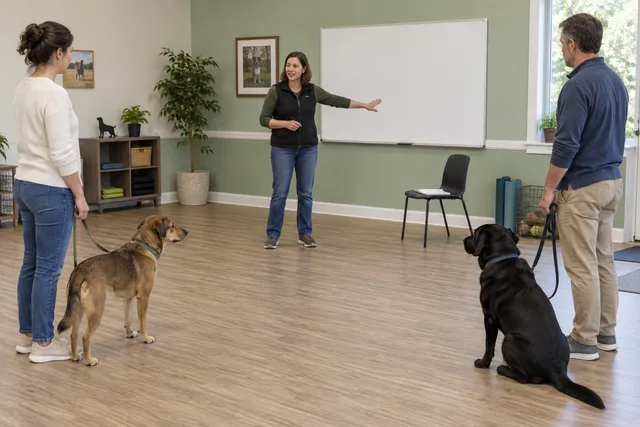
This guide focuses on reading and rehearsing a Novice course. It is not an entry service, a substitute for instruction or a promise of a qualifying score. The cover is an independent illustrative preparation scene, not an official AKC event photograph. Check the current regulations and event documents before competing, especially if your previous experience comes from another organization.
1. Understand the task before designing practice
AKC’s Rally getting-started guide describes Novice as an on-leash course with 10 to 15 signs, involving skills such as turns and changes of pace. It permits verbal encouragement, clapping and patting your legs at this level. A qualifying score is at least 70 out of 100; three qualifying Novice performances earn the RN title.
Those facts suggest two separate preparation questions. Can your dog respond to familiar cues while you move together, and can you recognize what a sign requests without stopping to invent a plan? Write separate answers. A dog may understand a sit while the handler still confuses two written sequences; repeating the sit alone would not solve that reading problem.
Choose a modest first-event objective you can evaluate afterward, such as following the complete numbered route while communicating clearly. Keep the official result separate from that learning objective. A useful personal goal should not encourage you to continue when your dog is struggling with the environment or when an official directs otherwise.
2. Build a sign reference that distinguishes similar exercises
Start with the official AKC Rally Resource Center, which links regulations, sign descriptions and demonstration videos. Use the written description alongside a demonstration. An isolated picture of the sign may be useful for recognition, but it cannot explain every detail of the required performance.
Create a small reference sheet with four columns: sign name and identifier, required sequence, the detail you tend to confuse, and the question to check with your instructor. Keep your own shorthand visibly separate from official wording. For example, a reminder about your footwork belongs in your notes; it should not be presented as an additional rule for everyone.
Work with a small selection at a time. First explain the sequence aloud without your dog, then compare your explanation with the current description. If two signs look similar, place them side by side and identify the exact difference before practicing. Guessing from a familiar symbol can reinforce the wrong sequence.
Keep a revision date on printed notes. If you discover an outdated explanation, replace the relevant card rather than accumulating contradictory versions in the same folder. The goal is a reference you can trust under distraction, not a large collection of screenshots.
3. Rehearse your own movement before adding the dog
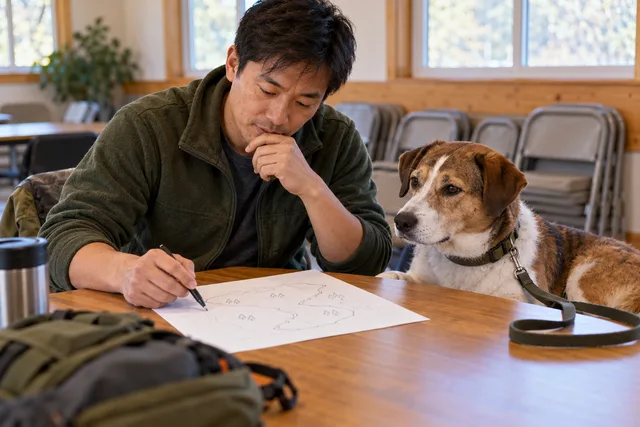
Set out a short, uncluttered practice route using safe markers in a suitable space. Walk it alone first. Read each prompt, imagine the dog’s position and notice where you need to look next. This separates your navigation errors from your dog’s responses and makes it easier to identify the actual problem.
Ask a training partner to observe one specific thing, such as whether you turn the intended direction or look ahead before leaving a station. A narrow observation is more useful than a general judgment that the run looked messy. Change one part of your plan and repeat a short section, rather than rehearsing the same confusion through a full course.
Leave room for your dog and your own movement. Furniture, slippery flooring and unstable improvised stands can make a home arrangement unsuitable even when the diagram fits on paper. A household practice route is an exercise in organization; it does not certify that your layout matches an official ring.
When the route makes sense to you, add your dog for an appropriately short session using skills you have already taught. If the difficulty rises sharply, simplify the sequence with your instructor. Do not use leash pressure to force a performance you have not prepared.
4. Practice transitions instead of collecting isolated successes
A station can go well while the approach to the next one falls apart. Review the space between exercises: where your attention goes, whether your cue is clear and whether the leash interferes with movement. These observations help distinguish a reading issue from a transition that needs more practice.
Change the order of a few familiar exercises so that you must read rather than recite a memorized routine. Keep the underlying skills familiar while changing the sequence. Adding unfamiliar skills, a new location and a long route at the same time makes it hard to tell which change caused difficulty.
AKC’s introduction to competing in Rally emphasizes teamwork and accuracy rather than racing through the course. It also distinguishes permitted encouragement from luring. Use that distinction as a question for instruction: your dog should understand the task without following a pretend food hand through every movement.
Record one transition that worked and one that needs help. A short factual note, such as losing the next sign after a turn, gives you something concrete to discuss. Avoid turning every imperfect practice into a longer session. More repetitions are useful only when the task and your response become clearer.
5. Confirm class eligibility without assuming beginner means A
Before entering, use the official class-selection reference and the Rally sections of the regulations. The document includes more than one sport, so locate Rally rather than using an Obedience class description by mistake. Previous handler experience and the dog’s titles can affect the correct choice.
List the dog’s relevant titles and your own competition history before checking the criteria. If something is ambiguous, resolve it with the event’s official entry contact before submitting. Do not select Novice A solely because this particular dog has never attended a trial.
Read the premium for the event you actually intend to enter. Then retain the judging program and any official updates with your confirmation. A personal practice schedule cannot establish the event’s class order, reporting instructions or permitted arrival arrangements. Keep those event-specific facts in a separate part of your notes so they do not get mixed with sign-study reminders.
6. Use a deliberate method for the course walkthrough
The AKC Rally Regulations, amended August 12, 2025, provide for a handler walkthrough without dogs, lasting up to ten minutes at the listed class start. They also describe posted course maps. Read the current provisions and event schedule rather than assuming you will have unlimited ring access or that a map will arrive well in advance.
During your available walkthrough, trace the complete numbered sequence first. Locate the start, finish and each change of direction. On a second pass, focus on the transitions most likely to confuse you. This two-pass approach is a suggested memory aid, not an official requirement or a guarantee that time permits unlimited repetitions.
At an awkward transition, look at the actual placement and your path toward the next sign. Do not rely exclusively on the apparent scale of a printed diagram. Mentally include your dog’s position instead of planning a route that only fits your own feet.
If you have a question about the course, ask appropriately while respecting other handlers’ access and the judge’s work. Do not expect a private lesson. Finish with a concise mental sequence, then leave the ring when instructed. Arrange safe, permitted care for your dog while you are walking; bringing the dog along would defeat the handler-only arrangement.
7. Separate warm-up rewards from the competition ring
The regulations require a nonqualifying score when a handler brings or offers food, toys or an item judged to be a training aid in the ring. This is a practical reason to check your pockets and clothing before approaching for your turn. A treat left in a pocket is not made irrelevant simply because you do not plan to use it.
Make a personal transition routine: finish any permitted warm-up, put rewards away in an appropriate place, check the equipment against current rules and approach only when called. Have your instructor review your collar and leash choice beforehand; ordinary walking equipment should not be assumed suitable for competition.
Keep the routine short enough to remember. A long checklist read at the gate may distract you from the steward and your dog. Prepare the detailed equipment questions earlier, leaving only a few final checks at the event. Your own reminders support official instructions; they do not override them.
8. Review the run without inventing the judge's reasoning
After your turn, distinguish the recorded result from your impressions. Write down the station or transition you found difficult while you still remember it, and review any available score information through the event’s normal process. Do not turn a remembered hesitation into an invented deduction or accuse a sign of being wrong without evidence.
For the next practice, choose a single issue that you can reproduce safely, such as reading the next sign after completing a turn. Work on that small task before attempting another complete route. If the main difficulty was coping with the venue, discuss an appropriate preparation plan with a qualified instructor rather than treating it as a simple memory failure.
Keep one positive observation too. A successful transition can show which cue or preparation step was useful. Your notes should lead to a concrete next action, not a vague verdict that your team is good or bad at Rally. A first trial supplies information; it does not establish a permanent limit on what you and your dog can learn.
A compact worksheet for the next practice
Make a one-page worksheet with space for the date, location, signs reviewed and one transition to improve. Under each exercise, distinguish what you intended from what you actually did. For example, you might correctly remember the required sequence but realize that you looked down so long that you lost the next marker. That observation suggests a handler rehearsal, rather than teaching the dog a different exercise.
Add a column for questions that remain unresolved. Label a question as a rule, a training skill or event administration. This helps you take it to the right source: regulations explain the required performance, instruction helps you teach it, and event documents establish local arrangements. None of these categories can answer every question alone.
Leave the last line for a stopping point. Decide what a manageable session would accomplish before you begin, and adjust if your dog or the setting makes that plan unsuitable. The worksheet’s benefit is clarity and a record of progress. Its limitation is that it cannot assess your team’s readiness from a distance. Bring specific uncertainties to an instructor who can observe you together.
FAQ: first AKC Rally Novice course preparation
Do I need to memorize a specific course before entering? Study the eligible signs and practice reading unfamiliar sequences. Use the event’s official course information when available; do not assume a sample practice map will be your trial course.
Can I take my dog on the walkthrough? The handler walkthrough described above is without dogs. Arrange an appropriate waiting plan and follow the event’s directions.
Should I practice without rewards immediately? Build understanding with suitable instruction and rewards in training. Prepare the transition to ring conditions gradually; never bring food or toys into the competition ring.
Does a first trial have to produce an RN title? No. The title requires multiple qualifying performances. Keep the result and your learning notes accurate rather than treating attendance as qualification.
Where should I check an unclear sign or class rule? Begin with the current AKC descriptions and regulations, then seek appropriate instruction or official event clarification. A social-media clip cannot resolve every rule question.