How to Prepare for Your Dog’s First Group Training Class
Confirm the first-session format, organize the instructor’s requirements, plan arrival and keep useful lesson notes without guessing at care changes.
Jump to a section
Direct answer: prepare the appointment and your learning tools
Prepare for your dog’s first group training class by confirming the course and first-session format, reading the instructor’s requirements, packing the approved equipment and requested records, and planning how you will arrive and take notes. Ask about anything unclear before the appointment. The aim is to make the lesson understandable and manageable, not to demonstrate that your dog already knows every exercise.
This guide concerns a handler-attended learning class. It is different from leaving a dog for a daycare evaluation or handing care to a sitter. It does not teach obedience techniques, diagnose behavior, recommend medication changes or set vaccination schedules. Your provider’s actual instructions govern the appointment, while this checklist helps you organize the practical details.
1. Confirm exactly which session you booked
Open the booking confirmation and note the course name, date, time, address and contact route. Check whether the first session includes dogs or is an orientation for people only. Do not assume that every beginner course uses the same arrangement. If the confirmation is ambiguous, ask the provider rather than arriving with equipment for a different format.
Keep one current copy of these details where you can find it without searching through several promotional emails. Include the name of the person registered to attend and the dog covered by the booking. If another household member will handle the dog, confirm the provider’s attendance rules first. A clear appointment record is more useful than a vague reminder that training starts sometime that evening.
2. Match your questions to the course purpose
Write a short statement about what you want to understand during the course. Keep it concrete: perhaps you want to learn the instructor’s approach to a skill, understand how to practice between lessons or clarify what the beginner class covers. A group course name does not guarantee that it addresses every issue in your household.
Separate questions about the syllabus from concerns that need an individual discussion. Tell the provider about relevant difficulties factually, without trying to diagnose their cause yourself. Ask whether the booked format is appropriate or whether another conversation is needed first. The outcome may be a clearer class plan or a different recommendation; this guide does not determine which training arrangement is suitable for a particular dog.
3. Read the supply list as a set of requirements
The AKC’s first-class guide recommends checking the trainer’s approach, preparing the requested supplies, allowing arrival time and asking questions when instructions are unclear. It also explains that participants can decline an activity they believe is inappropriate. These are limited preparation principles, not a promise that every course follows one curriculum.
Make two columns from the provider’s actual list: required and optional. Copy the specifications as given, including equipment restrictions, rather than rewriting them from memory. If the list is missing, request it. An optional mat or toy is not a required purchase just because a general article mentions it. A list supplied for another course or location may not apply to your booking.
4. Check your existing equipment before buying anything
Look at what you already own and compare it with the class requirements. Identify the leash type, length and attachment equipment the provider permits. Check that the items are in usable condition and that you know which set you plan to bring. This preparation step does not establish fit or teach a handling technique.
For a specific operator example, PetSmart’s training requirements specify an approved four-to-six-foot, non-retractable, non-chain leash and give equipment restrictions. Those are that operator’s rules, not universal rules for all schools. If your existing gear does not match your own instructor’s list, ask what is appropriate before purchasing a replacement based on a generic recommendation.
5. Organize the requested documents without changing care
Find out what records the provider requires and how they should be submitted. Keep copies clearly associated with the right dog and appointment. A document already sent may still need confirmation that it was received. Do not assume that paying for the course means every participation requirement has been checked.
PetSmart’s published requirements, for example, call for written vaccination proof for participation under its stated policy. That is an administrative example, not medical advice or a schedule for your dog. Discuss health questions with the appropriate veterinarian and eligibility questions with the provider. This checklist does not tell you to alter treatment, delay a medicine, change a diet or obtain a particular vaccine merely to make a class deadline.
6. Pack rewards and optional items according to the instructions
Ask what the instructor wants you to bring for the exercises and how it should be stored or accessed. If food rewards are requested, keep them identifiable and consistent with any existing dietary directions. Do not use a general class article as permission to introduce a new ingredient or modify a restricted diet. Clarify uncertainties with the relevant professional or provider.
Pack approved optional items separately from the essentials. That makes it easier to find the necessary leash or paperwork when you arrive. You can leave an optional item out if the instructor does not request it or if it adds complication. This is a preparation guide, not a shopping list: no specific treat pouch, clicker, mat or toy is required by the article itself.
7. Make a simple arrival plan
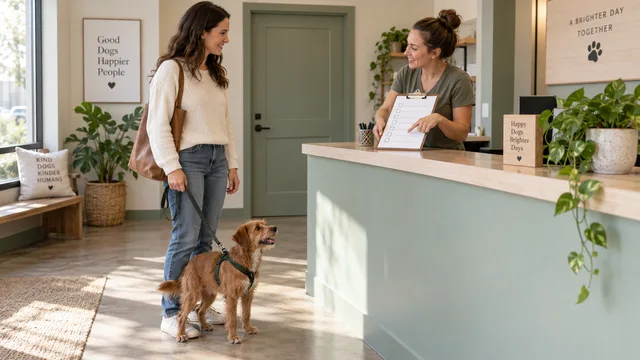
Identify the entrance, parking arrangement and check-in location before the day of class. Allow time for the provider’s arrival procedure and a normal opportunity for the dog to toilet, as appropriate to your existing routine. Avoid arriving at the last moment and then expecting the instructor to resolve several missing details while the lesson begins.
Keep the contact information accessible in case you are delayed. Ask the provider how late arrival is handled rather than inventing a way to enter an active group. If the venue has multiple entrances, note the correct one. The plan should reduce confusion about where to go; it does not guarantee that the dog will be relaxed or that every unfamiliar setting will be suitable.
8. Protect your attention during the lesson
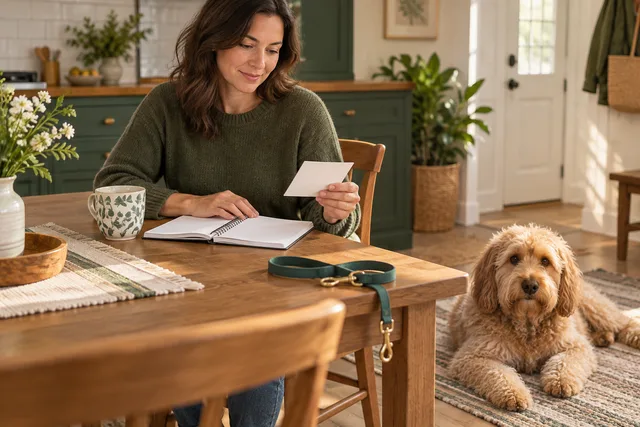
Before leaving, settle routine calls or messages that would otherwise interrupt you. Let relevant people know you will be occupied for the booked period, without sharing unnecessary information about other participants. Bring a small notebook or the note-taking method you can use while also attending to the dog.
Agree household roles if two people are permitted to attend. Decide who will handle the dog and who will record questions, subject to the instructor’s directions. Switching roles without agreement can make it hard to know who heard an instruction or who is responsible for the equipment. Keep this arrangement simple; the aim is to follow the lesson, not to create a second set of instructions competing with the teacher’s.
9. Ask where to wait and how to join the group
On arrival, follow the staff’s check-in and placement directions. Ask where you should wait if you are early or if the room is not ready. Do not assume that another participant’s waiting place is suitable for you. A clear arrival instruction can help prevent several handlers converging at an entrance at once.
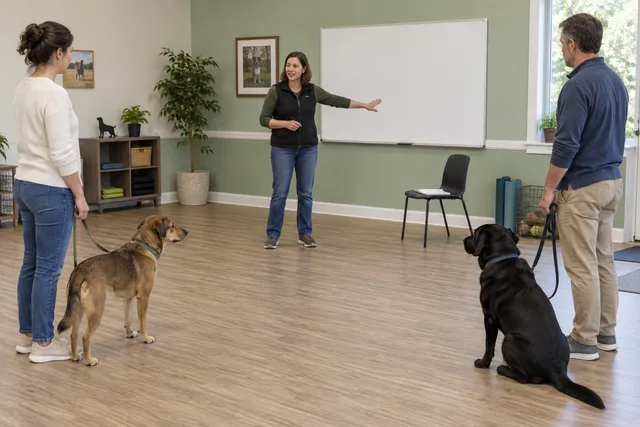
Keep the class purpose in mind. A group training session is not automatically an invitation for every dog to greet every other dog. Ask the instructor about the rules for spacing and interaction rather than deciding on behalf of another handler. If you need a different waiting arrangement, describe the practical problem and request help. This article does not provide a behavioral assessment of anyone in the room.
10. Turn unclear directions into useful questions
When an exercise is explained, ask what the instructor wants you to observe and what counts as completing that step. If you did not hear or understand part of the explanation, say which part is missing. A specific question gives the instructor something clearer to answer than a general statement that training is confusing.
You can ask for a demonstration or clarification without pretending to understand first. If a direction makes you uncomfortable, pause and explain the concern. The AKC guide supports asking questions and opting out of an inappropriate activity. This does not turn the article into an alternative training protocol; it means you can seek a clear explanation instead of following a misunderstood instruction simply to keep pace with the group.
11. Record the lesson without recording other people
Write brief notes about the exercise name, the instructor’s explanation, your unanswered question and the next step you were given. Distinguish what the teacher actually said from your own interpretation. A short factual note is easier to review later than a long account written from uncertain memory.
Ask about any photography or recording policy before taking a video. A class being held in a shared space does not establish that other handlers or dogs should appear in your recording. Follow the provider’s rules and respect other participants’ privacy. You can often preserve the learning point in text without recording anyone. This guide does not authorize publishing a class video, contacting other students or sharing their details.
12. Clarify the practice task before leaving
At the end, check which exercise or material you should review before the next session. Ask how the instructor wants you to report a question or difficulty. If there is a written handout, keep it with the dated class note. Do not replace an unclear assignment with a technique found elsewhere just because its title sounds similar.
The useful result is an understandable next step, not a claim that one appointment has solved every problem. If the instructor has not provided enough detail for you to understand the task, identify that gap. Ask for clarification through the agreed route. This article does not prescribe practice duration, repetitions, exercise intensity or changes to the dog’s usual care routine.
A compact class preparation record
Use a single page with these fields: course and location; first-session format; date and arrival procedure; required equipment; requested documents and submission status; optional items; questions for the instructor; class notes; assigned follow-up; next appointment. Keep unanswered points visible rather than marking the whole page complete because the bag is packed.
For each unresolved point, name the next action. Examples include request the supply list, confirm whether dogs attend orientation or check that records were received. This record is a household organization tool and can be adapted to the provider’s process. It does not assess the trainer’s qualifications, certify the dog’s readiness or serve as a medical clearance for participation.
Frequently asked questions
Does my dog need to know the exercises before the first class? Ask about the course’s prerequisites. A class described as beginner may still have participation requirements or a first-session format you need to confirm. Do not assume that a course label settles eligibility or that you need to rehearse an unfamiliar technique beforehand.
Should I buy a new leash or training device? Compare your existing equipment with the provider’s list first. Ask about an unclear specification before purchasing. This guide recommends no particular product and does not substitute for the class’s actual equipment rules.
Can I bring someone else from my household? Confirm the attendance policy, including any limits on additional people. If another handler is allowed, agree who will handle the dog and who will take notes. Do not assume every venue has space for extra participants.
What if the first lesson is difficult to follow? Identify the part you did not understand and ask the instructor to clarify it. You can request an explanation or decline an activity you consider inappropriate. Difficulty in one class is not a diagnosis and this article does not prescribe a treatment.
Should I change food or medication before class? This guide makes no such recommendation. Keep existing professional directions identifiable and consult the appropriate professional for a care question. Ask the provider how its administrative requirements apply without treating them as individualized medical advice.
Sources and related reading
The linked AKC article supplies general first-class preparation principles. The linked PetSmart page supplies an example of an operator’s specific requirements, verified on its rendered public page. The packing record, note format and appointment checks are original organizational suggestions. No actual class attendance, trainer credentials or results are claimed; the cover is an illustrative scene.
For other distinct appointments, read preparing for a daycare evaluation and preparing for a grooming appointment. For delegation rather than a learning class, see a sitter handover sheet. Their processes do not replace the instructor’s directions for this session.