Best Spinning Dog Puzzle? Nina Ottosson Dog Tornado Review
A focused review of Dog Tornado model 67332: three spinning tiers, twelve compartments, cover handling, cleanup and sourced owner feedback.
Nina Ottosson Dog Tornado 9.8-inch · 12 compartments · 3 layers
Consider it for
A shared, supervised puzzle session.
Check before buying
The name covers different versions. Check the actual compartment count and removable pieces before buying.
Jump to a section
Quick answer: is this Dog Tornado worth considering?
The Nina Ottosson Dog Tornado, model 67332, is worth considering if you want an attended food puzzle built around turning layers and finding rewards. Its useful feature is a clear progression from accessible food to a more involved setup. The compromise is that a dog may learn the pattern quickly, while another may need help understanding the first movement.
This review covers the three-tier, twelve-compartment version linked through Amazon ASIN B07239T47Y. It does not cover every product sold under the Tornado name. Match the model and layout before ordering, particularly when a shop offers several designs on one page.
Choose it for a short activity you can share with your dog. Reconsider it if your main requirement is guaranteed entertainment while you leave the room, or if your dog tends to chew removable pieces. We have not tested this puzzle with dogs, measured durability or established an average completion time.
Version check: model 67332, not just the name
| Identity | Reviewed version |
|---|---|
| Brand | Nina Ottosson by Outward Hound |
| Model | Dog Tornado 67332 |
| Amazon ASIN | B07239T47Y |
| US listing size label | 9.8 inches |
| Puzzle layout | Three tiers, twelve compartments |
| Additional pieces | Three bone-shaped covers |
| Manufacturer difficulty label | Level 2, intermediate |
The manufacturer’s model 67332 page confirms the layout. The US Amazon listing identifies the 9.8-inch, three-layer version. We have not interpreted that single size label as a complete set of dimensions.
Before checking price, compare the selected product image with the layout described above. A familiar name does not make two different designs interchangeable. If the offer changes to another configuration, this review’s details should not be used to fill gaps in that product’s description.
Keep a note of the model number with your purchase information. That makes it easier to find the correct care instructions later and avoids relying on a broad search result that may feature a newer or differently colored design.
What the turning-layer format asks of your dog
Outward Hound describes rotating tiers that reveal food, with the supplied covers adding difficulty. Its instructions require close supervision, prohibit chewing the game or pieces, and say to remove a damaged toy and store the empty puzzle between sessions. Those conditions define the use we recommend. Read the model-specific instructions.
The purchasing question is whether you want to help your dog engage with that sequence. A puzzle is not self-explanatory simply because a video shows another dog completing it. You may need to demonstrate the relevant movement and arrange an easier first attempt.
Think of the session as an interaction rather than a test of intelligence. A quick solution can mean your dog has learned the arrangement. A hesitant response can mean the food is too hidden, the object is unfamiliar or the activity is not appealing at that moment. Neither result justifies labeling the dog clever or difficult.
This format also gives you something specific to observe: which movement leads to the next reward. That can make a shared session interesting even when it is brief. If you want an activity that requires almost no participation from you, this may be the wrong purchasing priority.
Fit comparison for everyday households
| Your situation | Fit assessment | Reason |
|---|---|---|
| You enjoy showing your dog a simple food game | Consider | You can adjust the introduction |
| You need a guaranteed twenty-minute distraction | Reconsider | Individual completion times vary |
| Your dog takes loose pieces away to chew | Poor match | Piece management would dominate the session |
| You can wash and store several components | Possible fit | Care is part of ownership |
| You want a single difficulty setting forever | Reconsider | Familiarity can change the challenge |
This compares possible uses of one model. It does not rank unrelated toys or assign a score based on the number of compartments. More hiding places do not automatically create more useful play, especially if your dog is already familiar with the same movement.
Prepare a clear place and a small amount of food
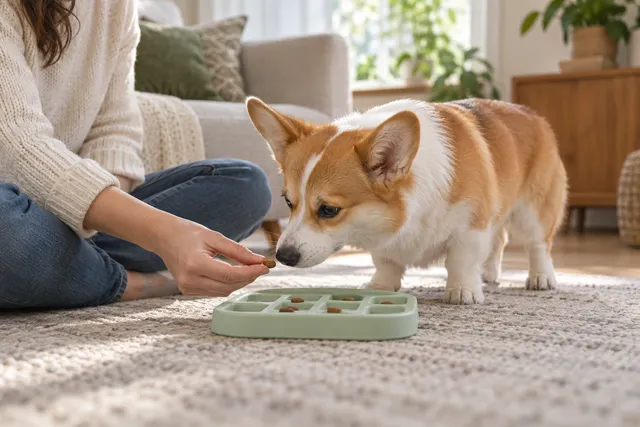
Choose a place where you can sit nearby and see the whole game. Clear away unrelated toys and loose items so you can account for the supplied pieces. Avoid starting in a busy doorway where people must step around the activity or repeatedly interrupt it.
Use a small amount of food already appropriate for your dog, within the existing daily feeding plan. You do not have to fill every location at the first attempt. A modest amount makes it easier to see what has been found and prevents preparation from becoming a lengthy task before you know whether your dog is interested.
Check that the pieces you choose fit the intended spaces without obstructing the movement. If something does not turn freely, investigate before offering the puzzle. Do not interpret a mechanical obstruction as a useful extra challenge.
Keep the covers that are not being used out of reach. Having a specific place for them is easier than collecting them from different corners afterward. In a shared household, make sure anyone helping with the activity knows which pieces belong to the set and where everything is stored.
For example, choose a short period after the household has settled rather than the moment everyone is preparing to leave. Keep a small container beside you for unused covers and a clear route to the washing area. At the end, check the game before returning to another task. This modest setup is enough to discover whether the activity works without reorganizing your day around it. If you repeatedly postpone sessions because setup feels inconvenient, simplify the routine before buying additional puzzles. The useful purchase is the one you can bring out willingly, not the one with the most elaborate preparation.
Introduce movement before hiding everything
For the initial session, leave the task easy to understand. Show accessible food and demonstrate a gentle turn rather than covering every reward immediately. The objective is to make the relationship between a movement and its result visible enough for your dog to investigate.
Give your dog room to respond. Repeatedly moving the puzzle toward them or completing every step on their behalf can make the interaction hard to interpret. Watch for voluntary engagement, and be willing to finish early if interest fades.
Only add complexity after the basic interaction is working comfortably. Change one aspect at a time so you can tell what caused a difference. If adding a cover stops productive engagement, return to the simpler arrangement instead of assuming persistence will solve every problem.
A short note after a session can help: what was uncovered, what you demonstrated and whether your dog returned without prompting. You are tracking household fit, not conducting an intelligence experiment. Our food-puzzle introduction guide provides a broader framework if this is your first such activity.
Treat the bone covers as a separate decision
The covers introduce another action beyond rotating a layer. That makes their usefulness depend on how your dog handles them, not just on whether you want a harder game. Watch the actual interaction before deciding that every supplied piece should be part of every session.
If your dog tries to carry a cover away, end that attempt and reassess. Do not attach improvised strings, handles or other household objects to change how a piece works. A modification recommended in a customer comment is not the same as an instruction from the manufacturer.
You can find value in an easier session without using every available challenge. The aim is an appropriate activity, not proving that the purchase is worthwhile by reaching its most complicated arrangement. If the simpler version is already useful, there is no deadline for progressing.
Before and after play, account for the pieces you used. Inspect the game in good light and stop using damaged components. If managing pieces repeatedly becomes the main task, take that as a sign that the format may not match your household.
What readable customer reviews actually tell us
On Chewy’s Tornado review page, Nica’s September 5, 2026 review reports a quick solution and disappointment with the duration. Carol’s August 15 review also describes completion in a few minutes, but regards the activity positively. Jo’s September 1 review describes difficulty handling the inserts for a short-muzzled dog.
These individual accounts highlight different expectations and handling needs. They do not establish an average playtime or prove suitability for an entire breed. The review page is not a verified model-67332-only sample. We could confirm the Amazon product identity but did not obtain a dependable set of individual Amazon reviews; the feedback here is therefore attributed to Chewy.
Our interpretation is that buying for a particular duration is less reliable than buying for an interaction you want to share. The same short session can satisfy one owner and disappoint another. Decide what would count as useful before you order.
Cleaning every compartment is part of the purchase
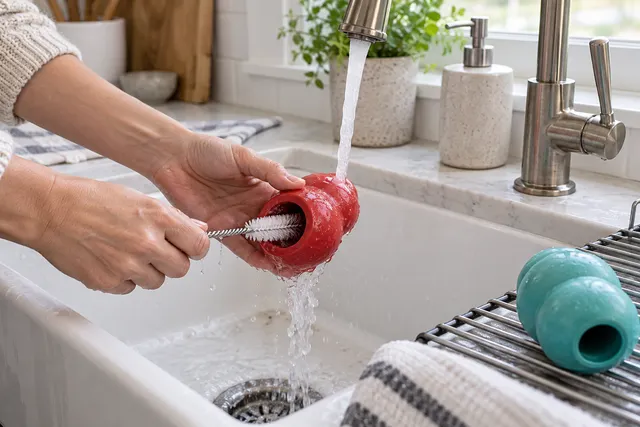
For model 67332, Outward Hound specifies hand washing with mild soap and warm water, followed by drying the compartments. Do not borrow dishwasher advice from a different toy. Manufacturer care directions.
Inspect the spaces you filled rather than checking only the visible top surface. Food can remain in a location your dog did not reach, and an apparently finished session is not proof that the puzzle is empty. Keeping the first few portions small makes this easier to assess.
Plan where the cleaned game and covers will dry without becoming separated. Once ready, store the complete set together. If more than one person prepares activities, a consistent storage arrangement is more dependable than relying on memory about what was last used.
Include washing time when judging value. A puzzle that is enjoyable for a few minutes may still be worthwhile, but the balance changes if you strongly dislike cleaning individual spaces. See our food-toy cleaning guide for a practical routine.
Buying checklist and the selected model
Verify model 67332, the three-tier layout, the quantity and the contents of the offer. Check the seller, shipping and return conditions before comparing checkout totals. A price difference is not meaningful if one page describes a different configuration or an incomplete set.
Read recent reviews for the actual interaction described. Look for whether an owner introduced the game, used the covers and identified the version. Do not treat a difficulty label as a promise of how long your dog will stay occupied.
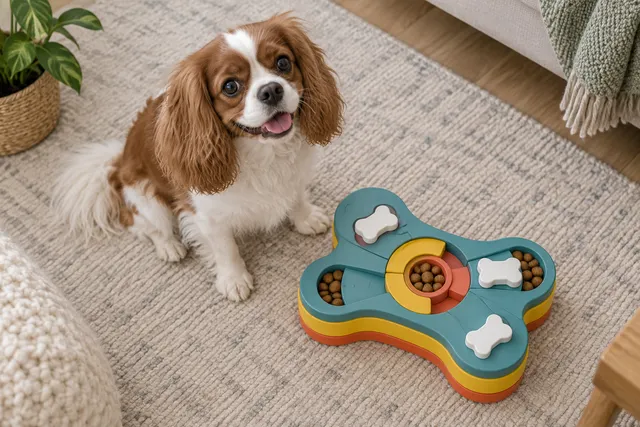
The scene below illustrates a dog activity setting, not this branded product. Open the retailer page to inspect the actual selected model and included pieces. No live price, numerical star rating or measured performance score is displayed.
Not this branded product
Nina Ottosson Dog Tornado
9.8-inch · 12 compartments · 3 layers
Read customer reviews on Amazon ↗
- Spinning puzzle format
- Linked version: 3 layers and 12 compartments
- Designed for shared, supervised sessions
Consider for: A shared, supervised puzzle session.
Before you choose: The name covers different versions. Check the actual compartment count and removable pieces before buying.
Product information source · Reviewed 2026-09-15
Check current price, seller and options on Amazon.
Amazon listing identity and manufacturer information; prices and availability are checked on Amazon. Affiliate link.
Frequently asked questions
Does Level 2 mean my dog must finish a Level 1 toy first?
It is a manufacturer difficulty label, not a qualification your dog must earn. Judge readiness by the interaction and make the introduction understandable. We do not use the label to predict a particular dog’s performance.
Is a fast solution a reason to stop using it?
Not necessarily. If the session remains enjoyable and convenient, it may still be useful. Reconsider it if your only reason for buying was a long period of distraction.
Must I use all the covers?
No. Assess the simpler interaction first and follow the instructions for any added difficulty. Using every piece is not a measure of success.
Can I leave the game out between meals?
The recommendation here is for attended sessions followed by collection and storage. It does not cover leaving the set available for unsupervised handling.
Does this article cover the two-tier version?
No. This review is tied to the three-tier, twelve-compartment model and its specific Amazon identifier. Check another version’s own instructions and specifications.
Verdict and further reading
Consider Dog Tornado 67332 when you want a supervised turning-layer puzzle and are comfortable introducing the game, managing pieces and washing the compartments. Reconsider it when predictable duration or almost no owner involvement is the main requirement. A suitable shared activity matters more than finishing the hardest arrangement.
Information checked September 15, 2026: the linked manufacturer model page, US Amazon identity and attributed Chewy feedback. No hands-on testing or behavioral treatment outcome is claimed. Continue with dog toy guides or our Wobbler and Dog Tornado format comparison.