How to Check a Dog Park’s Rules Before Visiting
Check a dog park’s designated area, hours, admission conditions and current notices, then make a practical entry checklist.
Jump to a section
Direct answer: check the designated area before entry
To check a dog park’s rules, identify the exact dog recreation area and its operator, read the current official visitor information, then compare it with the entrance notice before going inside. Record the boundaries, permitted hours, entry requirements and conduct rules that affect your visit. Keep the dog secured while you read, and choose another activity if an important requirement remains unclear.
A dog park is a shared recreation space with its own conditions. Permission to bring dogs into a larger park does not automatically grant permission to release them everywhere within it. This guide helps you make a short, usable entry checklist. It does not assess whether group play suits an individual dog or replace advice about health and behavior.
Step 1: name the actual facility
Start with the name of the dog run or designated off-leash area, rather than the name of the surrounding park alone. A large recreation site may contain several spaces with different access conditions. The place shown in a visitor photograph may be a lawn, a small-dog enclosure or a temporary area rather than the facility you intend to use.
Find the operator’s official facility page and look for a map or named entrance. Save the location of the relevant gate or boundary so that you can recognize it when you arrive. A map pin from a general listing is useful for navigation, but it does not by itself establish the limits of off-leash permission.
Also distinguish public facilities from private membership parks. A space described casually as a dog park may require registration, a reservation or paid access. Read the operator’s terms before traveling. Do not assume that a gate standing open, other visitors inside or a familiar neighborhood nickname means that your planned entry is permitted.
Step 2: separate park opening hours from off-leash hours
Write down two schedules when the operator provides them: when the wider park is open and when the particular dog area permits off-leash use. Those windows may coincide, but they may also differ. A morning opening time for the park is not enough information to settle what you may do on a nearby lawn.
For example, NYC311 distinguishes dog runs from certain unfenced areas with specified off-leash hours. That is a local example of why facility type and time both matter. Do not copy those hours into a plan for another city, or assume that every park in New York has the same designated areas.
Check whether the day you intend to visit has a separate schedule. Maintenance, events or temporary restrictions can affect access. Put the relevant hours next to the facility name in your note. A screenshot of a schedule is more useful when it also preserves which location the schedule belongs to and when you checked it.
Step 3: read the boundary and approach instructions
Look for the point where leash conditions change. The route from the parking area to a dog run may pass through ordinary park space. Read any instructions covering the approach, entry gate and exit rather than treating the entire journey as part of the off-leash area.
Portland’s official dog-park guidance says to leash dogs when entering or leaving its off-leash areas. It also notes that designated areas can be fenced or unfenced. These details show why a fence is not a complete rule check: absence of a fence does not necessarily prohibit a designated area, and presence of one does not establish the rules of every enclosure.
At the site, locate the posted boundary or map before changing how you handle the dog. If signs identify an adjacent sports field, path or water feature as outside the permitted dog area, keep that distinction in your plan. Permission for one part of a park should not be extended to a neighboring amenity by guesswork.
Step 4: check admission and documentation requirements
Find any stated requirements for licensing, identification, vaccination evidence, membership or registration. Record what the facility actually asks visitors to display or carry. Avoid reducing different requirements to a vague note such as bring paperwork, because a tag, a document and a member pass may serve different purposes.
NYC311 says dogs in its off-leash areas must have licenses and owners must carry proof of rabies vaccination. Portland’s guidance refers to displaying current license and rabies-vaccination tags. These examples are specific to their respective authorities. They are a reason to read your own operator’s wording carefully, not a universal checklist for all dog parks.
If an entry condition is ambiguous, identify the exact missing answer. For example, does the operator require a physical card, or does its published policy accept another format? Resolve that question through the official information or staff before relying on an assumption. This guide does not recommend medical schedules or tell you that a particular document satisfies an unfamiliar jurisdiction.
Step 5: identify who and what the area admits
Read any rules about the number of dogs per handler, supervision, children, dog size or separate enclosures. A limit can affect the whole visit when you are arriving with several people or dogs. Check it during planning so that you do not have to reorganize your group at the gate.
NYC311’s dog-run information gives a limit of three dogs at a time. Portland’s guidance reserves small-dog areas for small dogs. These are examples of different kinds of site conditions. Neither establishes a general nationwide number or a standard size cutoff. Where a facility uses a weight or age threshold, record that precise threshold from its own notice.
Consider the people accompanying you as well as the dogs. Read the operator’s instructions about who may enter and who must supervise. If your group cannot meet the posted conditions, select a different outing. Do not assume that another visitor’s behavior grants an exception to a rule you have already found.
Step 6: read conduct rules as entry conditions
The rules inside the recreation area matter before you choose to enter. Look for requirements about keeping the dog in sight, responding to problems, removing a dog when necessary and remaining responsible for waste. Decide whether you can follow those requirements for the duration of the visit.
Portland’s published guidance includes keeping the dog visible, picking up waste and removing a dog that displays aggressive behavior. The useful planning question is whether you can remain attentive and leave promptly when circumstances require it. Do not treat admission as a promise that every interaction inside will be suitable or that another visitor will manage your dog.
Read the operator’s process for reporting maintenance or rule concerns, if provided. Keep the facility name available so that a report can identify the right location. You do not need to resolve a disagreement with another visitor in order to decide that your own visit should end. Leaving is a practical option when conditions do not fit your plan.
Step 7: check food, toys and equipment restrictions
Review the site’s instructions about food, toys, collars, leads and other items you intended to bring inside. A familiar item may be useful during travel but restricted within a shared play area. Make the packing decision from the rules instead of discovering an incompatibility after entry.
For example, Portland’s guidance says not to bring food into the off-leash area. If you routinely carry food as part of an outing, determine how that affects your planned visit. Do not assume that an exception exists for an item simply because you personally regard it as small or convenient.
Avoid turning a site’s equipment notice into general training or medical advice. Record the restriction and determine whether your dog can be handled appropriately within it. If a required arrangement conflicts with what you need for your dog, another activity may be the better choice. No new purchase is necessary to complete this rule-checking process.
Step 8: separate standing rules from current closures
A permanent rules page and a current closure notice answer different questions. The first describes ordinary use; the second may tell you that ordinary use is unavailable today. Check both the facility’s visitor information and any official notices linked from it before leaving home.
Look for the date, affected area and duration of a notice. A closure of one entrance is different from closure of the whole dog run. An advisory for a neighboring field may not apply to the enclosure you plan to visit. Conversely, an old photograph of dogs using the space does not cancel a newer operator notice.
On arrival, read temporary signs as well as the permanent rules board. If a current sign and a webpage appear inconsistent, do not choose whichever version is more convenient. Keep the dog secured, identify the discrepancy and use another plan until the operator’s current instructions can be established. A saved page is a planning aid, not an override for a closure.
Step 9: make a compact visit note
Create a note with the facility name, operator, exact area, relevant hours and date checked. Add only the entry conditions that change what your group must bring or do. Include the official link so that you can revisit the information without searching through unrelated visitor reviews.
Use separate lines for confirmed conditions and unanswered questions. For example, you might have the opening schedule confirmed but still need to know which enclosure a size restriction covers. Mark that uncertainty clearly. A checklist that hides its missing answers can make an incomplete plan look finished.
Share the practical note with the person who will actually handle the dog. They need to know where leash conditions change, what evidence to carry and when to leave, rather than receiving a long collection of screenshots without context. Keep personal identification or veterinary records out of public posts when discussing the facility with other visitors.
Step 10: do a gate check and keep an alternative
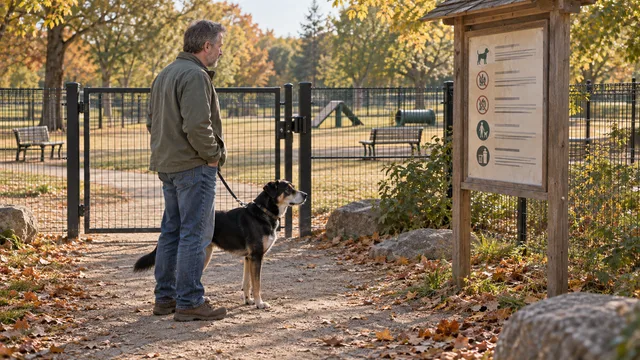
Before entering, pause in a place where you can read the notice without obstructing the entrance or losing control of the dog. Match the facility name and any enclosure label with your plan. Look for changed hours, temporary conditions and rules that were not clear from the online page.
Compare the conditions inside with what you can manage today. Even when entry is allowed, you can decide that a crowded gate, an unavailable enclosure or an unsettled situation does not suit the visit. Rule compliance and an appropriate outing are separate judgments; satisfying a listed requirement does not oblige you to enter.
Keep a simple alternative, such as a permitted leashed walk in an appropriate area or returning another day. Check that alternative’s conditions as well. This makes the rule check useful rather than symbolic: an unanswered question or a closure can lead to a concrete change in the plan instead of pressure to proceed anyway.
Frequently asked questions
Does dog-friendly mean dogs can be off leash? It does not establish that permission. Find the designated area’s rules and boundaries, including any time restrictions, before changing leash use.
Can I rely on a visitor review? Use it to discover a possible facility, then verify conditions with the operator. A review may describe a different date, entrance or part of the park.
What if other people ignore the sign? Their behavior does not change the posted requirements. Follow the operator’s conditions and choose another activity if the situation does not suit your visit.
Are fenced and unfenced areas governed identically? Do not assume so. Check the particular designated area; fencing alone is not a complete description of permission, hours or admission requirements.
What if I cannot find the documentation rule? Record the missing question and seek the operator’s answer before relying on a guess. This guide does not certify which documents a specific facility accepts.
Should I reread everything on each visit? Keep your saved note, but check current notices and the entrance sign for changes. A previous successful visit does not establish today’s access conditions.
Sources and related guides
Checked October 13, 2026: Portland Parks: Park Rules for Dogs and NYC311: Unleashed Dog and park off-leash information. Local examples are attributed to their operators. The planning steps are editorial organization, not a declaration of nationwide rules.
Related tasks: check a dog-friendly trail’s rules, find local licensing requirements and update dog ID-tag contact information. These cover route permission, licensing research and identification details rather than shared dog-park entry.