How to Manage Your Dog on Moving Day
Plan where your dog will stay while doors are open, assign a responsible caregiver and coordinate a calm transfer between homes.
Jump to a section
The direct answer: separate dog care from the loading route
Decide where your dog will stay during loading and unloading, name the person responsible for care, and move the dog only when both the route and destination are ready. A moving crew needs repeated access through doors. Your plan should keep the dog out of that traffic while preserving access for normal care.
This guide covers the practical coordination of a domestic moving day. It is not a packing checklist, a travel-document guide or a behavior treatment plan. The planning examples are editorial suggestions for organizing people and rooms; adapt them to your dog, property and actual moving arrangements.
The finished plan can be short. It should answer four questions without a group discussion: where is the dog now, who is responsible, who may open the relevant door, and what must happen before the next transfer? If those answers change, tell the people involved before activity resumes.
1. Choose the care arrangement before choosing a room
The AKC moving guide recommends arranging care with a friend or neighbor while belongings are carried out, or using a quiet room or familiar crate when an outside arrangement is unavailable. It also recommends keeping the dog away from open doors during unloading. These are starting options, not proof that every dog will tolerate every setting.
Consider an already familiar, suitable caregiver away from the property if you can arrange one. Confirm the actual hours and collection arrangement. A person who can help during the morning may not be available when a delayed truck finishes in the evening. Discover that limitation before making the booking central to your day.
If care will happen at home, choose an arrangement your dog already tolerates and that you can supervise appropriately. Moving day is a poor deadline for making an unfamiliar confinement arrangement work. If neither location is suitable, resolve the care problem before relying on a room label or a closed door.
2. Draw the route the movers actually need
Walk the route from the entrance to the rooms being emptied. Include stairs, corridors, service doors and any garden access the crew expects to use. You do not need a detailed floor plan; a short list of doors and rooms can reveal that the proposed quiet room lies directly on the busiest route.
Ask the moving company which spaces it must enter and in what order. Describe the dog-care arrangement as an access requirement. For example, a room cannot remain protected if the last wardrobe still needs to be removed from it. Agree when that room will be cleared before the dog uses it.
Do this separately for the new home. Loading and unloading are different operations, often involving different entrances. A spare bedroom that works at the old address tells you nothing about whether the new bedroom will receive boxes throughout the afternoon. Mark the arrangement for each property by address or another unmistakable label.
3. Give one person a clear care role
Name the adult who will manage the dog during each phase. Their role includes maintaining the agreed location, providing normal care and coordinating any necessary movement. Avoid assigning them to carry heavy furniture at the same time. Competing jobs make it easy for everyone to assume someone else is watching the door.
A named role does not mean one person must cover an entire long day without help. Arrange a replacement when needed, but make the handover explicit. The incoming caregiver should know the dog’s current location and the next planned step before the outgoing person returns to moving tasks.
Use names rather than vague labels such as whoever is free. A useful note is: “Loading phase: [name]. Transfer: [name]. Unloading phase: [name]. Changes confirmed with [name].” Fill those fields with people who have agreed. The note records an arrangement; it does not create consent or make an unsuitable caregiver suitable.
4. Prepare the agreed room before activity starts
If a room is part of the plan, finish the work that requires entry before placing the dog there. Remove items the crew still needs and resolve any access conflict. The aim is to avoid repeatedly opening the room because another forgotten box has been discovered.
Check the room as it exists that morning. Packing can introduce tape, small fittings, loose wrapping and cleaning products into places that were previously clear. Look behind the door and around the resting area. Make sure normal ventilation and a comfortable environment do not depend on opening an unsecured exit.
Place the dog’s familiar resting items and water where the caregiver can use them without moving a stack of boxes. Keep the floor route clear. This is not a recommendation to buy a new crate or gate for the occasion; use equipment only where it suits the dog and its instructions.
A door notice can communicate that entry needs coordination. It is an extra reminder for people, not a containment device or a substitute for the care arrangement. Tell the crew directly which door is involved rather than assuming everyone will stop to read a sign.
5. Agree what happens when someone needs access
A room that seemed finished may still need an inspection, a meter reading or a forgotten item. Decide that access request goes to the named caregiver before the door opens. They can then arrange the dog’s movement or another suitable solution while the rest of the household understands what is happening.
Keep the instruction practical: “Please speak to [name] before entering this room.” A broad request to be careful is harder to act on. Where several crews or helpers arrive at different times, include the access instruction in each arrival briefing instead of relying on the first person to pass it along.
If the route must change, pause the conflicting activity long enough to agree the new arrangement. Do not improvise by opening two doors and hoping the dog remains in place. A brief coordination stop is easier to manage than uncertainty about which area is currently being used for care.
6. Schedule breaks around the work
Keep the dog’s established care routine in view while the moving timetable develops. Write the ordinary care events into the day’s plan so they remain someone’s responsibility. The exact timing and requirements depend on your dog; this article does not prescribe how long a dog should stay in a room.
Before a necessary trip through a shared route, the caregiver should coordinate with whoever controls the moving activity. Identify the intended exit and make sure the passage is usable. Use your dog’s suitable familiar walking equipment and the agreed handling arrangement; do not make a break depend on a doorway that is blocked by furniture.
Keep care supplies accessible to that person rather than packed into the truck. For the separate inventory task, use our short-stay packing guide. Here, the important question is who can reach what is needed while the rest of the belongings are in transit.
7. Confirm the destination before setting off
Check that someone can receive the dog and use the agreed care area at the new address. Possession of a key alone is not enough if that room is still being painted, filled with furniture or used as the crew’s main passage. Confirm readiness with the person actually there.
The AKC advises loading the dog last to avoid unnecessary time in the car, and checking the new home and yard for hazards before allowing exploration. Keep the dog’s journey separate from a vehicle being used as a waiting area. Arrange suitable transport according to the relevant equipment and travel requirements.
Write the transfer as a sequence: destination ready, receiving person available, route coordinated, dog transferred, arrival confirmed. These labels are a communication aid, not a universal transportation procedure. Long-distance, air or international moves need additional planning beyond this local moving-day workflow.
8. Treat unloading as a new phase
At arrival, confirm the planned care arrangement before people turn their attention to boxes. Someone may assume the move is nearly finished even though the front door will remain in constant use for hours. The dog’s location and responsible caregiver need to remain explicit throughout that period.
Ask where the crew will put furniture and whether it needs access to the chosen room. If a late delivery changes the route, revise the arrangement before that delivery begins. Do not gradually turn the protected space into overflow storage while continuing to call it the dog’s quiet room.
Keep the caregiver informed when the final large items are inside, but distinguish that milestone from the end of all outside traffic. A crew member returning for tools, a cleaner arriving or a neighbor helping with boxes can reopen the same access problem. Decide who confirms that the loading route is no longer active.
9. Make a delay plan with a real endpoint
List the delays most relevant to your move: late keys, a truck arriving after the caregiver leaves, or a room becoming unavailable. For each, identify the person who will coordinate the change and a suitable alternative arrangement that has actually been discussed.
Do not write “stay with a friend” unless that friend has agreed and can receive the dog under the changed timing. Likewise, a boarding or daycare option is not available simply because it appears in a search result. Admission and opening hours may make a last-minute plan unusable.
A fictional example: the truck is late, but the dog is already with an agreed caregiver. Rather than collecting at the original time and waiting amid unloading, the owner checks whether the caregiver can extend the arrangement. If not, the owner uses the previously agreed alternative. No extension is assumed, and no one discovers the change only at collection.
10. Close the access plan before normal exploration
When active moving traffic ends, make a fresh check of the areas the dog will use. Conditions may have changed since the morning: doors may be unlatched, packing debris left behind or household products unpacked into reach. A check made before the crew arrived does not describe the finished room.
Resume the household’s care responsibility clearly if someone else has been looking after the dog. Review any outstanding practical needs and confirm that the temporary caregiver is finished. Our sitter handover guide covers detailed care instructions; there is no need to recreate that paperwork here.
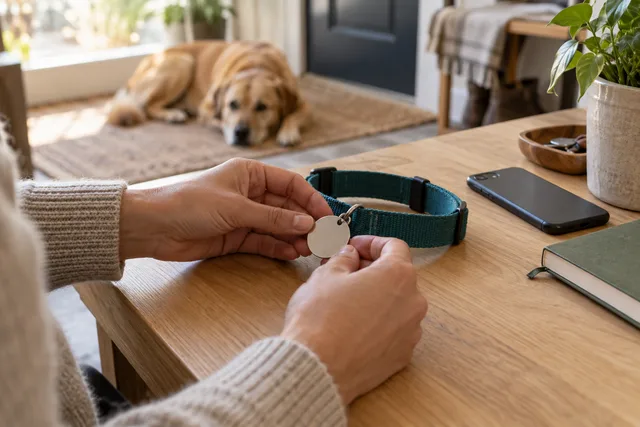
Keep contact information current using the separate ID-tag contact guide. Updating records, unpacking supplies and coordinating doors are different tasks. Completing one should not hide an unfinished step in another.
Frequently asked questions
Is a sign on the door enough? No. It helps communicate the arrangement, but people still need a clear access rule and a responsible caregiver. A sign cannot secure a door or establish whether the dog is comfortable.
Can the movers look after the dog? Do not assume dog care is included in their work. Agree a separate suitable caregiver so that loading responsibilities and care responsibilities are clear.
What if my dog cannot settle in the chosen room? Reconsider the arrangement rather than treating the room as a requirement. Discuss individual difficulties with an appropriate professional ahead of the move when possible. This guide does not recommend sedatives or forced confinement.
Does every household need two care locations? No. A suitable off-site arrangement may cover both loading and unloading. Confirm its actual duration and the return handover; the number of locations matters less than whether each phase has a workable plan.