How to Measure a Dog for a Crate: Size and Fit Questions Answered
Start with your dog’s measurements, compare usable interior space and check the assembled crate in your home. A size label alone cannot settle the fit.
Jump to a section
How do you measure a dog for an indoor crate?
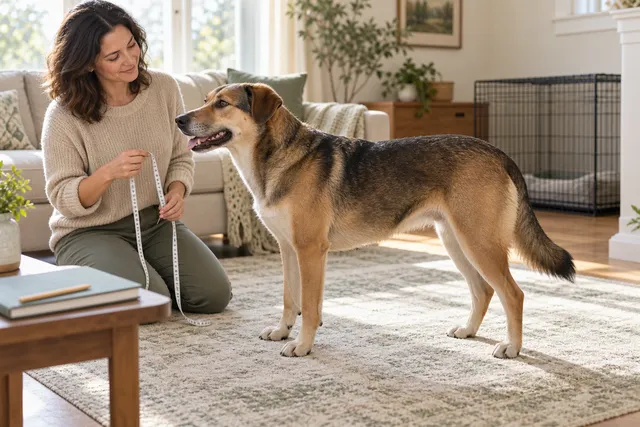
Measure your dog standing naturally, record body length and standing height, then compare those readings with the exact manufacturer’s sizing instructions and usable interior dimensions. The final setup must allow comfortable natural movement. Do not choose solely from a breed example, weight band or the word medium.
This guide helps you prepare a measurement record and compare indoor crate options. It does not establish airline acceptance, vehicle crash protection or a confinement schedule. Those are separate questions that need their own requirements and evidence.
Start with the dog, then consider the crate, and finally check the room. Reversing that order can lead to choosing an enclosure because it fits beside a sofa even though it is unsuitable for the animal. Treat all three checks as necessary before making the purchase.
What do you need before you start?
Have a tape measure, a notebook and a clear area where your dog can stand comfortably. A second adult can record the numbers while you observe the dog’s position. Keep the session calm and brief; there is no benefit in collecting a precise-looking number from an awkward pose.
Open the sizing instructions for the model you are considering. Different guides may describe their measurement points differently, so use the instructions that actually apply rather than combining several formulas into an invented rule.
Draw a simple side view in your notes and label each measurement. Add the date and the units. This is particularly useful when more than one person shops for supplies or when you compare two products over several days.
If your dog will not stand comfortably for measuring, pause. You can try again at a calmer moment or ask someone experienced to help. Do not force an animal into a pose merely to finish a shopping checklist.
Which body measurements should you record?
MidWest’s official sizing guide uses length from the nose tip to the tail base and height from the top of the head to the floor while the dog stands. It advises adding room for movement and clearance. Follow the specific guidance for your shortlisted product rather than treating that description as a universal numerical formula.
- Record the length. Use the endpoints in the relevant guide and label them in your notes.
- Record standing height. Make sure the dog is in a natural posture rather than crouching or stretching upward.
- Repeat each reading. A second measurement helps reveal a shifted endpoint or an unusual stance.
- Record the required allowance separately. Keep your dog’s actual measurements distinct from the space recommended by the manufacturer.
Separating measurements from allowances makes later comparisons clearer. If one brand uses a different recommendation, you can apply it to the original record without guessing which additions were already included. Do not write down only a final shopping number and discard the underlying measurements.
Why is weight alone not enough?
A weight band can help you locate a section of a product range, but it does not show every aspect of a dog’s shape. A breed example is similarly a browsing aid rather than a measurement of your individual dog.
Use those labels to narrow the search, then work through the actual dimensions. If the weight recommendation and your measurements point in different directions, ask the manufacturer how its chart should be applied. Do not resolve the conflict by choosing whichever value produces the smaller purchase.
This is also why borrowing a friend’s purchasing decision may not work. Their dog may look similar, yet the crate version, bedding and household arrangement may differ. Ask for the exact model if you want to investigate it, then perform your own fit check.
Save the size chart alongside your notes. A product page can show several configurations, and it is easy to lose track of which selection you were viewing when you copied a recommendation.
How do interior and exterior dimensions differ?
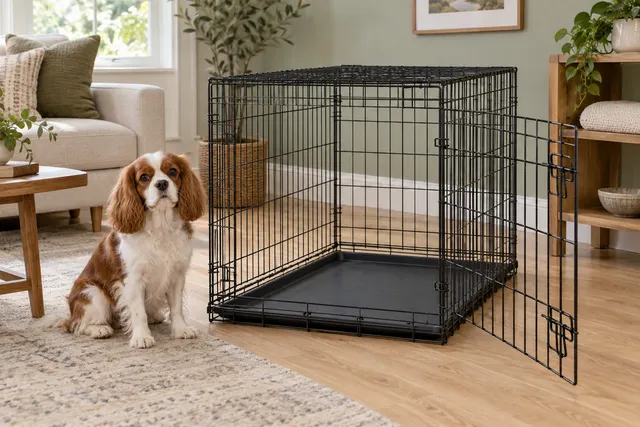
Exterior measurements tell you how much room the crate occupies; interior measurements describe the space available inside. A headline such as 30-inch crate does not supply every dimension you need.
Look for a labeled diagram. Identify length, width and height, and check whether the dimensions refer to the assembled frame, folded storage size or usable interior. A compact shipping measurement is not a substitute for any of these.
Consider the parts that affect the usable arrangement. A divider changes the available area, and bedding occupies space inside. If the product information leaves an important dimension unclear, ask the manufacturer instead of estimating it from a photograph.
For a tight location, include the door and cleaning access in your room plan. An enclosure may physically fit between furniture while leaving no practical way to open it or remove its tray. That is a location problem even if the interior is suitable for the dog.
What does a comfortable fit need to allow?
RSPCA guidance says a crate should allow a dog to stand, turn, lie down and stretch. Its detailed guide also describes sitting and standing at full height and resting naturally. These are useful practical checks beyond a size label.
Assess the finished setup with its intended bedding and any approved divider in place. Do not rely on an empty-frame comparison if the actual arrangement will be different. Observe without forcing the dog into the crate or closing the door to obtain a photograph.
If you are uncertain about comfort or suitability, get qualified help before treating the setup as ready. A measurement worksheet supports a decision; it does not replace observation of the individual animal.
Also separate physical fit from willingness to use the space. Buying a differently sized enclosure does not by itself explain or resolve distress. This article does not prescribe training steps or claim that a particular crate will make an uncomfortable dog settle.
How should you plan for a growing puppy?
MidWest recommends considering expected adult size and using a compatible divider as a puppy grows. An adult-size estimate is still an estimate, especially when a puppy’s background is uncertain. Ask your veterinarian or rescue for help interpreting the likely growth range.
Keep a dated measurement record so that changes are visible. Revisit the setup as the puppy grows instead of assuming the position that worked on arrival remains appropriate. Only use a divider designed and approved for the exact crate.
Check how the divider attaches before buying. The convenience of an adjustable product depends on having the correct component and being able to install it according to the supplied instructions. Do not substitute improvised panels or fasteners.
Include uncertainty in your budget. A growing dog may eventually need a different arrangement, so compare return conditions and suitable replacement options without assuming a lifetime fit has been guaranteed.
What should you put in a sizing worksheet?
| Record | What to write | Use |
|---|---|---|
| Dog measurements | Length, height, endpoints and date | Keep the original readings available |
| Model guidance | Required allowances and restrictions | Apply the correct sizing method |
| Interior space | Usable length, width and height | Assess the actual enclosure |
| Exterior space | Assembled dimensions and door direction | Plan the room layout |
| Accessories | Bedding and approved divider | Check the finished arrangement |
| Unanswered questions | Missing dimensions or unclear instructions | Resolve them before ordering |
Leave a field blank when you do not know the answer. A clearly identified question is more useful than an estimate presented as a specification. Keep the manufacturer’s response with the worksheet so that you can refer to it when the crate arrives.
How do you compare two candidate crates?
Create a separate column for each exact size and door configuration. Compare the same kind of dimension across both columns: interior with interior, assembled exterior with assembled exterior. Mixing them can make one option appear more spacious or compact than the evidence supports.
Then list the practical differences. Does one entrance open in a direction your room cannot accommodate? Can you remove the tray without relocating the whole enclosure? Is the supplied divider the one you need? These questions help you decide which details matter to your home.
For a specific example, our MidWest iCrate 30-inch single-door review examines model 1530. The manufacturer’s iCrate range includes multiple sizes and door arrangements, so the range name alone is not a complete product identity.
Use a model review after completing your measurements, not as a substitute for them. A favorable feature description cannot establish that your dog fits the reviewed size.
What should you check before and after delivery?
Before ordering, save the selected model number, size, door configuration and return conditions. Review the cart after changing any option; a listing that groups variants can make it easy to forget which one is currently selected.
When the crate arrives, compare the box label and included instructions with your record. Check for damage and missing components before assembly. Follow the supplied manual and stop if the parts or instructions do not match what you received.
Once assembled, confirm the dimensions and the planned access route. Revisit any tight clearances with the actual product in place. Do not force the frame into a narrow location or modify its structure to recreate a measurement from a listing.
Keep the paperwork until all of the checks are resolved. If an exchange is needed, a clear model record and specific explanation of the mismatch will be more helpful than simply saying that the crate seems wrong.
What common sizing mistakes are worth avoiding?
Rounding every number: retain your actual readings. If a decision sits close to a published limit, ask for clarification rather than erasing the difference in your notes.
Shopping around furniture first: record the dog’s requirements before trying to fill a particular corner. A convenient location does not turn an unsuitable enclosure into an appropriate one.
Comparing photographs: camera angles, dog sizes and staged accessories can make space difficult to judge. Use labeled measurements and instructions for the fit assessment.
Forgetting the final setup: bedding, dividers and door access belong in the comparison from the beginning. Recheck when the arrangement changes.
Treating indoor sizing as travel approval: a crate that suits a home routine has not thereby demonstrated airline acceptance or crash protection. Start a separate research process if transportation is your actual purpose.
What other questions do owners ask?
Should I automatically choose the next size up?
Resolve the fit using the manufacturer’s guidance and your dog’s needs. A universal size-up rule cannot answer questions about interior dimensions, growth or the intended arrangement.
Can I use the measurements from a year ago?
Measure again when reassessing a purchase or a changed setup. Old notes can be useful context, but current information is a better basis for the decision.
Is a double-door crate larger inside?
Do not assume so. Compare the published usable dimensions of the exact options. Door count describes access, and it does not by itself establish a larger interior.
Can this guide tell me how long to crate my dog?
No. Sizing and duration are separate decisions. An appropriate daily care and training plan needs to account for the individual dog rather than relying on a product measurement.
Which sources support the sizing advice?
Sources checked September 15, 2026. The worksheet and shopping workflow are editorial planning suggestions. No hands-on fit, durability or crash testing is claimed.
- MidWest: crate sizing guide — measurement points and growing-puppy guidance.
- MidWest: iCrate product range — size and configuration distinctions.
- RSPCA: dog crates — comfortable movement and space considerations.
Continue with measuring a doorway for a dog gate if you are planning room separation, or browse crates, houses and pens to explore the category.