How to Organize Dog Walking Supplies: Questions Answered
Set up a simple walking station that keeps leashes, pickup supplies and weather items easy to find without cluttering your entryway.
Jump to a section
How do you organize dog walking supplies?
Give every walking item one dependable home near the exit, then use a small leave-the-house check before each outing. A useful station keeps everyday items easy to see, separates clean from used items, and makes it obvious when something needs replacing.
This guide is about household organization. It does not prescribe a walking duration, assess a dog’s equipment fit, or replace local rules for waste disposal. The goal is to make your own routine easier to repeat without turning the entryway into storage overflow.
Begin with what is actually used in a normal week. Put every leash, harness, waste-bag roll, pouch, light, towel and weather item on a table. Seeing the whole set at once is more useful than buying containers before you know what must fit.
What belongs at the station?
Make two lists: leave-with items and return-home items. A leash and identification check may belong to the first list; a damp towel and used pouch belong to the second. This stops clean supplies from accumulating with things that need attention.
Keep the list small. A walking station is not a second pantry or a place for every dog product in the house. Store bulk refills elsewhere and bring a working quantity to the station. You will be able to see the actual supply level instead of discovering a shortage at the door.
Where several people walk the dog, agree on names for the same items. “Evening leash” is clearer than an unspoken rule based on color. A label can be useful, but a visual location that remains the same is usually more important than a long instruction sheet.
Where should the supplies live?
Choose a location based on the route out of the home, not a photograph of a perfectly styled entryway. Check whether people can pass, whether the dog can wait without blocking a door and whether the location stays dry. Open nearby cabinets, drawers and doors before making the final choice.
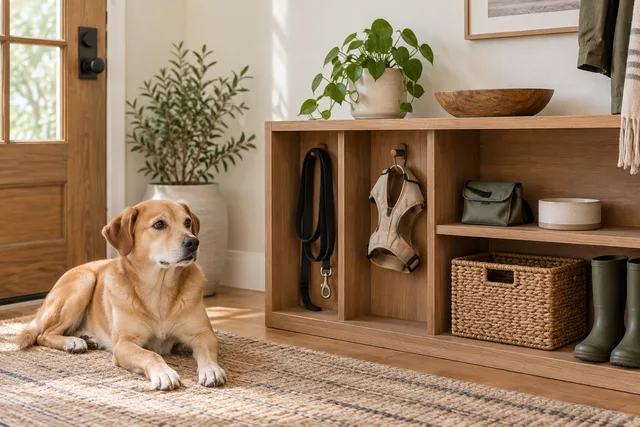
A hook, drawer, basket or low shelf can work if it keeps hardware from tangling and allows the adult responsible for the outing to reach items without searching. Keep loose straps off the floor and out of the dog’s reach. Do not obstruct an exit to make the station more visible.
If the front door is not the usual departure point, put the core station by the real route. A compact backup kit near another door may be more realistic than expecting everyone to carry supplies across the home.
How do you separate equipment without creating clutter?
Group items by the moment you need them: attachment equipment together, pickup supplies together, weather items together. Use one open area for the current kit and one closed area for backups. The division makes it easier to return an item to a known place.
Avoid storing a wet item in a sealed container simply to make the shelf look neat. Give it a place to air as appropriate, then return it once it is clean and dry. Follow the individual product care directions rather than treating all nylon, leather, lights or fabric pouches the same way.
If you have multiple dogs, create a separate assigned set where possible. A small tag with the dog’s name can prevent a rushed mix-up. It is not a substitute for checking the actual size, condition and intended use of the equipment.
What should the pre-walk check include?
Use a short check that you can do every time: choose the correct equipment, inspect visible hardware and webbing, confirm the waste-bag supply, and take any location-appropriate essentials. The list should be short enough to use on a busy morning.
Keep “take” and “check” separate. Taking a leash is not the same as seeing whether a clasp closes normally. Taking a light is not the same as knowing whether it has power. If a problem appears, pause to solve it rather than improvising a repair at the doorway.
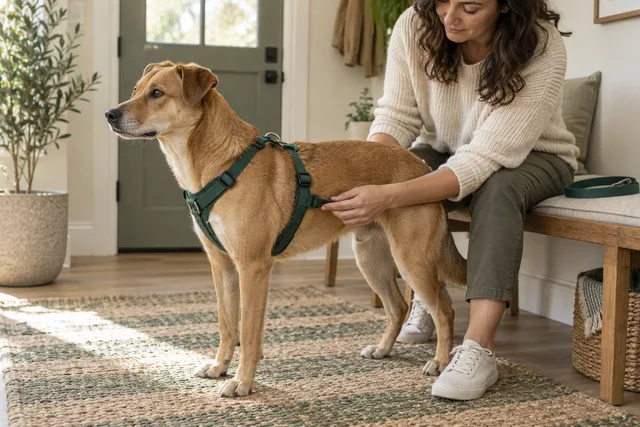
For harness-specific observations, see how to check a dog harness fit. This station guide only helps you make the equipment available; it does not decide whether a particular item fits or is suitable for your dog.
How can you restock without guessing?
Choose one simple trigger for refills. For example, keep a visible working roll of bags and replace it when the last backup leaves the basket. Write the trigger where the refill is stored if more than one person handles it.
Buy and store refills according to your actual use, shelf space and product directions. More stock is not always better when it makes older supplies hard to find. Rotate ordinary unopened items so you use the first available package rather than building an untracked pile.
Keep receipts and replacement information somewhere separate from the walking station. If an item fails, you need the model identity and purchase record, not another loose paper tucked behind the leash.
What changes in wet or cold weather?
Create a return-home zone before the weather changes. Decide where a towel, rain layer or dirty footwear goes, and make sure the route does not carry mud through the home. The best setup is the one people can use while holding a leash and closing a door.
Do not make one bin do every job. Clean backup supplies, wet items and rubbish need different destinations. Follow care labels for drying and cleaning, especially for electronic lights and hardware. Replace a damaged item rather than assuming a little water or dirt is the only issue.
Review the station after the first wet outing of the season. That is when a missing hook, undersized mat or badly placed basket becomes apparent. A small relocation is usually easier than adding another collection of containers.
How do you make the system work for a shared household?
Set one return routine: hang, wipe, refill, charge or place the item in its designated next step. Ask each person to use the same sequence for a week, then adjust only the part that repeatedly fails. A system that requires perfect memory will drift quickly.
Keep a simple note for household-specific changes, such as a new attachment point or a replacement item on order. Do not treat the note as permission to use unfamiliar equipment without checking its instructions. Clear communication helps, but it cannot verify a product’s condition.
Children can help with age-appropriate organization under adult direction, but adults remain responsible for equipment selection, access and supervision. A storage station should not become a place where children retrieve equipment independently without the household rules being clear.
How do you reset an overloaded station?
Take everything out once a month or when searching starts to replace the routine. Sort into use now, clean or repair, refill, and store elsewhere. Do not keep broken hardware in the active zone “just in case”; move it to a clearly marked decision area.
Remove duplicate containers before buying more organizers. Often the issue is not lack of storage but a missing return location. A single hook and open basket may be more practical than a complex cabinet that everyone avoids using.
Photograph the working version for your own reference. The picture gives the household a simple reset target after a busy week, without claiming that every home needs the same layout.
How can you build the system in one afternoon?
Start with the route, then make only the changes that help the next outing. First clear a surface or a small section of wall. Next assign the active leash or harness to one reachable position, and place a working bag roll beside it. Finally, give returned items a separate place to wait for cleaning or drying. Test the arrangement by leaving and coming back once.
Notice where the routine pauses. If you have to put the dog down to open a cupboard, the placement may be wrong. If you must move shoes to reach a bag roll, the working supply is too hidden. Move one object at a time and retest. This lets the layout respond to the household rather than to a generic storage diagram.
Write a small “not here” rule as well. For example, no food rewards on the low shelf, no damp fabric in the backup basket, and no repair projects in the active zone. Removing ambiguous items keeps the station legible when someone is in a hurry.
How do you plan for visitors and changing routines?
Temporary changes are where a simple system earns its place. Before guests arrive, move only the active equipment to a familiar temporary location and tell the people who will walk the dog where it is. Do not scatter individual parts into drawers that no one normally opens.
When a new routine begins, such as a different work schedule or a seasonal route, keep the station the same for several outings while you observe what changes. Add a second lead or weather layer only when the need is repeated. A brief trial prevents the entryway from collecting supplies for scenarios that never occur.
At the end of the change, return the station to its ordinary setup and decide what should stay. Treat every addition as something that needs a clear owner and return location. The purpose is to make a departure calmer, not to display a larger collection.
Frequently asked questions
Should I keep all supplies by the front door?
Keep the everyday set by the route you use most. Store bulk refills and rarely used items where they are safe and easy to inventory.
Can one station serve two dogs?
Yes, if individual equipment remains clearly assigned and the station does not become crowded. Check each dog’s actual equipment before an outing.
Do I need a special cabinet?
No. A stable, accessible arrangement matters more than a particular furniture style. Test the route and return routine before buying storage.
How often should I inspect the station?
Use a quick check before outings and a fuller reset when the routine begins to fail or seasons change. Product instructions determine individual care needs.
What makes a station easy to maintain?
Choose the lowest-effort version of the routine. A hook that can be reached with one hand may outperform a beautiful box that needs to be opened and closed. A small visible refill indicator can prevent more failures than a large hidden supply cabinet. Keep the system understandable to a person who has not seen it for a week.
Use natural checkpoints: when you remove shoes, return from an outing, or prepare for the next morning. Attach one walking-station action to that moment rather than creating a separate task that is easy to postpone. If the same item repeatedly ends up on the floor, change its location instead of blaming the person who last used it.
Review the arrangement when the dog’s equipment changes. A larger harness, a different lead clip or a newly added weather layer may need more room. Refreshing the layout before the old system is crowded keeps the routine from breaking all at once.
A walking station that stays useful
Start with one home for each current item, a quick pre-walk check and a simple return routine. Keep it close to the real exit, clear of the dog’s reach and easy for the whole household to reset.
Browse How-To Guides for other everyday routines and Collars, Harnesses & Leashes for related buying research. This article is original editorial organization guidance. The cover is an illustrative unbranded home scene, not a product recommendation or an equipment-fit diagram.