How to Prepare for an AKC Farm Dog Certified Test
Map the twelve FDC elements, clarify livestock boundaries and site arrangements, discuss readiness questions and organize qualifying-test records.
Jump to a section
Direct answer: prepare for the whole farm setting
Prepare for an AKC Farm Dog Certified test by reading the twelve required elements, identifying questions about livestock, surfaces and temporary separation, and discussing those questions with an appropriate instructor before entering. Confirm the actual event arrangements and keep the two qualifying-test records needed for a later title application. Familiar obedience at home does not answer every question raised by a farm setting.
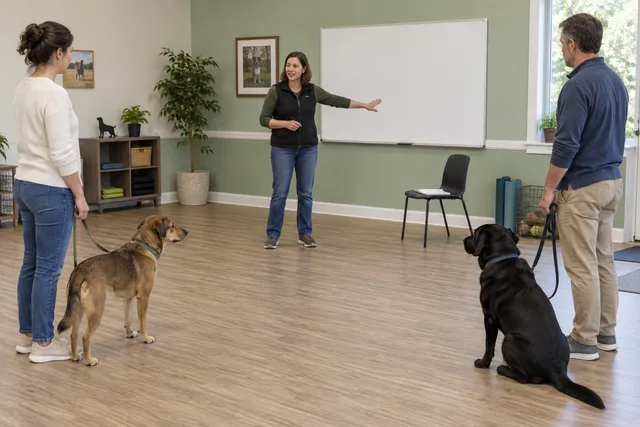
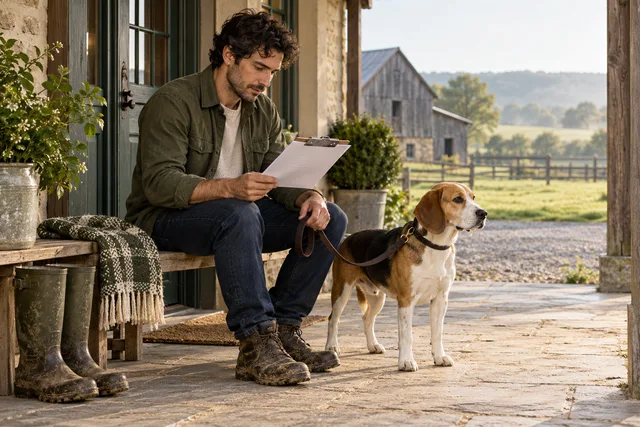
This guide organizes the owner’s preparation; it does not prescribe jumping practice, livestock exposure, tethering technique or a conditioning schedule. Physical suitability and unresolved behavior concerns need individual guidance. The cover is an independent illustrative preparation scene, not a photograph of an AKC test or evidence that a particular handling method has been evaluated.
Confirm that Farm Dog Certified is the intended activity
AKC’s Farm Dog Certified program page describes an assessment of self-control, confidence and cooperation in a farm environment. It involves twelve elements and no herding. The program is open across breeds, with a minimum age of nine months and an appropriate AKC, PAL, Canine Partners or FSS number.
Begin by deciding why this setting interests you. A companion’s ability to remain responsive amid rural distractions is a different question from moving livestock, winning a herding trial or receiving a professional working-dog qualification. Do not choose an entry because the word farm sounds like a shortcut to one of those outcomes.
Use the dog’s registered or listed identity consistently, keeping its call name separate. Resolve uncertainty about the registration number before entering.
Minimum age does not establish individual readiness for jumping, unfamiliar surfaces or the outing.
Make a twelve-element map, not a home-built test
Use the official FDC evaluation form as a compact map. It covers greeting the judge; a farm walking pattern and passive stranger; a bale jump and stay; walking past penned animals; unusual surfaces; supervised separation; a gate; the handler feeding livestock while the dog waits secured; another dog; background noise; approaching penned livestock and returning; and the handler’s physical examination of the dog.
Group those situations on a preparation sheet under movement, waiting, distractions and handling. The grouping is simply an organizing tool. It helps reveal whether all your questions concern one area or whether several parts of the outing are unfamiliar. It is not an official scoring system and should not be used to award a practice qualification.
Beside each situation, record a concrete question instead of a broad conclusion such as good with animals. You might need to understand the separation enclosure, identify the rural surface used by the host or clarify how participants are directed between areas. A specific unanswered question is easier to resolve than a reassuring label.
Do not assemble improvised livestock pens, unstable obstacles or startling noise demonstrations to reproduce the form. The test’s outline is information for discussing readiness and event arrangements, rather than permission to create an uncontrolled version at home.
Read the rules before treating the elements as isolated tricks
The linked regulations, Chapter IX, amended to August 2025 when reviewed, require all twelve elements and an overall assessment within the same test. A second attempt at an unsuccessful element is allowed, but not unlimited repetitions. The greeting and final examination retain their first and last positions; intervening elements may be arranged differently.
The practical implication is that a memorized sequence is an incomplete preparation plan. If the dog expects a familiar pattern, an instructor can help you consider how changes in location or order affect the work. That does not mean repeating a full simulated course until the dog can continue through uncertainty.
Separate completing an action from the conduct surrounding it. The evaluation concerns the dog’s responses across the environment, so an owner should not assume that one successful jump or a single quiet moment settles the whole question. Leave the actual assessment to the judge rather than counting actions from a phone recording.
The same chapter excludes females in season and permits certain breed restrictions at specialty or Group events. Check the specific event’s eligibility as well as the general program description. An all-breed program does not guarantee that every individual listing accepts every eligible dog.
Livestock boundaries are central to the preparation
The official FDC FAQ explains that livestock remain behind protective fencing, sometimes double fencing, and direct dog-to-livestock contact is not allowed. FDC does not confer herding ability. Treat those boundaries as fundamental to understanding the activity, rather than assuming that getting closer to an animal improves preparation.
If the dog’s response to livestock is unknown, make that an explicit question for a qualified instructor or the event’s appropriate contact. Do not use a neighbor’s animals, an open field or an unapproved farm visit as a convenient experiment. Permission to be on a property would not itself establish a suitable training arrangement.
Ask what animal species and separation arrangements the actual host expects to use if that information affects your decision. A generic photograph of sheep does not establish that the event will use sheep, nor does a past event’s layout establish the current one. Keep observations about a particular venue distinct from assumptions about the whole program.
Farm animals also have their own welfare needs and routines. Follow the host’s boundaries and access instructions rather than stopping to feed, photograph closely or greet them during arrival. Your preparation should reduce unplanned interaction, not create extra encounters before the evaluated activity starts.
Surfaces and the bale element need an individual readiness discussion
The test guide currently linked by AKC is marked November 2017. It describes an independent bale jump with a stay of at least ten seconds and three unusual surfaces. The guide also describes supervised separation in a kennel or crate with the handler out of sight for at least a minute. These are test descriptions, not recommended practice doses.
For movement questions, explain the actual task to the person advising you rather than asking only whether the dog can attend a farm event. An ordinary walk, a jump onto a raised surface and remaining there can pose different questions. This article provides no jump height, repetition target, rehabilitation adjustment or permission to lift a dog through an element.
For surface questions, ask what the host intends to provide and how the area is managed. Familiarity with one piece of flooring at home does not establish a response to every rural surface. Likewise, an online example does not give you enough information to decide whether an improvised obstacle is stable or appropriate.
The useful outcome of this discussion may be a decision to defer entry. A schedule should leave room for that answer. Preparation is successful when it identifies a mismatch early, even if the immediate result is choosing not to participate.
Plan for separation and farm chores without improvising restraint
The separation and waiting situations deserve their own questions. Ask about the enclosure used for separation, the staff directing participants and any information the host needs about your dog. Do not assume that being comfortable beside a familiar person predicts comfort when that person moves out of sight in a new place.
The livestock-feeding element also differs from ordinary leash walking. Read its full description with an instructor if you are uncertain about the dog’s ability to wait while the handler performs the task. This guide does not show how to stake or tie a dog and does not certify an anchor, collar or improvised arrangement.
The linked guide specifies a secure, well-fitting flat collar and a four-to-six-foot leash for the evaluation. Confirm your actual equipment against the current directions before travel. An accessory recommended for another activity does not automatically satisfy these requirements, and the format of a product review is not an event approval.
If the setup or an instruction is unclear on the day, ask before proceeding. The owner’s role includes understanding where to stand and what is happening; guessing quickly in order to keep a line moving is not a useful substitute for clarification.
Handle noise, another dog and the final examination as distinct questions
Background noise and another dog’s presence can change the context even when a task seems familiar. Make separate notes about those situations rather than combining them into a broad claim that the dog is socialized. An instructor will get more useful information from a description of a specific response than from that label.
Do not create sudden loud sounds to see whether the dog passes an imagined version of the test. The aim of your preparation is to understand the required setting and identify appropriate help. Repeated exposure chosen without guidance can also leave you with poor information about what the actual event will be like.
The final element involves the handler examining the dog for material collected during the outing. Think about whether you can calmly handle the dog and recognize an unresolved concern, rather than treating this as a veterinary examination. This article does not teach removal of embedded objects, diagnose injury or recommend a treatment.
The FAQ states that food is not permitted during the test, while ordinary commands and encouragement are allowed. Discuss the difference between training support and the evaluation before entering. Do not assume that a reward arrangement used in another class can simply be carried into this event.
Choose a real event and prepare a farm-specific arrival plan
Follow the official program’s event-search route and obtain the actual organizer’s entry information. Verify the date, venue, eligibility, reporting instructions and availability before relying on a listing. If two tests are advertised, confirm their separate event details and judge arrangements instead of assuming that two time slots meet the title requirements.
Ask where participants should park, report and wait with their dogs. Rural access can involve gates, restricted work areas or routes that are not obvious from a street address. Save the specific directions you are given and make them accessible without depending entirely on reception at the venue.
Prepare the host-requested paperwork and ordinary suitable travel supplies. Keep documents protected from wet equipment and muddy footwear. If another person accompanies you, agree beforehand on who manages the dog while entry details are checked, and make sure both people understand the host’s boundaries.
Review current weather and organizer notices before departure. No fixed waiting time, event fee, cancellation arrangement or accessible-site guarantee is established here. If the circumstances or the dog’s condition change, retain the option to withdraw rather than treating the trip as a commitment to finish.
Keep qualifying records separate from the title application
The current FDC title application, marked 10/25, describes two qualifying occasions under two different judges and requests their dates, clubs, event numbers and locations. It states that title processing waits for the event results to be processed. The program page also links an online application route.
After an attempt, understand the result and preserve the official record. Verify identifying details and keep the two occasions distinguishable, even on one outing.
When applying, compare the dog’s name and number with its existing record and check the two event entries against your documents. Use the current official instructions for the chosen payment route; this guide quotes no permanent fee or processing deadline and does not submit an application on your behalf.
For preparing to attend instruction before considering a test, see our first group training class guide. It addresses the lesson setting. FDC preparation additionally requires understanding the particular farm tasks and livestock boundaries described here.
FAQ: preparing for Farm Dog Certified
Does a herding breed automatically qualify? No. Breed identity does not replace the actual evaluation or establish an individual dog’s readiness.
Should I recreate every element at home? Use the official descriptions to identify questions for appropriate instruction. Do not improvise livestock access, restraint setups or noise tests.
Is one successful action the same as passing? No. The required elements and overall assessment belong to the official test, with the judge determining the result.
Can a generic event listing answer every venue question? No. Confirm the actual host’s arrangements, requirements and current notices.
What if preparation reveals a concern? Resolve it with appropriate individual guidance before relying on an entry. Deferring participation can be the useful result of careful preparation.