How to Wash and Store a Dog Life Jacket
A label-first routine for cleaning a dog flotation vest, drying hidden wet areas, checking damage and storing it without crushing its panels.
Jump to a section
Quick answer: follow the label, then dry completely
Read the care label for your exact dog life jacket, hand wash only when those instructions allow it, rinse away cleaning residue and let the jacket air dry fully before storage. For the Outward Hound Granby Splash, the manufacturer specifies warm water, mild soap and air drying. That is a model-specific example, not permission to apply the same treatment to every flotation vest.
Keep cleaning separate from deciding whether the jacket remains usable. A clean outer surface cannot establish that foam, seams, straps or hardware are sound. If you find damage or cannot resolve a concern, set the jacket aside and ask its manufacturer about replacement. Do not treat a successful wash as a flotation test.
This guide covers the after-use care of a conventional foam-filled dog vest. It does not cover inflatable devices, establish water-use suitability or replace fitting instructions. Its purpose is to help you organize washing, drying and storage without losing the information you need for the next inspection.
Start with the exact care instructions
Locate the sewn-in label and the manufacturer page or manual for the jacket you own. Product names can survive changes in construction, so keep the size label, model information and any supplied instructions together. If the label and current website disagree, ask the manufacturer which guidance applies before choosing a cleaning method.
Write down the allowed wash method, cleaner and drying method in plain language. For a jacket whose instructions say hand wash, a washing machine’s delicate cycle is not an equivalent instruction. Likewise, “air dry” does not authorize tumble drying at a low setting. Follow the words provided rather than trying to translate them into a faster appliance cycle.
Check for special components or removable parts before opening anything. Only detach a panel or accessory if the manufacturer describes it as removable. Do not open seams or pull foam out to accelerate drying. A jacket with an unreadable label and an uncertain identity needs clarified care guidance, not an improvised deep clean.
Keep a small care record when the jacket has had an unusual exposure or needed manufacturer advice. Note the date, the issue and the answer you received, rather than simply marking it as washed. That information can prevent a second household member from repeating an unsuitable treatment or overlooking a replacement recommendation. Routine cleaning does not need an elaborate log, but unresolved questions should remain visible until someone has actually resolved them.
Set up a cleaning area away from your dog
Choose a sink, basin or other washable area where the jacket can lie without being forced into a tight fold. Have the permitted cleaner, water and a clean towel available. Clear a ventilated drying place before starting; otherwise a freshly washed vest may end up bundled in the same bag that brought it home.
Remove the jacket from your dog for cleaning and keep the dog away from wash water and supplies. Empty any permitted storage pocket and note where loose accessories belong. Photograph the strap arrangement if that will help you recognize the configuration later, while remembering that the next fitting still needs to be checked on the dog.
If the vest contains an electronic accessory or another component with separate instructions, resolve its care requirements first. Do not assume the flotation vest’s wash directions apply to everything attached to it. A short preparation pause is easier than discovering an incompatible component after the whole assembly is wet.
Check the jacket before washing
Lay the vest open and look at both sides. Note torn fabric, opened stitching, damaged straps, cracked buckles or a panel that looks distorted. Take clear photographs of questionable areas for the manufacturer. When damage is apparent, stop treating the jacket as ready for the next outing, even if you still need advice about its condition.
This early inspection also separates dirt from a possible structural problem. A dark patch may simply need cleaning, while fraying at a strap attachment needs a different decision. Do not cut loose stitching flush, glue a torn panel or sew over a damaged connection to make the jacket look tidy. A cosmetic improvement would not verify its function.
Record a concern before washing if you think it may become harder to see when wet. You do not need to perform a forceful pull test or invent a load test. Follow any inspection method supplied for the actual jacket, and seek manufacturer guidance when ordinary visual inspection leaves a question unanswered.
Hand wash gently when the model allows it
For a model with instructions like the Granby’s, use warm water and mild soap, working gently over the outer fabric. Give attention to areas that collected dirt, including the underside and places where straps overlap. Keep the work controlled so you can see what is being cleaned rather than hiding the jacket in a crowded load.
The Granby instruction does not provide a universal soap dose, soaking duration or exact water temperature. Do not invent those numbers. Follow any more detailed label guidance and the cleaner’s directions where compatible. If a stubborn mark cannot be removed by the permitted routine, ask about that stain rather than escalating automatically to a stronger chemical.
Avoid turning routine care into an unverified disinfection treatment. Do not add bleach, solvent, scent treatment or another product simply because it cleans household surfaces. Compatibility with the jacket’s materials must come from the relevant instructions. A vest contaminated in a way that calls for more than ordinary washing needs specific advice before reuse.
Rinse and let water drain without reshaping the panels
Rinse away the soap you applied, checking folds and strap overlaps where residue can remain. Handle the jacket gently as you turn it to reach the other side. The aim is to remove cleaning residue while preserving the jacket’s normal shape, not to squeeze every drop out by twisting the assembly.
Let free water drain and use a clean towel beneath the vest to catch drips. Do not fold it tightly, wring it or put a heavy object on top to press out water. General life jacket care guidance from the Life Jacket Association cautions against crushing flotation material; the dog jacket’s own instructions remain the deciding reference.
Before transferring it to the drying area, look for soap caught around adjustable fittings and any debris still visible in accessible surfaces. If you cannot reach a dirty internal area without taking the jacket apart, stop at the permitted cleaning method. Opening its construction is not a routine cleaning step.
Air dry with access to both sides
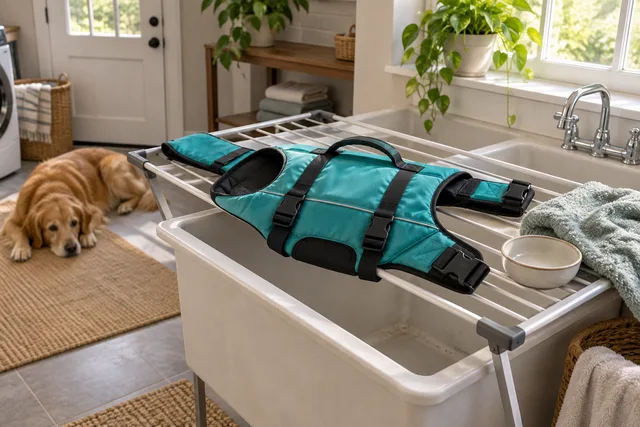
Arrange the jacket in its normal open shape in the drying location, following any hanging or placement instructions supplied with it. Keep the surrounding air able to reach the surfaces rather than placing it inside a closed bag. Protect the floor from drips and keep the drying vest out of your dog’s reach.
Check the side against the rack or support as well as the side facing the room. Strap overlaps, padded contact areas and folds can feel different from an exposed outer panel. Adjust the position gently when needed to expose a damp area, without bending the flotation sections sharply or using an attachment point as an improvised loaded hanger.
There is no dependable universal drying time for every vest and room. Check the actual jacket rather than packing it because a fixed number of hours has elapsed. Do not speed the process with a heater, radiator or tumble dryer. General flotation-device guidance favors ventilation and avoiding direct heat; follow stricter model-specific limits whenever provided.
Inspect again before calling the job finished
Once the jacket is dry, return to the concerns you recorded. Inspect seams, straps, closures and accessible panel surfaces in good light. If your manufacturer provides a pre-use checklist, keep it with the jacket and use it. A strap that can be adjusted is not proof that its attachment remains secure.
Persistent odor, visible deterioration or an unusual change in shape should prompt a question about condition, not repeated harsher washes. Tell the manufacturer what happened and what cleaning method you used. Include the model and photographs. If the jacket is damaged, follow replacement instructions; Outward Hound explicitly says to remove and replace a damaged Granby.
A visual check has limits. It does not measure buoyancy or certify the jacket for a particular dog, activity or water condition. Keep a questionable vest separate from ready-to-use equipment until the concern is resolved. The convenience of having it clean and packed should never be the reason to overlook an unresolved defect.
Store it dry, ventilated and uncrushed
Choose a storage place where the jacket can keep its shape without luggage, tools or other heavy items stacked on top. Allow ventilation and avoid direct heat. Keep the care information accessible, either with the vest or in a clearly named record. Storage should make the next inspection easy rather than burying the jacket beneath other equipment.
A travel bag can help carry equipment, but do not use it to conceal a damp jacket for long-term storage. If a wet vest had to travel home in a container, unpack it and resume drying promptly. Before closing up any storage arrangement, check the hidden contact areas again instead of relying only on the outer surface.
Keep suspect equipment clearly separate so another household member cannot mistake it for a ready jacket. A simple note describing the concern is more useful than a vague reminder to “check later.” When the next outing arrives, inspect and fit the jacket again; completing today’s care routine does not eliminate the next pre-use check.
Frequently asked questions
Can I put a dog life jacket in the washing machine? Only if its exact care instructions allow that method. The Granby Splash example specifies hand washing. A gentle machine program does not change that requirement, and this guide does not generalize machine compatibility across brands.
Can I put it away when the outside feels dry? Check the underside, strap overlaps and padded areas as well. An exposed surface is only part of the jacket. Allow further air drying if an accessible area remains damp, and follow any additional storage directions for your model.
What if it still smells after washing? Do not mask the smell or assume a stronger cleaner is safe. Recheck the permitted method and contact the manufacturer about persistent odor or possible deterioration. An unresolved condition concern belongs on the inspection list before another use.
Does cleaning restore lost flotation? No claim of restored flotation can be made from this routine. Washing removes dirt; it does not measure or repair flotation performance. Damage, distorted panels and other concerns need the manufacturer’s replacement or inspection guidance.
Should I repair a torn seam myself? Do not assume a home repair preserves the jacket’s function. Ask the manufacturer about the specific damage. Where the instructions require replacing a damaged vest, a neatly sewn patch does not override them.
Sources and related reading
The model-specific washing example comes from Outward Hound’s Granby Splash product and care instructions. The Life Jacket Association’s care guidance supplies general flotation-device storage principles. Its human life jacket context is not a certification standard for dog vests. Neither source establishes a universal drying time for this guide.
For the separate purchase and fit questions surrounding the example product, read our Granby Splash buying assessment. For an everyday walking item, see how to check a dog harness fit; harness guidance does not substitute for flotation-vest instructions. The cover is an illustrative care scene, not a photograph of the reviewed Granby or evidence of product testing.