
Best Fit for the MidWest 552-30: No-Door Exercise Pen Review
Assess the MidWest 30-inch no-door exercise pen by planning daily access, floor space, setup and your individual dog’s behavior.
MidWest 552-30 Exercise Pen 30-inch / No Door
Consider it for
A household with a workable access and supervised management plan.
Check before buying
No escape-resistance or floor-grip testing claimed; no built-in walk-through door.
Jump to a section
Best fit: a household that has planned access
The MidWest 552-30 is worth considering when you want a 30-inch exercise pen and can manage a design without a built-in door. Before choosing it, decide how you will reach the dog, refresh water and clean the enclosed space. Those everyday tasks can matter more than a small difference in purchase price.
The verified US Amazon listing is ASIN B000H8YTJI, titled MidWest 30-Inch Exercise Pen, No Door, 16 Sq Ft Play Area. Its product-information table identifies model 552-30. This assessment concerns that version, not the shorter 550-24 or a door-equipped model with a similar name.
This is a research-based buying guide. We have not tested escape resistance, floor grip or long-term durability. Our recommendation depends on the dog’s behavior, the room and the household’s access needs; the height alone does not establish suitability.
Understand the no-door tradeoff first
A built-in access door and an enclosure that closes by connecting its ends are different arrangements. With the latter, think through the connection you would need to open and restore. Do not assume that the product photo hides a convenient walk-through gate.
For some households, occasional access may be manageable. For others, repeated bending, reaching or reconnecting will be inconvenient. If you expect to enter the area frequently, compare the actual access arrangement of a door-equipped alternative before committing.
Avoid making stepping over the side your default plan. Consider mobility, balance, nearby furniture and the possibility of a dog moving toward you. This is a purchase-planning question: choose equipment that supports a routine you can perform comfortably rather than improvising around the wrong layout after delivery.
Try describing the access sequence aloud before buying: where you stand, where the dog waits, which connection you operate and how you restore the enclosure afterward. If the sequence depends on moving a heavy chair or reaching across the whole area, change the plan on paper first. This simple rehearsal can expose inconvenience that a clean catalogue photograph leaves out.
Separate model number, height and enclosed area
Write three items on your comparison sheet: model 552-30, the selected 30-inch height, and the advertised 16-square-foot play area. They describe different attributes. The model identifies the version, height describes a vertical dimension, and area describes the space enclosed in a stated arrangement.
Do not read 30 inches as a recommended dog height, or treat 16 square feet as an unchanging result of every possible shape. Rearranging a fixed boundary changes the usable interior. A long narrow shape may work differently from a more balanced footprint even when it uses the same panels.
Use the manufacturer’s exercise-pen family page to distinguish available versions, then return to the exact selection. Family photographs and reviews can include products other than the one you intend to buy.
Sketch the room before opening a shopping cart
Start with a rough drawing of the intended location. Mark doors, furniture edges, the route through the room and anything the dog could reach beyond the proposed boundary. Measure the available space instead of judging it from a photograph of another home.
Include your own working space outside the pen. A footprint that fits between a sofa and wall may leave little room to operate the connection or reach a bowl. An arrangement that blocks a frequently used doorway will be frustrating even if its interior seems generous.
A removable floor outline can help you imagine the footprint before buying; remove the marking material afterward. Walk around the outline, open nearby doors and check the route you actually use. This planning exercise evaluates the room, not the pen’s structural safety.
Account for what goes inside
A stated area is empty space until you add supplies. Sketch the dog’s resting place and any other appropriate items at roughly their real size. Ask whether the resulting layout still supports the activity you have in mind without becoming cluttered.
Do not use the pen as a storage corner for household objects. A low shelf beside it or an object pressed against the outside can be relevant even though it sits beyond the outline. Think about reach and the surrounding environment, not only what appears inside a top-down drawing.
If the only workable arrangement requires piling belongings against the panels, reconsider the location. Buying a pen should simplify management of the space. It should not depend on a collection of improvised supports that the product instructions do not describe.
Read the matching assembly instructions
The MidWest instruction sheet covering 552-30 identifies eight connected panels, eight ground anchors and four snaps. It shows how to connect the ends and describes permitted setup details. Read the diagrams and supplied instructions before assembly; this review is not an installation replacement.
Lay out the delivered components and compare them with the correct parts list. Keep packaging and purchase information until you have checked identity, condition and completeness. If something is missing, resolve that with the seller or manufacturer rather than substituting a similar-looking clip.
Take special care when a listing offers several heights and styles in one place. The right brand name is not enough to select a manual. Match the actual model on the delivered product or packaging, including any suffix, before following a diagram.
Match the enclosure to behavior, not a breed label
A 30-inch panel does not prove that a particular dog will stay inside. Consider whether your dog tries to climb, jump, push boundaries or becomes distressed by confinement. A familiar breed description cannot answer those questions for an individual animal.
The MidWest instructions warn that an animal unaccustomed to restriction may attempt escape and be injured. They also direct owners to remove collars, tags and leads before placing the pet inside to avoid entanglement. Review the full warnings for the product you receive.
If your dog persistently attempts to escape or panics, do not treat a different arrangement of the same panels as an automatic solution. Get appropriate help with the behavior and reconsider the management plan. This review does not prescribe a confinement-training program or promise an escape-proof setup.
Evaluate indoor flooring without guessing grip
During a supervised initial setup, pay attention to the relationship between the pen and the intended floor. We have not tested this model on tile, wood, carpet or mats. Do not transfer a reviewer’s result on one surface to another home as a guarantee.
If you plan a protective layer, check its dimensions and the practical cleaning arrangement. A mat extending into the room may create a separate walking obstacle. A cover under the pen also does not establish that the assembly cannot move.
Ask the manufacturer about approved solutions if movement or surface protection is unresolved. Do not attach the structure to furniture or modify panels to compensate without appropriate instructions. The useful question is whether the complete setup works as intended, not whether one accessory looks reassuring in a product image.
Treat outdoor placement as a separate decision
Do not assume an indoor arrangement is ready for outdoor use merely because ground anchors are included. Check the supplied instructions and the actual location. Ground conditions, exposure and the ability to watch the dog all belong in the decision.
A portable enclosure should not be confused with a secure perimeter fence. Consider the surroundings and what could approach the pen. This article does not establish protection from other animals, weather or unattended access by people.
For a trip, plan what you will do if the chosen location does not suit the equipment. Having a different activity available is more practical than discovering at arrival that the entire outing depends on a setup you cannot confidently use.
Compare a pen, crate and gate by the task
A pen creates a bounded area, a crate provides a different enclosure, and a gate controls passage through an opening. Begin with the task you need to accomplish. These products should not be ranked as though they are interchangeable ways to solve every household problem.
If your main concern is a doorway, review our doorway measurement guide. If you are deciding on a crate, our crate measurement guide addresses a different set of dimensions. Neither guide determines whether this no-door pen suits your dog.
Write down the repeated task that matters most: accessing the area, separating an activity or providing a managed space while you are present. Then compare products against that task rather than selecting whichever offers the largest advertised number.
Consider storage and the person doing the work
Decide where the pen will go when it is not in use. Consider the path from the storage spot to the room, the space available for handling it and who will perform that task. A theoretically convenient product can still be awkward in a narrow home.
We do not claim a measured folded thickness or a tested carrying weight here. Check those details with the seller or manufacturer if they determine whether you can manage the item. Avoid estimating them from a staged lifestyle photograph.
For shared households, make sure everyone understands which version you bought and how its ends are secured. Keep the instructions accessible. A setup that depends on one person’s memory becomes less convenient when someone else needs to clean or rearrange the room.
Inspect, clean and reassess over time
Check the condition of the panels and connections before returning the pen to use. Look for obvious damage or a component that no longer works as expected. Do not bend a damaged part back and assume that its original function has been restored.
For cleaning, follow the instructions supplied for the finish and components. This review does not add a dishwasher recommendation, chemical recipe or rust-prevention guarantee. Keep the surrounding floor accessible so ordinary cleanup does not require unsafe reaching.
Revisit the choice as your dog grows or household routines change. An arrangement that suited an earlier stage is not automatically the right long-term solution. Record the model so that questions about parts or compatibility can be answered without guessing from appearance.
Frequently asked questions
Does the 552-30 have a walk-through door?
The verified listing is the no-door version. Check the selected model before ordering and do not assume that another size or a similar product photo provides the same access arrangement.
Does 30 inches mean it suits every small dog?
No. Panel height does not establish containment for a particular animal. Behavior, the setup and the manufacturer’s instructions still matter.
Will every configuration provide 16 square feet?
Do not assume that. The same boundary can be arranged in different shapes with different usable space. Review the intended configuration and measure the actual footprint in your room.
Can I add an accessory from another pen?
Confirm compatibility with the manufacturer for the exact model and part. Matching color or approximate height is not enough evidence that connectors or installation arrangements are suitable.
Has this review tested escape resistance?
No. This is a documented buying assessment, with no hands-on containment trial or strength test. It does not claim that the pen is escape-proof.
The purchase decision
Choose the MidWest 552-30 only after the no-door access arrangement makes sense for your household and you have resolved the space and behavior questions. If repeated entry is central to your routine, compare a properly identified door-equipped option before ordering.
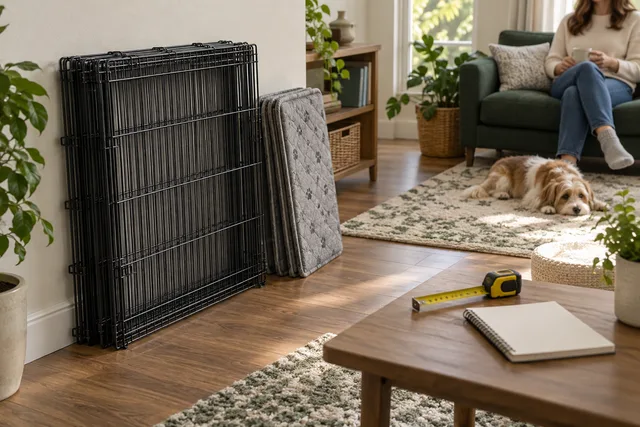
Sources checked September 19, 2026: the US Amazon listing for B000H8YTJI, MidWest’s exercise-pen family page and the linked manufacturer instruction sheet. We do not quote current prices, ratings or customer experiences. The cover is an illustrative planning scene, while the product panel uses the verified listing’s first image.
Explore crates, houses and pens for related decisions. Keep your exact model, room measurements and unresolved questions together so that a last-minute variant change does not undo the comparison.

MidWest 552-30 Exercise Pen
30-inch / No Door
Read customer reviews on Amazon ↗
- Verified 552-30 no-door model
- Plan daily access before purchase
- Check actual room layout and individual behavior
Consider for: A household with a workable access and supervised management plan.
Before you choose: No escape-resistance or floor-grip testing claimed; no built-in walk-through door.
Product information source · Reviewed 2026-09-19
Check current price, seller and options on Amazon.
US Amazon title/model table and manufacturer instructions for 552-30. Affiliate link.