How to Prepare a Dog Carrier for a Day Trip
Use a calm, repeatable checklist to inspect, pack, set up and reset a dog carrier for an ordinary day trip.
Jump to a section
How do you prepare a dog carrier for a day trip?
Prepare the carrier before the dog is ready to leave: inspect the specific carrier, confirm the destination’s rules, pack only what has a clear purpose, and plan where the carrier will sit when you arrive. That sequence is easier to repeat than trying to solve every detail at the door.
This is a household organization guide for an ordinary day trip. It does not decide whether a carrier is airline-approved, vehicle-crash-rated, appropriate for a medical condition, or suitable for a particular length of confinement. Those questions depend on the carrier’s instructions, the transport provider, the destination and the dog’s individual needs.
Start with the carrier you will actually use. Take it out early enough to see the floor, seams, zippers, fasteners, ventilation panels and any removable insert. A clean-looking carrier is not automatically ready. Look for the manufacturer’s care and use information, and stop if you find damage you cannot confidently resolve.
Confirm the trip before you pack
Write down the simple facts: where you are going, how you are traveling, who will handle the dog, and where the carrier can rest on arrival. A café patio, a relative’s house, a hotel lobby and a vehicle all have different rules and practical limits. Check the destination or transport provider directly rather than relying on a general travel list.
Keep the plan realistic. A carrier is one part of the outing, not a substitute for supervision, breaks, climate control or local requirements. If a location does not allow the carrier or cannot offer a suitable place for it, change the plan before leaving instead of negotiating from the doorway.
Tell any other adult involved what carrier is being used and where the small trip kit is stored. Shared trips go better when people do not assume the other person packed an item or checked a closure.
Inspect the carrier as equipment
Open and close every entry the same way you will use it during the trip. Check that zippers travel normally, clips and fasteners engage as designed, and mesh or fabric has no obvious tear. Inspect the handle, shoulder strap and attachment points only within the maker’s intended use. Do not improvise repairs with knots, tape or borrowed hardware at departure time.
Look inside for loose objects, dampness, debris and removable parts that no longer sit correctly. Follow the care label for cleaning and drying. If the carrier uses an insert or pad, make sure it lies flat and cannot bunch under the dog. A day-trip check is also a good time to remove outdated notes, receipts or small objects that have accumulated in pockets.
For sizing, use our guide to sizing a soft dog carrier. Size and condition are separate checks: a carrier that once worked still needs its hardware and fabric inspected today.
Travel checklist and source
Keep drinking water and a bowl accessible, along with a leash, waste bags, current identification and any documents required for the trip. Store supplies where you can reach them without opening the occupied carrier or blocking its ventilation. Check contact details before leaving.
The ASPCA travel safety guide supports preparing a travel kit, securing the carrier against movement and never leaving a pet alone in a parked vehicle. For vehicle use, follow the specific restraint instructions for your equipment; a carrying handle alone does not establish crash protection. The organization and reset routine here is editorial guidance.
Make a small purpose-based trip kit
Pack by purpose instead of building a large “just in case” bag. One area can hold identification and destination information; another can hold the supplies you normally use for pickup and cleanup; a third can hold any item needed for the particular weather or route. Keep the kit small enough to inventory at a glance.
Use only items you know how to use and maintain. Read each product’s instructions rather than assuming a similar item has the same limits. Avoid putting loose objects in the carrier itself unless they are intended to be there and can remain secure for the planned use.
Keep food, medication and health decisions separate from a generic packing checklist. If your dog has individual dietary, medical or behavior needs, use the plan provided by the appropriate professional or caregiver. This article cannot set that plan.
Set up the departure area
Choose a calm staging spot away from a busy door swing, hot appliance or loose household clutter. Put the open carrier on a stable surface or floor as appropriate for its design, with the trip kit beside it. This lets you complete the inspection before the dog is near the carrier.
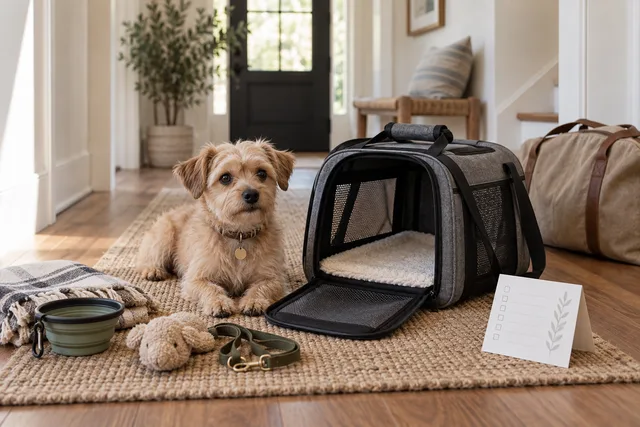
Use a short departure card: carrier checked, destination confirmed, kit packed, route clear. Four prompts are more likely to be used than a long checklist. If one prompt cannot be answered, pause and solve that specific issue.
Do not rush the dog into a carrier merely because the schedule has slipped. If the plan becomes unworkable, it is better to adjust or postpone than to make unsupported assumptions about equipment or comfort.
Prepare the vehicle or destination space
Before loading, identify the exact place where the carrier will be positioned and how people will move around it. Keep it away from shifting luggage, open doors, food service areas and routes where someone could kick or trip over it. Follow the carrier manufacturer’s instructions and the vehicle or venue’s rules; this guide does not certify a placement as safe.
At the destination, choose a quiet, stable spot before opening the carrier. Check the ground, nearby traffic, other animals, children and room access. Let the household or host know what boundaries are needed for the planned visit instead of leaving the carrier in a passageway and hoping everyone notices it.
Having an arrival spot prepared prevents the carrier from becoming a parcel that is set down wherever there is space. It also makes the return routine easier because the kit remains together.
Use a simple arrival routine
On arrival, pause before unpacking. Confirm that the location still matches the plan, then place the carrier in its intended area. Keep doors, zippers and fasteners managed according to the carrier instructions. Do not turn the arrival into a test of whether the dog can tolerate a new environment.
Make one person responsible for the next step so several people do not reach for the carrier at once. If the environment changes unexpectedly, return to the plan: move to a calmer location, reconsider the activity or leave. A checklist is useful because it gives you a known sequence when the setting is unfamiliar.
Record only practical observations for later: an awkward handle route, a pocket that was hard to reach, or a destination rule you did not anticipate. These notes improve the next trip without pretending they are universal guidance.
Reset the carrier after returning home
Do the reset before storing the carrier. Empty pockets, remove debris, check for dampness and follow care directions for any fabric, insert or hardware. Put the carrier somewhere it can finish drying if needed instead of sealing it immediately in a closet.
Restock the small kit from a known backup area. If a supply is nearly gone, make that visible now. Our dog walking supplies guide shows the same idea: a reliable next outing begins with a clear return location, not a memory test.
Inspect any problem you noticed during the trip. A jammed zipper, worn seam or lost accessory deserves a decision—repair through the maker’s guidance, replace, or remove the carrier from active use until you know what is appropriate.
Build confidence through predictable preparation
Preparation works best when it is ordinary rather than dramatic. Bring the carrier into the staging area before the day of the trip, open it according to its instructions and let the household complete the same packing and reset motions without a deadline. The purpose is to learn whether the layout is practical: can the kit be reached without leaving an open door unattended, does the carrier fit through the route, and is there an obvious place for returned items? This is a planning rehearsal, not a claim that a dog will react in one particular way.
Reduce choices at the door. Pick one labeled place for the carrier, one for the active kit and one for items waiting to be cleaned or replenished. If a family member cannot tell which area is active, simplify it. A visible separation prevents a clean insert, loose strap or used towel from being packed together by accident.
Review the basic route from storage to the vehicle or exit. Notice narrow corners, stairways, gates and places where another person may need to pass. Relocate a bulky bag or open a different door if the carrier would require an awkward turn. Do not modify a handle, strap or fastening system just to make a route work; consult the maker’s guidance or change the arrangement.
Keep language clear for anyone helping. A carrier check should mean the agreed visual inspection is complete, not that a person has made a universal safety judgment. A trip kit packed should name the small group of items you agreed to use, not an assumption that every possible need has been covered. Precise shared words make handoffs less error-prone.
After a few normal outings, remove anything that is repeatedly unused and give any repeatedly needed item a defined home. A good day-trip setup becomes smaller and clearer over time. It should help you notice a missing detail early, while still leaving manufacturer instructions, destination policies and professional guidance in charge of the decisions they are designed to address.
Keep a practical record without overcomplicating it
A small note can prevent repeat problems. Record the carrier model, the care instructions’ location, the last full cleaning and any item that needs attention. Keep purchase documents elsewhere, not loose in the carrier.
Do not create a complicated log for routine use. The useful record is the one someone can read before the next outing: destination rule checked, carrier inspected, refill needed, or different layout required. If the same problem appears twice, change the preparation step rather than adding another vague reminder.
When the trip routine changes, test the revised plan at home first. Check the staging spot, the carry route and the return location before a time-sensitive departure.
Frequently asked questions
Should I pack the carrier the night before?
Prepare the kit and inspect the carrier early, then do a short final check before leaving. That catches changes in destination rules or equipment condition.
Can I use one kit for every trip?
Use a stable core kit, then add only destination-specific items after checking the actual plan and product instructions.
What if the carrier is damp after a trip?
Follow its care directions and let the relevant materials dry as instructed before storage. Do not seal damp fabric away for convenience.
Does this guide tell me whether a carrier is safe for a car or plane?
No. Consult the carrier maker, the vehicle or transport provider, and any applicable destination requirements for that specific use.
A repeatable day-trip routine
Prepare the trip in the same order every time: confirm the plan, inspect the carrier, pack a small kit, stage the departure area, set up the arrival location and reset on return. The routine keeps ordinary details visible without making claims about a carrier’s certifications or a dog’s individual needs.
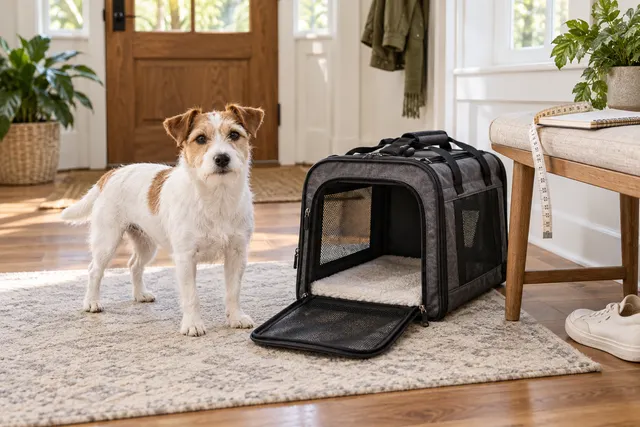
Find more everyday planning at How-To Guides and related research at Carriers & Travel Products. The cover shows an unbranded illustrative home scene, not a product demonstration or endorsement.
Before the next departure, glance at the carrier’s assigned location rather than searching several rooms. If anything has moved, return it to the active area, check it against the maker’s instructions and communicate the change to anyone sharing the trip. This last small check is useful precisely because it is concrete: it helps the household prepare an ordinary day trip without turning a general checklist into a promise about every carrier, every route or every dog.