How to Plan an Amtrak Trip With a Small Dog
Check the complete rail itinerary, combined carrier weight, pet reservation, paperwork and route-specific instructions before traveling with a small dog.
Jump to a section
Direct answer: confirm the whole itinerary before buying
Plan an Amtrak journey with a small pet dog by checking three things together: the specific services you will use, the dog and carrier as one traveling unit, and a pet reservation covering the journey. A passenger ticket alone is not a complete pet travel plan. Start with the current Amtrak pet policy, then review the details attached to your proposed trip.
This guide provides an organizing method for ordinary pet travel in the United States. It does not confirm availability on a particular departure, certify a carrier, or describe personal train testing. Service-animal travel follows a separate policy. A trip that works on paper may still be unsuitable for an individual dog; resolve suitability concerns before committing to transport.
1. Build a journey sheet with every segment
Write down the departure and arrival stations, date, train or service name, departure time, arrival time and any connection. Include the return journey as a separate entry. The purpose is to make hidden assumptions visible before comparing tickets. A route name can describe a network, while your actual itinerary may use several different services.
For example, a proposed journey might contain an outbound train, a connection and a later return. Put each on its own line rather than writing only the two endpoint cities. Add a column for pet eligibility and leave it blank until confirmed. Blank means unresolved, not automatically allowed. This is an example of a planning worksheet, not a claim that any particular combination is available.
Keep the sheet short enough to read on your phone. Store the official policy link beside it, with the date you last checked. If you change a station or departure, revisit the affected entries instead of carrying the earlier answer forward. Small booking changes can alter the question you need answered.
2. Apply the basic eligibility limits
Amtrak’s national pet page currently sets a combined dog-and-carrier limit of 20 pounds and a maximum carrier size of 19 by 14 by 10.5 inches. The trip limit is seven hours including transfers. Excluded services include Auto Train, Gold Runner and Amtrak Connection; the page also identifies Canadian restrictions. Check its class restrictions before selecting accommodation.
Treat these as separate gates. A dog being light enough does not establish that a chosen carrier fits, and a short journey does not establish that its service accepts pets. Put a result beside each gate rather than making a single broad note saying that the train is pet friendly.
If any gate fails, change the plan before purchasing. Do not try to solve a dimensional problem by describing the bag differently, or a duration problem by ignoring the transfer. A useful worksheet records a clear reason for rejecting an option. That makes later comparisons easier and prevents the same unsuitable option from returning to the shortlist.
3. Check the dog and carrier together at home
Measure the carrier you intend to use, not a similar photograph or the dimensions of its shipping box. Note whether your measurement describes the outside of the assembled carrier. Include its normal base and components when considering the combined traveling unit. If the specification or your measurement is uncertain, resolve that uncertainty before relying on it.
Carrier dimensions alone do not show how your dog fits inside. Observe the dog with the carrier at home, without forcing it into a position for the sake of a measurement. Compare the actual setup with the comfort and containment requirements on Amtrak’s page. A product described as airline approved is not automatically approved for a railway journey.
Our travel-carrier measuring guide covers the separate measuring task. This article concerns checking a rail itinerary, so it does not recommend a particular carrier or repeat a carrier review. Keep fit notes factual: the carrier used, the measurement obtained and the question still needing an answer.
4. Separate published rules from booking results
A policy page tells you the general conditions; a booking result tells you what is being offered for the date and journey you entered. Keep both pieces of information. Do not treat a general statement about accepting pets as proof that your preferred departure has a pet place available.
Before payment, inspect the trip summary for the pet entry and the complete itinerary. If the interface does not clearly show how to include the dog, use Amtrak’s official assistance options yourself rather than guessing. This guide does not reproduce a checkout screen sequence because interfaces and route-specific handling can change.
Save the confirmation after booking and read it. Check the date, stations and journey against your worksheet while you can still recognize an entry error. Keep questions about changes or cancellation separate from the initial eligibility check; do not assume that changing the human ticket automatically preserves every pet arrangement. Revisit both when making a change.
5. Handle conflicting official instructions openly
During our source check, the Amtrak Cascades pet page described telephone or staffed-station reservations, a fixed fare and a 30-minute staffed-station check-in. The national page described variable booking-summary fees, an online release form and 45-minute check-in. These published instructions are not identical.
For a Cascades journey, confirm the current reservation method, fee and reporting time for your actual booking. Do not use this article to declare one page obsolete. For planning, allow the earlier arrival indicated by the national page unless your confirmed instructions require more time; arriving early does not itself resolve a missing pet reservation.
Record the question precisely: which instruction applies to this departure and station? Keep the answer with the trip confirmation. The useful result is a resolved instruction for your journey, not an argument about which webpage looks newer. No live booking or direct contact with an operator was performed for this guide.
6. Organize the release and station instructions
The national page requires a release for each segment, with online retrieval through the booking or My Trip. It calls for staffed-station ticket-office check-in 45 minutes before departure; at unstaffed stations the conductor validates eligibility and paperwork aboard. Read the age, vaccination certification and behavior conditions before signing.
Create a private travel folder containing the confirmation and the information you need to retrieve the form. Name files with the date and direction of travel so the return journey is easy to distinguish. A screenshot can be convenient, but it should not be your only way to access information that might be updated.
Next, identify where you need to report at the departure station. Add getting to the station, parking or a local transfer as separate tasks. The reporting time is not the moment to begin searching for the building. A simple sequence helps: reach the station, find the required reporting point, complete the check and follow boarding instructions.
7. Plan the station and onboard handoff
Amtrak’s national instructions require the pet to stay with you in a closed carrier in stations and aboard. The usual placement is beneath your own seat; Cascades has a different floor-placement instruction. Check the route-specific direction instead of copying an airline seating habit. Pets are excluded from station lounges under the published policy.
Pack so that the confirmation and a small cleanup kit can be reached without unpacking every bag. Keep supplies organized around what you can carry and manage yourself. Do not plan to leave the carrier with a stranger while you move luggage. A traveling companion should know which bag holds the documents and who is responsible for the dog during each transition.
Use a brief home rehearsal to notice practical problems: a handle blocked by another bag, a document buried in a suitcase, or too much luggage to manage together. Reorganizing those items before departure is more useful than discovering the problem in a crowded doorway. A rehearsal is not a guarantee of a calm journey.
8. Make a disruption plan before departure
Write down a realistic alternative if the proposed journey cannot proceed. That might mean returning home, arranging different transport or delaying the trip. Decide who can help and what information they would need. These are contingency arrangements you make yourself, not services promised by a ticket.
Amtrak’s pet page says pet-friendly lodging during a disruption is not guaranteed. Do not build a plan around a hotel automatically accepting the dog. Research any accommodation directly and keep its own pet conditions separate from the railway conditions. A train confirmation does not settle a hotel’s requirements.
Avoid relying on a tight onward appointment when evaluating the consequences of delay. Consider how you would communicate a changed arrival to the person meeting you. If a disruption occurs, follow staff instructions and reassess the actual situation rather than trying to preserve an outdated worksheet. The worksheet exists to support decisions, not to replace current instructions.
9. Review the complete plan the day before
Read the journey sheet from beginning to end as if another person had prepared it. Can you identify the exact departure, the dog entry, the reporting point and the documents without searching several unrelated messages? Check that any unresolved question has been answered or has caused a change of plan.
Repeat the same review for the return. A successful outward reservation is not evidence that a different return service has the same arrangements. Keep the carrier and documents ready together, while storing private booking details somewhere they will not be exposed in public photographs.
After the trip, retain a short practical note about the preparation you would change next time. Distinguish your observations from operator policy. One helpful staff interaction or one particular carriage layout should not become a universal instruction for another traveler. Check the official requirements again for a future booking.
A compact record you can reuse
Use a single note with these fields: travel date, direction, departure station, arrival station, service, connection, pet entry, carrier measurement, combined weight, document location, reporting point and unresolved question. This is your own organizer, not an official form. Copying it for the return trip is useful only if you replace the details and verify them again.
For each unresolved question, add a next action and a place to record the answer. For example, a missing pet entry needs a reservation clarification; an uncertain external measurement needs a measurement check. Neither is solved by adding more equipment to a packing list. Match the action to the actual uncertainty.
Before sharing the note with a companion, remove payment details and anything they do not need. They should be able to understand the plan without receiving your account password. Keep the official confirmation available separately so your shortened note never becomes the only record of the booking.
Frequently asked questions
Does a small dog automatically qualify? No. Size is only part of the decision; the carrier, itinerary and reservation must also meet the published conditions.
Can I assume a carrier approved for flying will work? No. Compare its actual dimensions and your dog’s fit with the railway’s own requirements.
Should I budget from an older fixed fee? Use the amount confirmed for your booking. The national page says fees vary, while the Cascades page displayed a fixed amount when checked.
Can this guide confirm a departure has space? No. Availability is a booking-specific question. We have not made a test reservation or purchased travel.
Is emotional support status the same as service-animal travel? Amtrak’s service-animal page treats emotional support animals under the pet requirements. Consult that separate policy for trained service-animal travel.
Sources and related reading
The national Amtrak pet page supplies the principal limits and process described here. The Cascades page supplies the regional instructions and the discrepancies identified above. The service-animal page explains the separate category. Our worksheet, packing sequence and comparison examples are organizational suggestions, not additional railway rules.
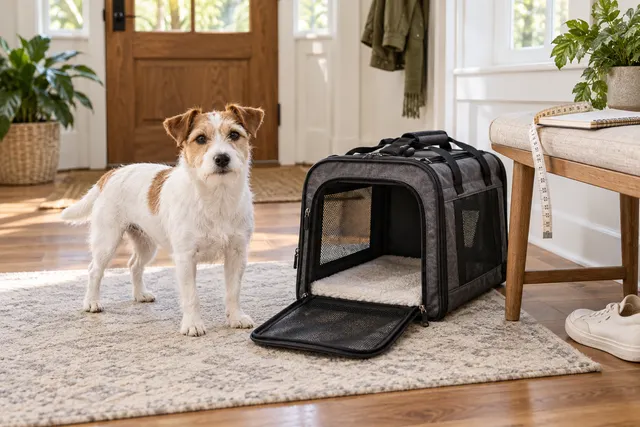
For another transport task, see our Washington State Ferries planning guide. Ferry rules do not transfer to rail travel. The cover is an illustrative home preparation scene, not an Amtrak vehicle, a carrier certification or evidence of a personally tested journey.