How to Measure a Dog for a Raincoat: Chest, Back and Neck
Take repeatable measurements, distinguish body size from garment dimensions, and check raincoat fit with the walking equipment your dog actually wears.
Jump to a section
The short answer: record measurements before choosing a size
Measure your standing dog, record chest girth, back length and lower-neck circumference, then compare those numbers with the exact raincoat’s instructions. Keep the original measurements separate from any allowance the manufacturer requests. A familiar Small or Medium label is not a reliable shortcut between brands, styles or product generations.
This guide covers choosing and checking a simple raincoat rather than a fitted overall with sleeves. If your selected garment covers the legs, its additional measurements still apply. The purpose is to arrive at a defensible size choice and a useful indoor fit check, not to promise that every coat will suit every body shape.
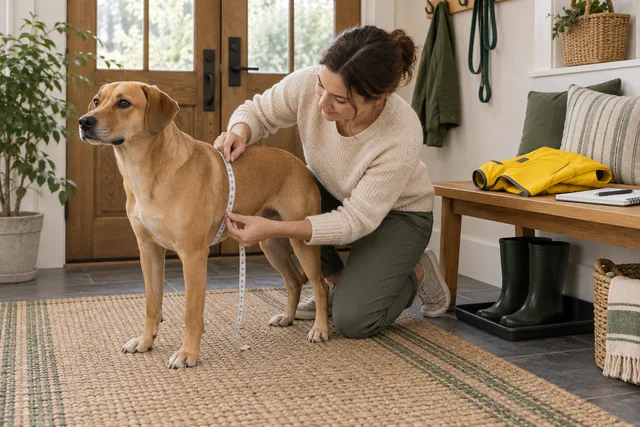
You will need a flexible measuring tape, somewhere to write the results and the current product size guide. A helper can make the process easier. The cover is an illustrative measuring scene; use the manufacturer’s diagram, not a photograph’s tape placement, to locate the landmarks for your chosen garment.
1. Open the exact product chart first
Find the chart attached to the specific raincoat you are considering. Note the product name and whether it is a vest, shell jacket or coverall. A general clothing chart may provide background but should not override instructions for that particular cut. Save the page or take your own screenshot so the comparison remains clear later.
Look for definitions as well as numbers. Does “length” describe a dog’s back, the finished fabric panel, or the distance between two marked points in a diagram? Does a chest range represent the dog’s measurement or an adjustable strap? These differences can change how you read the entire table.
Write down any question the page leaves unresolved. For example: “Is this back figure a body range or the garment length?” That precise question is easier to answer than asking whether a coat generally runs large. Do not resolve an unclear label by silently choosing whichever interpretation makes your preferred size fit.
2. Set up a repeatable measuring session
Choose a familiar area with secure footing and enough room to stand beside your dog. Let the dog settle into a normal standing position. If measuring becomes a struggle, pause rather than holding the dog in an awkward pose to obtain a number. A hurried reading is unlikely to improve the purchase decision.
Check the tape’s units and starting point. Some tapes have an unmarked tab before zero, and many show centimeters on one side and inches on the other. Decide which scale you will use and keep it facing outward. Record the unit every time instead of trusting yourself to remember it after comparing several charts.
Keep a short note of the setup: date, coat condition and the instructions followed. These notes help explain later differences. A reading taken after a haircut or while the dog was leaning sideways should not be treated as automatically interchangeable with a calm, repeatable measurement from another day.
3. Measure chest girth using the defined landmark
For the usual chest measurement, pass the tape around the widest part of the rib cage, generally behind the front legs. Keep it untwisted and check both sides before reading it. Follow the selected brand’s guidance about contact with the coat and any measuring allowance; do not pull the tape tight to make a smaller size seem suitable.
Take the tape away and repeat the measurement. If the second result differs noticeably, examine placement and posture instead of averaging the numbers immediately. You may have moved toward the narrower abdomen, allowed the tape to slope or read the wrong scale. Correcting the method is more useful than manufacturing a tidy average.
Record the body reading clearly, such as “chest: 62 cm.” If the instructions ask for extra room, write that as a separate calculation beside it. Keeping the measured value intact lets you compare another raincoat without forgetting that the first brand’s allowance was already added.
4. Measure the back between the correct endpoints
Hurtta’s measuring guide places the back measurement from the base of the neck, where it meets the shoulders, to the base of the tail. Use the equivalent landmarks shown by your chosen maker. Do not extend the reading to the tail tip or start at a high collar simply because those points are easier to see.
Check that your dog has not curled, crouched or stretched forward while you follow the back. Ask your helper to observe posture while you handle the tape. When a measurement feels uncertain, record that uncertainty and repeat the reading later; it is better than treating an unstable result as a precise specification.
Back length describes one dimension. It does not tell you whether the neck opening, chest panel or belly strap will suit the dog. A coat that reaches the desired point behind the shoulders can still have the wrong proportions elsewhere, so resist choosing from length alone unless the full product guidance supports it.
5. Measure the neck and identify any extra requirements
Measure the lower neck according to the garment diagram, usually near the shoulders rather than high behind the ears. A raincoat neckline may sit differently from an everyday collar. Keep the tape reading separate from the collar’s printed size or the length of the collar laid flat on a table.
Check how the garment goes on. An opening that must pass over the head creates a different fitting question from a neckline that opens fully. Do not assume that an adjustable closure means every nearby dimension is adjustable too. Read the dressing instructions before deciding that a borderline neck measurement is unimportant.
If the chart requests another measurement, add it to the record rather than substituting a familiar one. A coverall may need leg information that a simple vest does not. This guide’s three main measurements are a starting framework, not permission to skip fields in a more detailed product chart.
6. Compare numbers without mixing body and garment dimensions
A useful worksheet has four entries: your dog’s measurement, the matching chart field, the allowed range and any unanswered question. This makes mismatches visible. It also prevents you from comparing chest circumference in one column with the flat width of a garment in another.
Ruffwear’s Sun Shower page provides a concrete example of why labels matter: it displays a dog-sizing table and a separate product-dimensions table. Those tables serve different purposes. Read the accompanying diagrams before treating a finished coat length as the exact body measurement required for that size.
When converting units, one inch equals 2.54 centimeters. A hypothetical 62 cm chest is about 24.4 inches. Keep enough precision for a boundary comparison, but do not invent accuracy beyond what the tape reading supports. Rounding that value to 25 inches before checking a narrow boundary can change the apparent result.
Use a fictional chart to practice the logic: suppose Size A covers chest 58–64 cm and Size B covers 64–70 cm. A 62 cm reading falls inside A’s chest interval, but that does not settle neck or back fit. These example ranges are not specifications for any product and are not a purchase recommendation.
7. Resolve boundary sizes and conflicting instructions
If the chest fits one row but the back or neck does not, pause. Moving up a size may solve one dimension while creating excess fabric elsewhere. The useful question is whether another cut or adjustment range matches the whole set of measurements, not whether you can force every dog into one standard size ladder.
Do not apply a universal “always size up” rule. Brand and model guidance varies. During research, the Sun Shower page displayed more than one formulation of between-size advice in different sections. That is a reason to clarify the exact model and intended fit rather than select a sentence that supports an existing preference.
Send the manufacturer or seller the measurements, units, product name and the conflicting wording if clarification is needed. You can prepare that information without ordering first. Avoid adding a speculative growth allowance to a current measurement and presenting the inflated number as the dog’s actual size.
8. Check the raincoat with your normal walking setup
Before taking the coat outside, try it in a clean, dry space according to the seller’s return conditions. Keep tags and packaging until you have completed the checks allowed by those conditions. This is a practical way to preserve your options, not a guarantee that a used or altered garment can be returned.
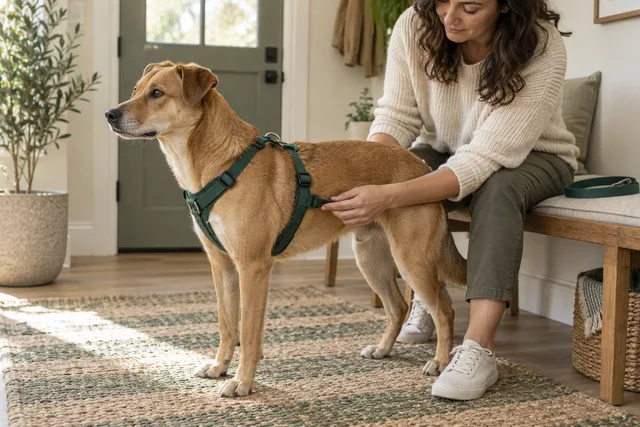
Use the harness or collar arrangement intended for the walk. Check whether the coat’s leash opening aligns with the actual attachment point without pulling fabric across it. A hole in a raincoat is not itself a leash attachment. Continue using the restraint equipment as its manufacturer directs.
Observe ordinary standing, a few calm steps and a turn. Look for fabric catching around the front legs, a panel shifting sideways or a hem that interferes with normal movement. If the dog appears uncomfortable, stop the fitting attempt rather than treating the chart match as proof that everything must be fine.
Check access for toileting and the position of fasteners. A closure should not be left partly secured simply to make an unsuitable size usable. Likewise, do not cut a new opening or alter straps before resolving the fit problem; a modification can introduce another issue and affect return options.
9. Keep a fitting record for the next purchase
Record the model, selected size and what you observed during the indoor trial. Useful notes describe the fit: “chest closes normally, back coverage acceptable, leash opening misaligned with our harness.” A bare note saying “Medium” loses the context that made the decision meaningful.
Keep body measurements separate from the size that eventually worked. If a different brand becomes your next choice, start with its chart rather than translating the label directly. Measurements can also change, so check again when the old record no longer represents the dog standing in front of you.
For a shared household, leave the fitting information where everyone who orders supplies can find it. This prevents an otherwise helpful replacement purchase from repeating the same uncertainty. A short factual record is more valuable than relying on a photograph of the coat or a remembered breed recommendation.
Frequently asked questions
Can I measure with string? A nonstretch piece of string and a ruler can help when a flexible tape is unavailable. Mark the measured section carefully and do not stretch it while transferring the length. Use the same landmarks and repeat the check.
Should I measure over a harness? Follow the raincoat maker’s method. Keep bare body measurements as your baseline and separately note the walking equipment or layer you expect underneath. Do not add an arbitrary amount and assume every pattern needs it.
What if my dog is between two sizes? Compare all required dimensions and the model’s adjustment guidance. If instructions conflict or one dimension fails in both sizes, seek clarification or another cut instead of relying on a generic sizing rule.
Does a good fit prove waterproof performance? No. Fit and rain protection are different questions. Measurements cannot establish fabric performance, seam behavior or how dry your dog will remain during a particular outing.
Can I choose by weight or breed alone? Those descriptions may help you browse, but they do not replace the measurements requested by the specific product. Dogs with the same weight can have different proportions.
Sources and final check
This guide uses Hurtta’s measurement diagrams, its product sizing guidance, and the separate sizing and garment-dimension tables on Ruffwear’s Sun Shower page. Product-specific instructions take precedence over the general workflow here.
Before ordering, confirm the landmarks, units and exact model chart. Before a wet walk, confirm movement and compatibility with your normal equipment. Those two checks address different problems: choosing a plausible size on paper and establishing whether the delivered garment actually works for your dog.